Has NY Governor Kathy Hochul Killed Congestion Pricing For Good?
Or just until after the election? Either way, she’s blown a $15 billion hole in the MTA budget, leaving New Yorkers with overcrowded streets, filthy air, and an underfunded subway.
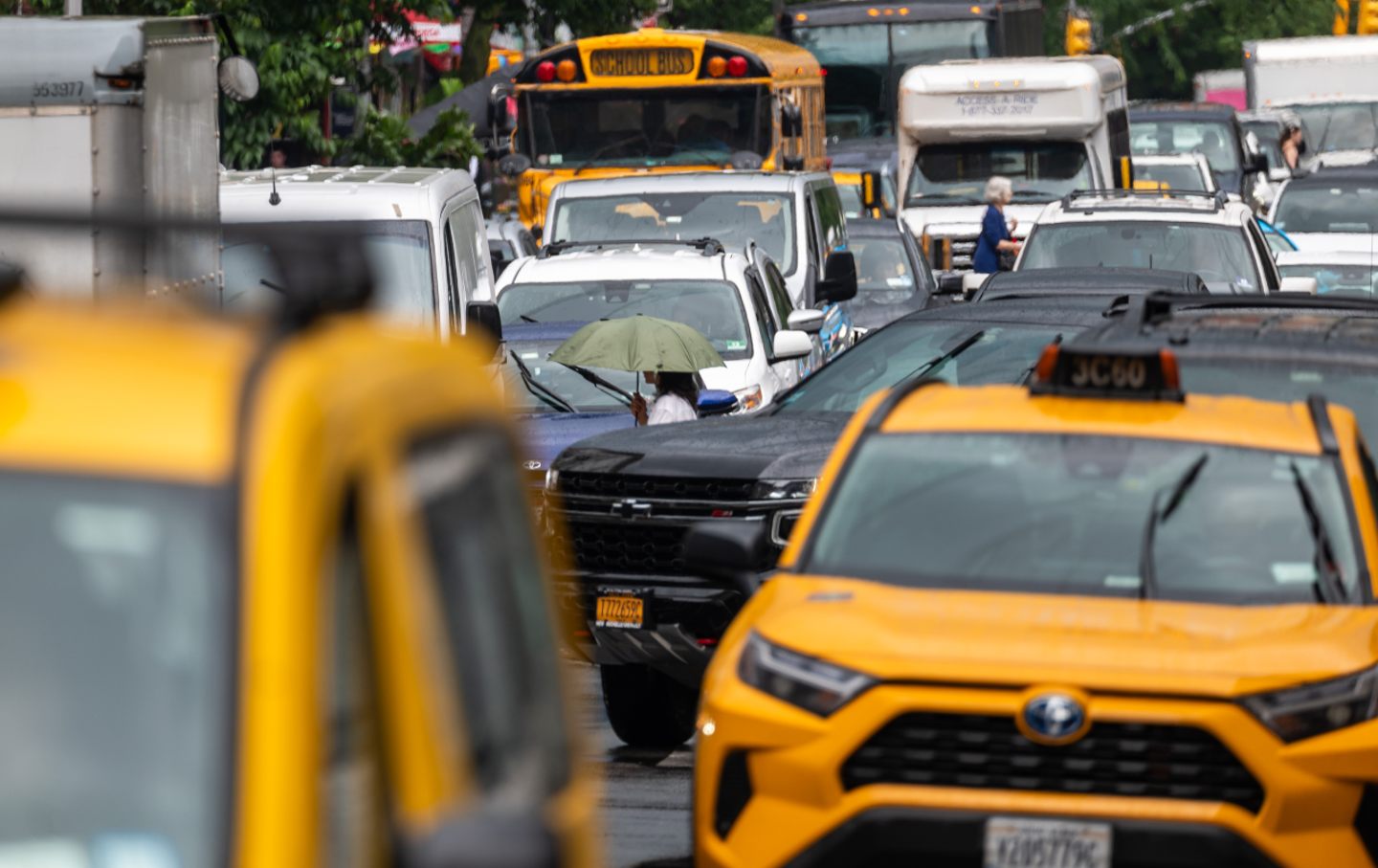
On June 30, New York was supposed to turn on its $507 million investment in cameras and E-Z Pass technology and start collecting $15 tolls from motorists driving into the heart of Manhattan. Governor Kathy Hochul was publicly supportive, and employees at the sprawling state agency she controls, the Metropolitan Transportation Authority, were thrilled to make history—they would oversee the very first congestion pricing program in America.
Instead, to the great horror of some New Yorkers—and to the delight of many others—Hochul announced last week that she was pausing the program indefinitely. Talk to anyone in city or state government now and you’ll believe congestion pricing is dead for good, though some transportation and environmental advocates hold out hope that one day—in some vague and tentative future—tolling drivers entering Manhattan south of 60th Street will be a reality. In the interim, Hochul’s decision to walk away from congestion pricing has blown a hole as large as $15 billion in the MTA’s capital budget, putting a host of repairs and upgrades, including an extension of the Second Avenue Subway, in jeopardy.
The goals of congestion pricing were straightforward: to discourage outer-borough and suburban residents from driving into transit-rich Manhattan and raise around $1 billion annually for the MTA. The politics, though, were incredibly fraught from the moment Andrew Cuomo, the disgraced former governor, signed the congestion pricing legislation into law in 2019. The challenge was increased by the pandemic, which emptied out Manhattan’s core in the early 2020s and made local businesses much more sensitive to any new financial hurdle potential customers might face.
No politician, Democrat or Republican, has been able to successfully implement new tolls on vehicles entering Manhattan. Michael Bloomberg, the billionaire former mayor, found himself stymied by both parties in Albany when he advocated congestion pricing in the 2000s. When Democrats took control of the state legislature in 2019—the city government lacks the legal authority to levy tolls on its own streets—support built for congestion pricing, as a new crop of left-leaning Democrats embraced the idea and Cuomo, wanting to bolster his environmental credentials in the first year of his third term, decided he could back it, too.
But in true Cuomo fashion—and with the buy-in from pliant legislative leaders—the bill’s language was crafted in such a way, as the columnist Nicole Gelinas has pointed out, that no start date was ever mandated for the tolls. Instead, Cuomo and Democrats put off implementation until after the 2020 elections, fearing political backlash. In the swing districts of Long Island and the Hudson Valley, the concept of congestion pricing is deeply unpopular, even if most locals aren’t regularly driving into Manhattan.
Meanwhile, New Jersey Democrats, beginning with Governor Phil Murphy and Josh Gottheimer, a centrist congressman, mounted a furious public campaign against congestion pricing. They sued in court and bogged down implementation for years. They eventually found others allies, including the United Federation of Teachers, and plenty of bipartisan support from motorist-friendly Republicans. Nicole Malliotakis, the Republican congresswoman who represents Staten Island, regularly denounced congestion pricing. Donald Trump, in recent weeks, weighed in to deride it as well.
Hochul seemed to have backed away because it was never her idea to begin with and Hakeem Jeffries, the House minority leader and a Brooklyn Democrat, fretted over the impact of the new tolls on his candidates in the suburbs. Congressional Republicans were prepared to bash Democrats over the summer and fall if the tolling cameras were turned on. To save democracy, as they might say, Hochul shelved a long-awaited, and ultimately beneficial, transportation and environmental program. If congestion pricing is truly dead forever, New Yorkers will certainly be worse off.
Advocates, though, must concede that the new tolls were sold poorly to the public. They may have lacked an effective champion in Hochul, but the various transit, environmental, and business interests who wanted congestion pricing never made strong, sustained arguments for its implementation—and neither did most progressive Democrats. There are transit deserts in New York City where having a car is necessary. There are locals wondering how the MTA can be trusted to spend an extra $1 billion a year when it has such a long, distressing track record of wasting enormous sums of money. In other parts of the world, transit agencies rapidly build out new train lines in a timely manner and on budget. New York’s subway map has barely changed in the last 60 years.
Another mistake the MTA made was pursuing a double-tolling strategy. While the bridges crossing the East River are free—the Brooklyn Bridge, the Manhattan Bridge, the Williamsburg Bridge, and the Ed Koch–Queensboro Bridge—the tunnels coming from Brooklyn, Queens, and New Jersey already have tolls. Motorists paying at the Lincoln or Midtown Tunnels would have received a small discount when entering the congestion zone, but they still would’ve incurred a second toll. This wasn’t necessary; the better option would have been to simply just ensure that the free crossings were no longer free. Transportation advocates like “Gridlock” Sam Schwartz had pitched a plan, ultimately ditched by Cuomo, that would have lowered other outer-borough bridge tolls in exchange for new tolls on the East River.
Carrots could have been paired with sticks. If you live on Staten Island or in parts of eastern Queens, you have no subway access. To residents of those neighborhoods, congestion pricing felt like a punishment with no tangible benefits. Why didn’t the MTA consider reducing the subway fare as a trade-off for new tolls? Why didn’t the MTA, pro-transit Democratic politicians, and advocates boast of tangible projects that would be made possible with the tolling revenue? Most congestion pricing boosters acted as if they were victorious already; there was never a sense that new tolls in Manhattan had to be won in the public arena.
Hochul and the MTA may still face court challenges. There are legal experts who believe she can’t force the MTA, an authority she ultimately controls through appointees, to completely abandon congestion pricing. It’s plausible, too, that Hochul might revive the tolls after the November elections, especially since the state is already on the hook for all of the cash spent on setting up the technology in Manhattan. In the meantime, Hochul and the legislature have to figure out how to begin plugging the holes in the MTA’s capital budget. Hochul, who has often been a dismal political operator, pulled the plug on congestion pricing without lining up support in the legislature for any replacement plans. Democrats already shot down her proposal for a new tax on city businesses. For now, she can bask in the glow of praise from the many Republicans and Democrats who wanted congestion pricing dead. But her existence only gets more precarious from here; Manhattan is congested and public transportation needs revenue. None of these problems vanish just because the governor feels she’s won a PR war.
Support independent journalism that does not fall in line
Even before February 28, the reasons for Donald Trump’s imploding approval rating were abundantly clear: untrammeled corruption and personal enrichment to the tune of billions of dollars during an affordability crisis, a foreign policy guided only by his own derelict sense of morality, and the deployment of a murderous campaign of occupation, detention, and deportation on American streets.
Now an undeclared, unauthorized, unpopular, and unconstitutional war of aggression against Iran has spread like wildfire through the region and into Europe. A new “forever war”—with an ever-increasing likelihood of American troops on the ground—may very well be upon us.
As we’ve seen over and over, this administration uses lies, misdirection, and attempts to flood the zone to justify its abuses of power at home and abroad. Just as Trump, Marco Rubio, and Pete Hegseth offer erratic and contradictory rationales for the attacks on Iran, the administration is also spreading the lie that the upcoming midterm elections are under threat from noncitizens on voter rolls. When these lies go unchecked, they become the basis for further authoritarian encroachment and war.
In these dark times, independent journalism is uniquely able to uncover the falsehoods that threaten our republic—and civilians around the world—and shine a bright light on the truth.
The Nation’s experienced team of writers, editors, and fact-checkers understands the scale of what we’re up against and the urgency with which we have to act. That’s why we’re publishing critical reporting and analysis of the war on Iran, ICE violence at home, new forms of voter suppression emerging in the courts, and much more.
But this journalism is possible only with your support.
This March, The Nation needs to raise $50,000 to ensure that we have the resources for reporting and analysis that sets the record straight and empowers people of conscience to organize. Will you donate today?