
Democrats “Lose When They Fail to Prioritize a Strong, Working-Class Message”
Painters union President Jimmy Williams Jr. says “working people deserve a party that… places their issues front and center.”
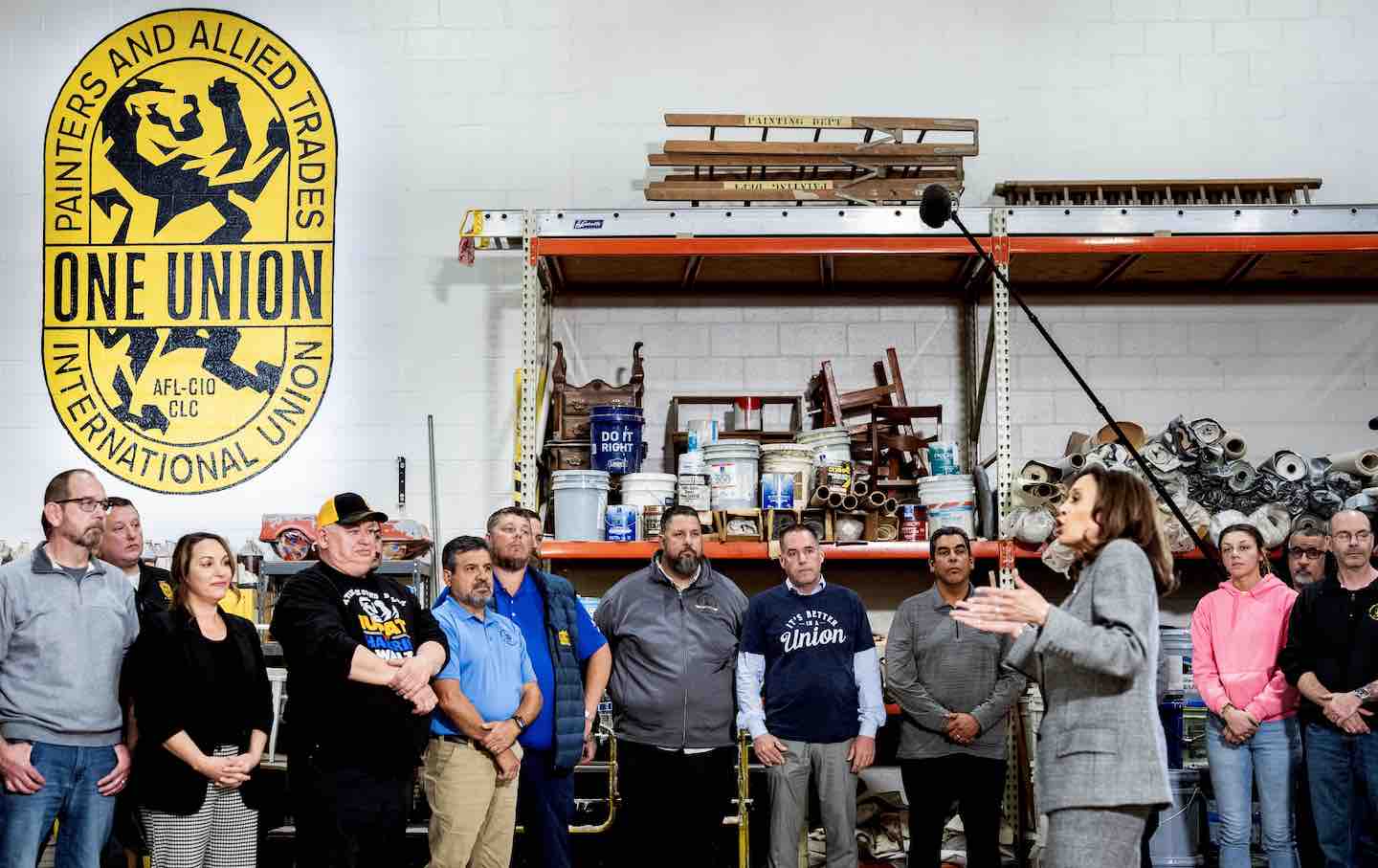
Democratic Presidential Nominee Vice President Kamala Harris meets union workers at the International Union of Painters and Allied Trades training facility in Warren, Michigan, on Monday October 28, 2024.
(Melina Mara / The Washington Post via Getty Images)
Most unions in most places did everything they could to turn out voters for Kamala Harris, and their efforts paid off—at least with their own members. Union members voted for the Democratic presidential nominee by a solid 57–39 margin, according to exit polls. That was comparable with the union vote for Joe Biden in 2020, a notable fact in an election year where Democrats declined among so many demographic groups. “In fact,” noted Politico, “union voters were one of the few groups that did not appreciably shift toward Trump and Republicans in what is shaping up to be one of the party’s strongest presidential election cycles in recent memory.”
Endorsed by the AFL-CIO, the United Auto Workers, the United Steelworkers; the International Association of Machinists; the Service Employees International Union; the American Federation of State, County and Municipal Employees; the American Federation of Teachers; the National Education Association; and dozens of other national and international labor organizations, Harris benefited from internal education campaigns that contrasted her pro-union agenda with that of the historically anti-union Donald Trump. When the International Brotherhood of Teamsters failed to make an endorsement, regional councils and unions locals across the country filled the void, with robust endorsements for the Democratic nominee and active organizing on her behalf among Teamsters nationwide.
Unfortunately, while the union vote held for Harris, her campaign lost ground among working-class voters who aren’t in unions.
Since the election, pundits and strategists have criticized the Democratic Party for failing to reach out to nonunion workers at the scale that was necessary.
“It should come as no great surprise that a Democratic Party which has abandoned working class people would find that the working class has abandoned them,” Senator Bernie Sanders (I-VT) said in a stark reflection on the decline in Democratic fortunes. “First, it was the white working class, and now it is Latino and Black workers as well. While the Democratic leadership defends the status quo, the American people are angry and want change. And they’re right.”
Sanders, who made dozens of campaign stops across the country for Harris this fall, faulted Democratic Party donors and strategists for failing to develop a message that connected with frustrated voters—and nonvoters. “Will the big money interests and well-paid consultants who control the Democratic Party learn any real lessons from this disastrous campaign?” he said after it became clear that Harris had lost and that Democrats had lost the Senate. “Will they understand the pain and political alienation that tens of millions of Americans are experiencing? Do they have any ideas as to how we can take on the increasingly powerful Oligarchy which has so much economic and political power? Probably not.”
Sanders was not alone in expressing frustration. One of the savviest and most outspoken labor leaders in the country, International Union of Painters and Allied Trades president Jimmy Williams Jr. held nothing back in his postelection analysis. Williams gained notice earlier this year when he called upon the US government to “stop funding the genocide” in Gaza and urged the Biden administration to immediately halt all military aid to Israel. He’s not afraid to call out Democrats when they are on the wrong side of issues—and when they stumble in their strategies and messaging.
Williams did just that this week after the election produced devastating results for Democrats.
“Here’s my take on the election,” said Williams. “I spent the last several months traveling around speaking to my members across the Rust Belt. We spoke with thousands of IUPAT members and stressed the importance of this election. And it worked: Vice President Harris got a stronger percentage of union voters this election than President Biden did in 2020. But she still lost!”
Why? Williams says it’s “because the Democratic Party has continued to fail to prioritize a strong, working-class message that addresses issues that really matter to workers. The party did not make a positive case for why workers should vote for them, only that they were not Donald Trump. That’s not good enough anymore!”
Williams was blunt in his critique of messaging failures.
“Rather than offer a positive agenda on what immigrant workers bring to our country, they bought into the punitive, ‘tough,’ anti-worker messaging that is championed by Trump, even though we know it’s the bosses’ fault.” And he added, “They failed to address inflation, saying that it wasn’t a big issue or that the pain that working people feel right now isn’t real. So while we were able to get many of our members out to vote for Vice President Harris, many other workers went with Trump. Trump was able to build a stronger coalition of voters and may very well wind up with a Republican trifecta [controlling not just the White House but the US Senate and House]. This will be disastrous for my members.”
The bottom line is clear, says the leader of the 145,000-member union. “Working people deserve a party that understands this, one that puts them first and places their issues front and center.”
More from The Nation
On Being Awarded the Women Waging Peace Award On Being Awarded the Women Waging Peace Award
It has never been more urgent to revive the idea of peace, not as a slogan, but as the only serious, respectable, responsible, reasonable, humane position.
PSA: Trump Continues to Commit Crimes PSA: Trump Continues to Commit Crimes
While the president is unlikely to face any consequences for his patently illegal, taxpayer-funded ads, it’s essential to remember he should.
Freedom Can’t Be Fenced In Freedom Can’t Be Fenced In
A call for freedom written across a pedestrian overpass, framed by wire.
Zohran Mamdani’s Campaign May Have Accomplished Something More Fundamental Than Moving Policy Debate to the Left Zohran Mamdani’s Campaign May Have Accomplished Something More Fundamental Than Moving Policy Debate to the Left
It’s the people, stupid.

