Democratic Voters Are Clear: It’s Time to Fight
The party’s base has sent the same message in primary after primary: playing it safe won’t cut it in 2026.
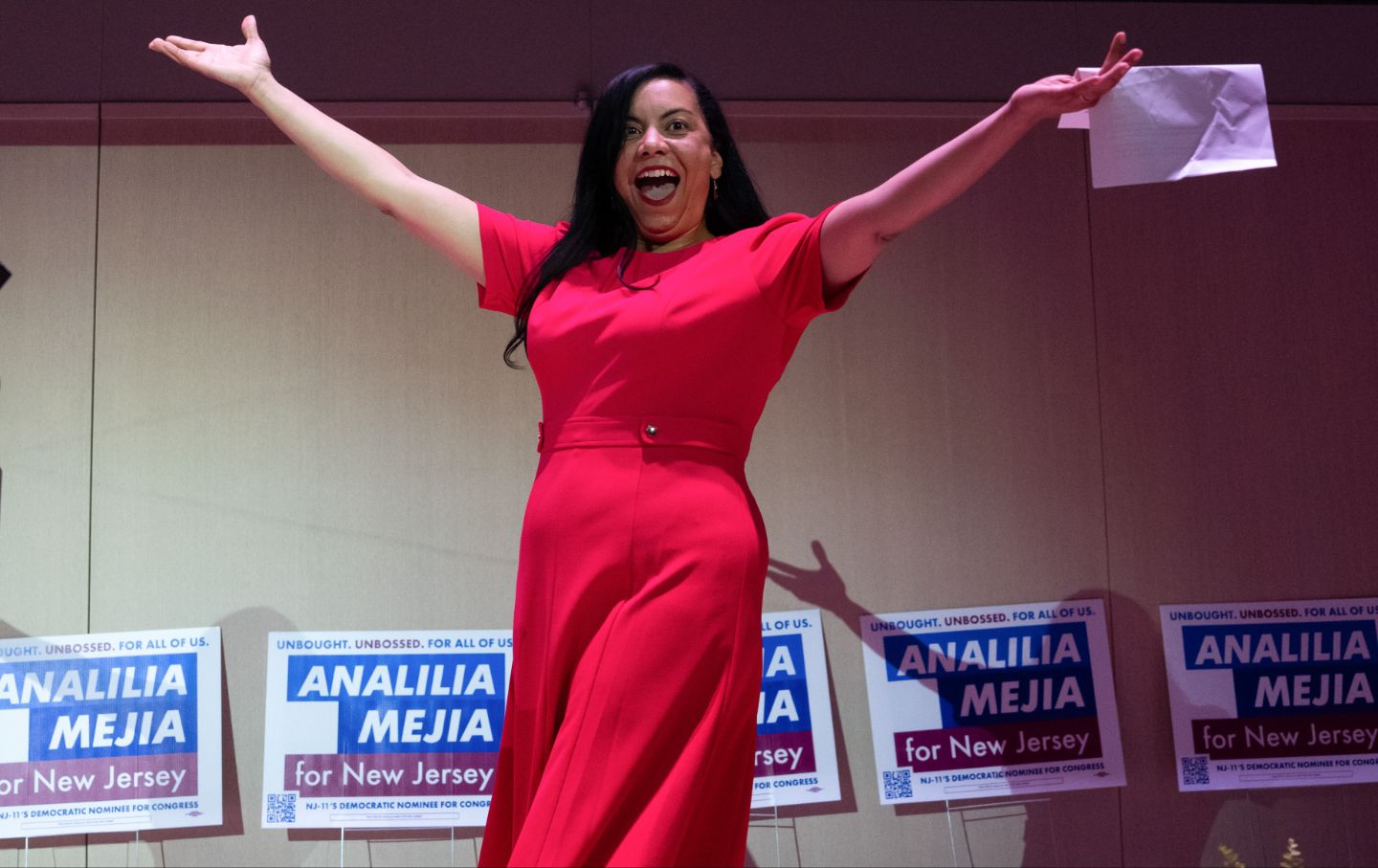
If Democrats want a role model ahead of this year’s midterm elections, they could not do better than Analilia Mejía, the newest member of Congress. The winner of an April special election to fill a suburban New Jersey seat that party insiders thought would favor a centrist, Mejía, a former political director for Senator Bernie Sanders and the director of the New Jersey Working Families Alliance, ran as a progressive who was prepared to take on the “bosses and bullies in both parties to get things done.” After emerging as the victor in a crowded and complicated primary—in which she backed Medicare for All, guaranteed paid sick leave, and a moratorium on AI data centers; accurately described Israel’s assault on Gaza as a genocide; and declared that “it’s time to abolish ICE”—Mejía won the general election by a 20-point margin (more than double the margin that the district gave Kamala Harris in 2024). Mejía embraced her mandate by immediately proposing to raise the federal minimum wage to $25 an hour.
That’s the sort of initiative Democrats need to take in a 2026 election cycle in which, by most accounts, the winds are at their back. “Largely because Donald Trump is so unpopular, his party will be trounced in the midterm elections in November,” declare the sober editors of The Economist. Even as the Supreme Court was eviscerating the Voting Rights Act in late April—creating new concerns about gerrymanders that could erase the mostly Black-held Democratic seats in the South—a generic congressional ballot poll by Emerson College found that 50 percent of likely voters favor Democrats and 40 percent favor Republicans, confirming that the surge that began last fall when the party swept off-year elections in Virginia, New Jersey, and Georgia is accelerating.
The question for Democrats in 2026 is not one of viability—they’ve got that. The question is whether Democratic candidates will do more than merely occupy ballot lines as mild alternatives to the red-hot crisis that is Donald Trump.
Democratic primary voters need to look for candidates who are bold enough to break the cycle of frustration that has seen the party gain ground in one election and then lose it in the next. It should not be this hard to crush Trump and a GOP that combines hateful rhetoric with failed economic policies, and that cannot even remain consistent on whether it is the party of peace that Trump promised in 2024 or the party of a globally destabilizing war with Iran that is costing this country $1 billion a day. Yet Democrats have repeatedly snatched defeat from the jaws of victory, choosing cynical caution over strategies that make sense morally and politically.
“The Democrats lost in 2024 because they were not paying attention to the base of the party,” argues New York State Representative Claire Valdez, a union organizer and democratic socialist who’s a top contender for the Democratic nomination to fill an open US House seat representing parts of Brooklyn and Queens. “If the Democratic Party would have been paying attention to the base, it would have actually been working for a ceasefire [to prevent the genocide in Gaza]. We would have passed Medicare for All, so that everyone could have healthcare free at the point of service. We’d be investing in permanently affordable housing all over this country.”
“The biggest thing that we have to overcome is not [a] difference of politics,” Valdez says. “It is differences in a belief that government can actually deliver for people and that Democrats are worthy of supporting.”
Those who imagine that Valdez simply speaks for New York, the city that made the democratic socialist Zohran Mamdani its mayor, might consider the message from Maine. There, the progressive populist Senate candidate Graham Platner went from working as an oyster farmer to building such a strong movement behind his “When we fight, we win” message that the state’s sitting governor, Janet Mills, quit the Democratic primary race, clearing the way for Platner to challenge the vulnerable Republican incumbent Susan Collins in November.
By elevating Platner, Maine Democrats delivered a message to Senate minority leader Chuck Schumer, who had pushed Mills to get into the Senate race: The party must do much more than simply play it safe in 2026. Smart candidates know this. Minnesota Senate candidate Peggy Flanagan, Michigan Senate contender Abdul El-Sayed, and California gubernatorial hopeful Tom Steyer, for instance, have all surged in the primary polls as backers of Medicare for All and tax hikes for the rich.
Instead of chasing corporate cash, Democrats should listen to the Working Families Party, which is calling for a national unionized-job guarantee to address potential unemployment stemming from artificial intelligence. They should also consider the Congressional Progressive Caucus’s “New Affordability Agenda,” which takes on corporate greed in order to raise wages and slash costs for gas, groceries, and childcare.
“These are the kind of bold, populist ideas Democrats should talk about in 2026 and pass in 2027,” says CPC chair Greg Casar, a Democrat from Texas. He’s right.
Become a Sustaining Donor This September
Between the reemergence of right-wing red-baiting and Donald Trump’s use of the chilling National Security Presidential Memorandum–7 to criminalize left political organizing, we’re seeing McCarthyism reborn before our eyes.
This assault on democracy cannot be ignored or wished away. Resisting it requires bravery in the face of threats and repression, a steadfast commitment to the truth, and the unwavering belief that we can—and will—overcome this darkness.
We must have an independent media that sets the record straight, unearths corruption and abuses of power, and advances a politics of justice and dignity for all if we’re to win this fight.
That’s why I’m writing to you today. This September, The Nation needs to add 100 monthly donors to sustain our progressive journalism. Your contribution makes the next investigative report, the next truth-speaking column, and the next pathbreaking essay all possible.
I hope you’ll support our work with a recurring donation today. If you donate $10 or more a month, we’ll send you a brand new “Hands Off the Free Press!” sticker to recognise your commitment to our cause. Please, donate today.
Onward,
Katrina vanden Heuvel
Editor and Publisher, The Nation