
Democrats Need to Have an Honest Talk About White People
The party needs a sober, empirically grounded analysis of what we really know—and don’t know—about how best to expand support among white voters.
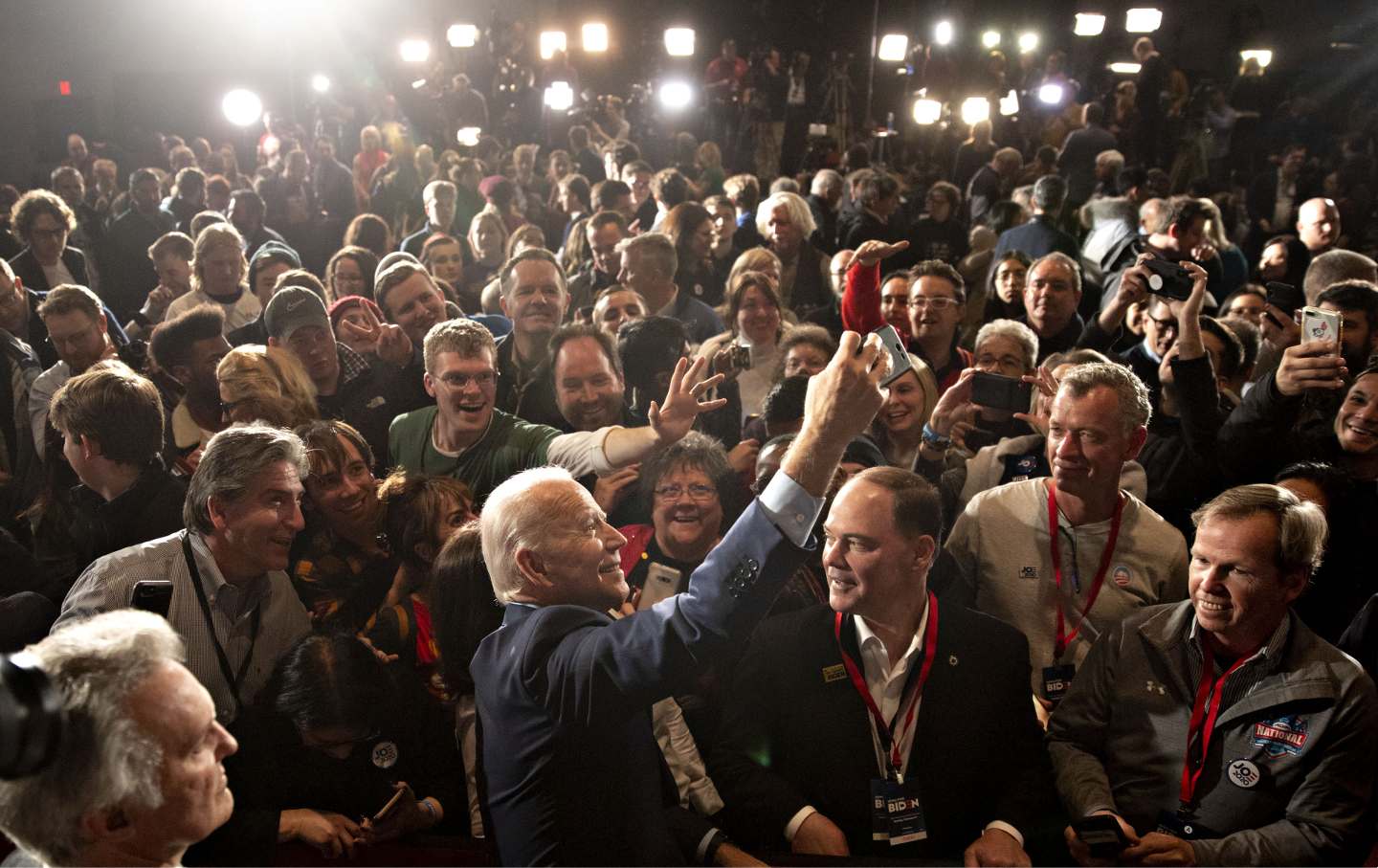
Joe Biden with supporters during a caucus night watch party in Des Moines, Iowa, on Monday, February 3, 2020.
(Daniel Acker / Bloomberg via Getty Images)We need to talk about white people. Heading into the very high-stakes 2024 election cycle, progressives and Democrats need to engage in a sober, empirically grounded analysis of what we really know—and don’t know—about how best to expand support among white voters.
For the past 10 years, I’ve been banging the drum about how the Democratic Party overprioritizes wooing white swing voters (a shrinking population) and does not spend nearly enough on investing in, inspiring, and mobilizing voters of color—who, after all, make up nearly half of the party’s voters. But I’ve always also said that Dems need at least a certain percentage of white voters to win.
With Democrats and their allies preparing to spend more than $1 billion next year in the 2024 presidential election cycle, it’s critical for us all to pause and make sure that the planning, spending, and strategy heading into next year’s Election Day is informed by the latest and best data, including data on the most effective ways to attract more white voters. It’s also imperative to assess the limits of that support, that is, to get crystal clear on which—and how many—white voters are actually woo-able.
Much of the conventional wisdom about voting patterns along racial lines in this country is faulty. Many people are surprised to learn that Lyndon Johnson was the last Democratic presidential nominee to win the white vote (in 1964). After he signed the Voting Rights Act in 1965, no Democratic nominee has won the majority-white vote again. Ever. (Jimmy Carter came the closest, winning 48 percent in 1976.)
Many misremember Bill Clinton’s 1992 election as a high-water mark of white support for Democrats, but Barack Obama actually eclipsed Clinton’s numbers in 2008 when he secured 43 percent of white votes compared to Clinton’s 39 percent. In Clinton’s 1996 reelection bid against a weak Bob Dole, he did manage to get the backing of 44 percent of whites.
That was the high point of white support for Democrats since the advent of modern-day exit polling in 1976; the nadir was Walter Mondale’s 34 percent in 1984, and the average has been 40.3 percent. Forty-one percent of whites supported Joe Biden in 2020.
These figures should prompt Democrats to ask themselves two fundamental questions. First, how do we move the needle closer to the 43-44 percent that Clinton and Obama enjoyed? Second, when does political spending that targets whites reach the point of diminishing returns—that is, at what point do we reach the ceiling on how many white votes we can win?
This inquiry needs to go beyond the usual handwringing about Democrats’ problems with white working-class voters. Trump bested Hillary Clinton among white non-working-class voters as well. How should we understand this, especially in light of the ongoing outsized attention showered on white working-class voters in Midwestern diners by candidates and the media? Maybe we should be paying more attention to trying to boost the turnout of college-educated white voters instead of continuing to chase those least likely to support us.
I’ve spent the better part of the past decade trying to sound the alarm about the need for Democrats to have a data-driven conversation about how to maximize the turnout of voters of color in a nation that is increasingly diverse and increasingly racially polarized. In a 2016 analysis, I showed that nearly 80 percent of Democratic dollars in that election cycle were spent on targeting white voters. In my 2016 book, Brown Is the New White, I broke down the math of the Obama coalition, which I dubbed the “New American Majority.” This coalition comprises of progressive people of color (23 percent of all eligible voters) and progressive whites (28 percent of all eligible voters). These two groups make up 51 percent of all eligible voters. My book offered lessons on how Dems could maximize support from each racial group, including whites, in such a way that the elements commingle and create a winning formula. And yet that year the Democratic Party’s white support dropped to a 34-year low as Trump turned white racial resentment and rage into a powerful political force.
While wooing white voters has always been top of mind for Democratic strategists, operatives, and leaders, there has been shockingly little transparent and constructive conversation about the evidence underlying the party’s strategies and spending tactics. For example, Democratic operative David Shor has become infamous over the past couple of years for his advocacy of “popularism” as a way to boost white support. In The New York Times, Ezra Klein distilled the essence of popularism down to: “Democrats should do a lot of polling to figure out which of their views are popular and which are not popular, and then they should talk about the popular stuff and shut up about the unpopular stuff.” (Spoiler alert: Much of that “unpopular stuff” includes talking about the problem of racism in this country.)
Shor’s views have reverberated throughout the Democratic ecosystem. His tweets and views have been retweeted by Obama. Klein’s 6,000-word piece in the Times was a paean to Shor’s way of thinking. And yet, despite the reverence for his ideas and his lofty status as a “data scientist,” Shor has never published anything clearly articulating his views, let alone outlining the evidence supporting it. (One thing is clear, though: as Elie Mystal has pointed out, Shor is “convinced and vocal that Democrats should dump their racial justice message if they want to maintain power.”)
Over the past 20 years, I have been in multiple meetings with top Democratic Party leaders and operatives who were making million-dollar asks of major donors. Rarely in those meetings did I witness insiders share any meaningful data to justify these asks. Shockingly, too many billionaire donors simply fork over large political contributions without asking tough questions or demanding to see hard evidence or plans. These are the same donors who conduct extensive due diligence before making private-sector investments.
Popular
“swipe left below to view more authors”Swipe →Small-dollar donors also fall prey to impulse buying. Time and again, we have seen tens of millions of dollars flow to Democratic candidates running against prominent and destructive Republican leaders such as Mitch McConnell, Susan Collins, and Lindsey Graham. These candidates’ respective opponents—Amy McGrath, Sara Gideon, and Jamie Harrison—received a combined $300 million in 2020, but all three Democrats lost badly because the races were never really that winnable in the first place based on historical voting patterns. This would have been obvious based on a clear-eyed assessment of the data.
The stakes next year are too high for our standards to be so low. That’s why I have joined with the Working Families Party and Showing Up for Racial Justice (SURJ) to start a candid conversation among progressives about what the data really shows about how best to attract and retain the maximum amount of white support possible. We are calling this effort the White Stripe Project (broadening our nation’s multiracial rainbow). We will be inviting all sectors of the progressive movement—including Democratic Party and super PAC leaders—to share the data they rely on and encourage a transparent and constructive conversation about 2024 strategy and spending.
This conversation is long overdue and vital as we gear up for an election taking place at a time when the country is more racially polarized than at any point since Martin Luther King’s assassination and the subsequent urban rebellions in 1968. Notably, Richard Nixon won the ’68 election by less than 1 percent of the vote. The margin of difference in 2024 also stands to be razor-thin (even if one of the candidates is in jail). This means that those spending the most money need to engage in the important work of explaining, sharing, and defending their plans and the evidence underlying them.
Support independent journalism that does not fall in line
Even before February 28, the reasons for Donald Trump’s imploding approval rating were abundantly clear: untrammeled corruption and personal enrichment to the tune of billions of dollars during an affordability crisis, a foreign policy guided only by his own derelict sense of morality, and the deployment of a murderous campaign of occupation, detention, and deportation on American streets.
Now an undeclared, unauthorized, unpopular, and unconstitutional war of aggression against Iran has spread like wildfire through the region and into Europe. A new “forever war”—with an ever-increasing likelihood of American troops on the ground—may very well be upon us.
As we’ve seen over and over, this administration uses lies, misdirection, and attempts to flood the zone to justify its abuses of power at home and abroad. Just as Trump, Marco Rubio, and Pete Hegseth offer erratic and contradictory rationales for the attacks on Iran, the administration is also spreading the lie that the upcoming midterm elections are under threat from noncitizens on voter rolls. When these lies go unchecked, they become the basis for further authoritarian encroachment and war.
In these dark times, independent journalism is uniquely able to uncover the falsehoods that threaten our republic—and civilians around the world—and shine a bright light on the truth.
The Nation’s experienced team of writers, editors, and fact-checkers understands the scale of what we’re up against and the urgency with which we have to act. That’s why we’re publishing critical reporting and analysis of the war on Iran, ICE violence at home, new forms of voter suppression emerging in the courts, and much more.
But this journalism is possible only with your support.
This March, The Nation needs to raise $50,000 to ensure that we have the resources for reporting and analysis that sets the record straight and empowers people of conscience to organize. Will you donate today?
More from The Nation

An Argument Against Voting for the “Electable” Guy An Argument Against Voting for the “Electable” Guy
In this week’s Elie v. US, The Nation’s justice correspondent shares his thoughts on the Texas primaries. Plus, a terrible Supreme Court decision and a bad play by Major League Ba...


A Conflict Without Reason Has Become a Dangerous Holy War A Conflict Without Reason Has Become a Dangerous Holy War
Lacking a clear rationale for the attack on Iran, Trumpists are increasingly talking like crusaders.
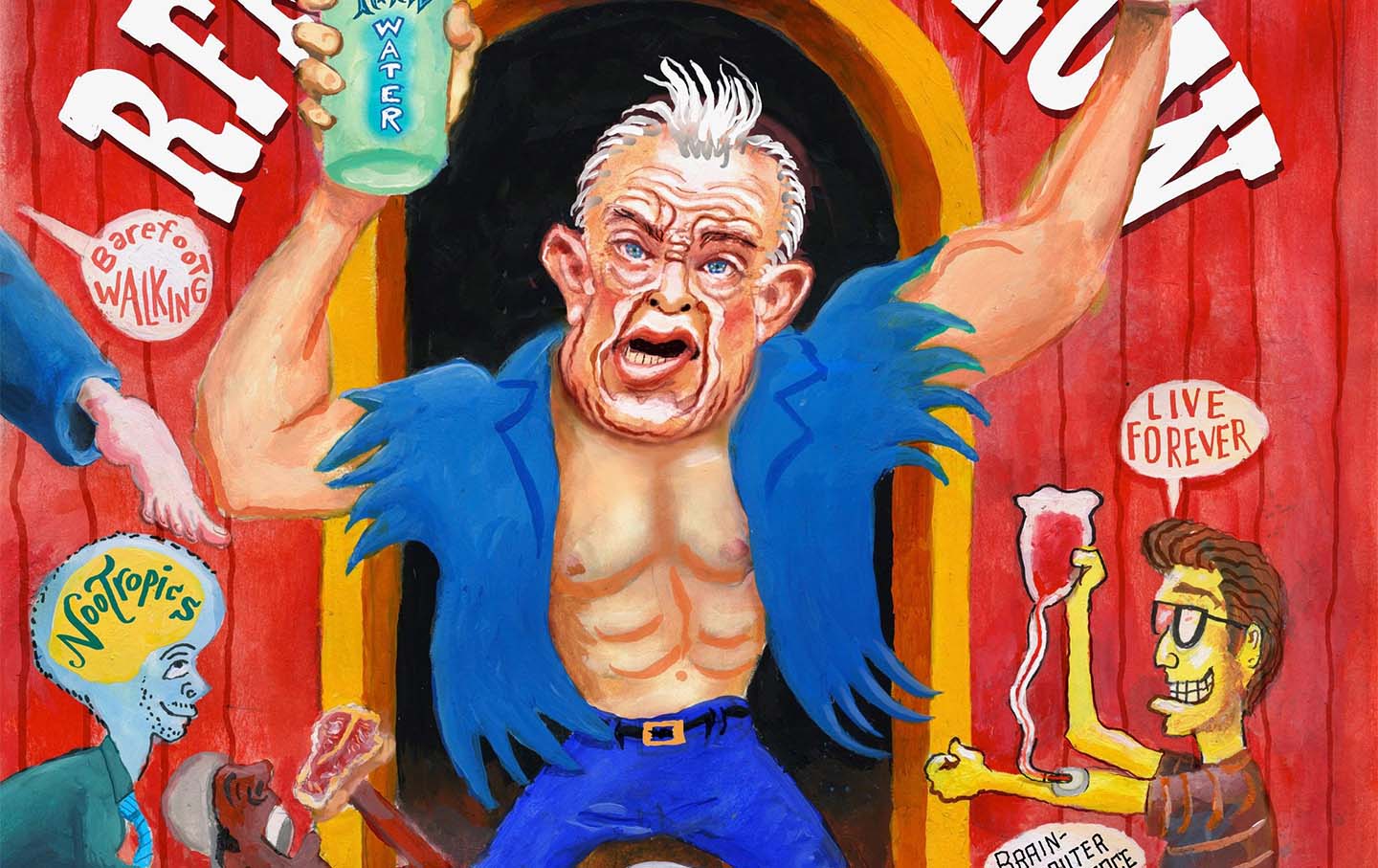
RFK Jr.: America’s Snake Oil Salesman RFK Jr.: America’s Snake Oil Salesman
Raw truth: MAHA is NUTS.

The Unfathomable Toll of the Syrian Civil War The Unfathomable Toll of the Syrian Civil War
How to make sense of the 13-year conflict?
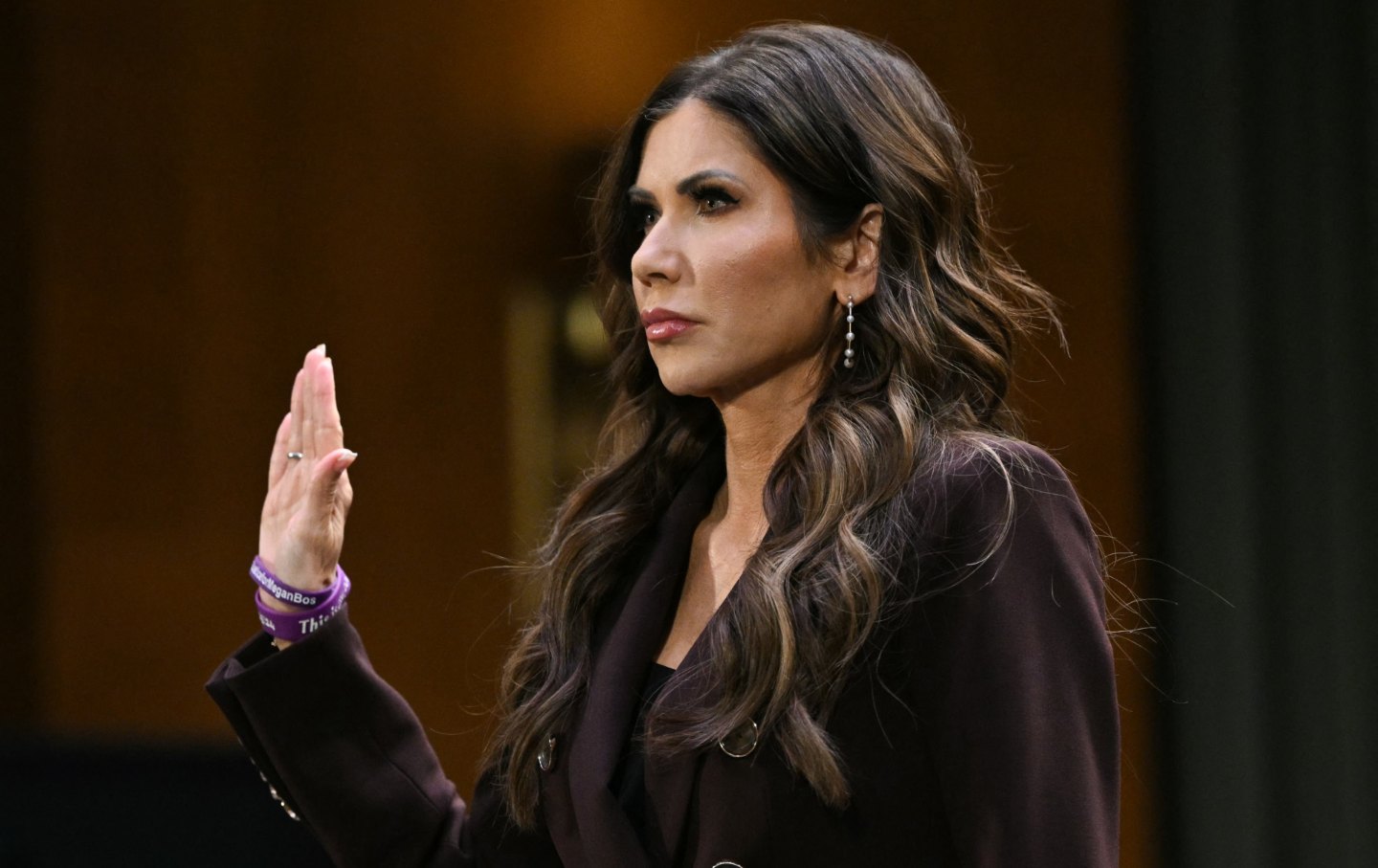
Celebrate Kristi Noem’s Firing. But Keep Protesting ICE. Celebrate Kristi Noem’s Firing. But Keep Protesting ICE.
Finally, someone in the administration is paying for their cruelty and incompetence.

