Bernie Sanders Says a Mamdani Win Can Transform American Politics
In an exclusive interview with The Nation, Sanders says Mamdani can show Democrats how to campaign—and govern—for the working class.
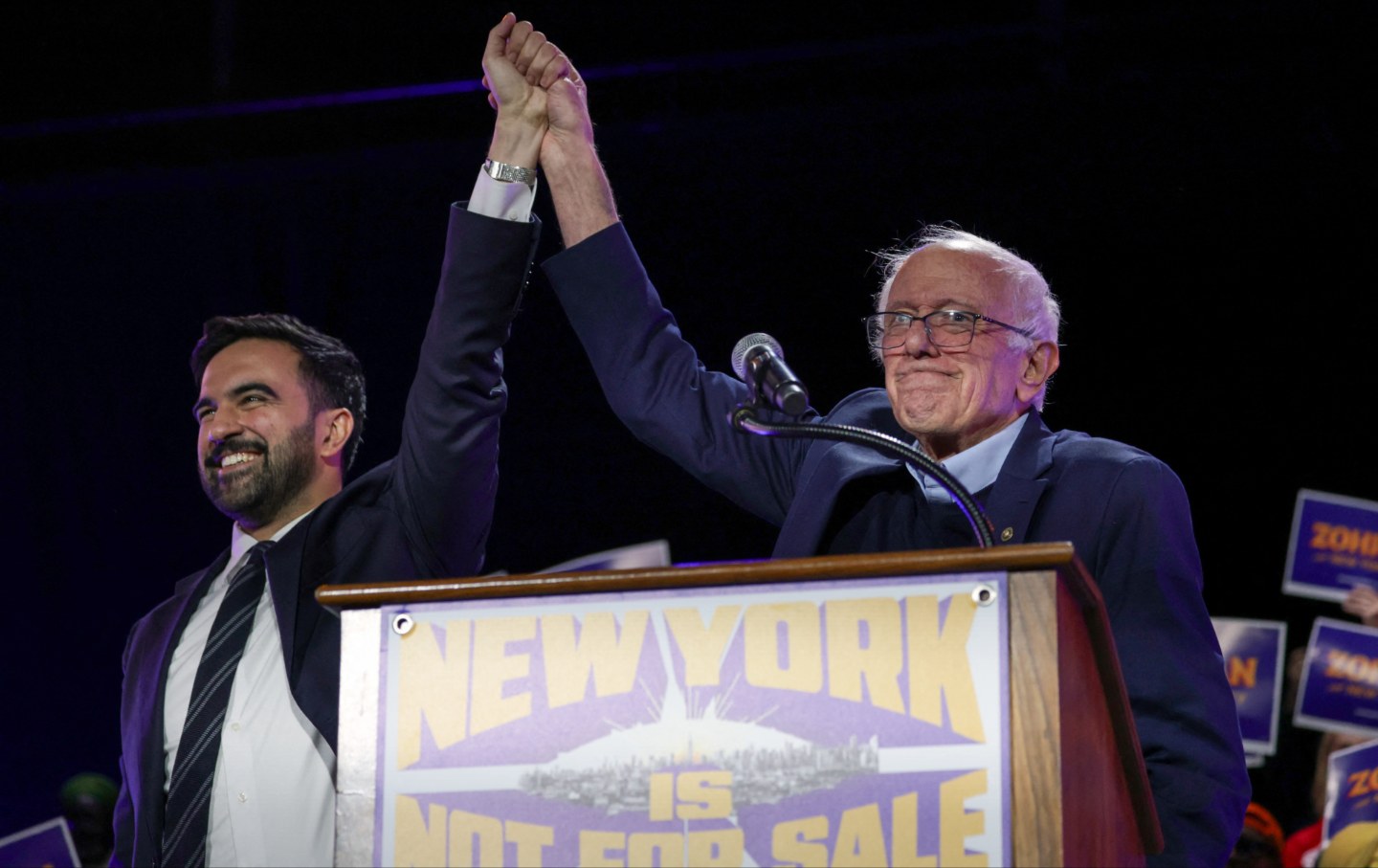
Zohran Mamdani holds hands with Senator Bernie Sanders during a campaign rally at Forest Hills Stadium in Queens, on October 26, 2025.
(Angela Weiss / AFP via Getty Images)Bernie Sanders knows that if Zohran Mamdani is elected as mayor of New York City on Tuesday, it will matter most profoundly for the people of the Bronx, Brooklyn, Manhattan, Queens, and Staten Island. But the Brooklyn-born senator from Vermont believes that a victory for his fellow democratic socialist will resonate far beyond America’s largest city.
A Mamdani win, says Sanders, could transform the politics of the entire country.
“I consider the New York City mayor’s race enormously important, not just for New York City but as a very profound statement in terms of what’s happening all over this country,” Sanders tells The Nation in an exclusive interview. “I think there is profound disgust at the political establishment. People want real change, and a strong victory on the part of Mamdani, I think, will inspire people all across our country to fight for that change.”
Sanders endorsed Mamdani before June’s Democratic mayoral primary, when the 34-year-old legislator stunned the political establishment by defeating former New York governor Andrew Cuomo and other prominent Democrats.
The billionaire class, which Sanders exposed and challenged in his 2016 and 2020 presidential bids, was stung by the primary result. But they have since doubled down on trying to defeat Mamdani in Tuesday’s general election matchup with Cuomo, who has repurposed himself as an independent and mounted an increasingly desperate and divisive fall bid.
“These billionaires are saying: ‘we’ve got to do everything we can to stop him,’” notes Sanders. “Usually, the money people sit in back rooms and figure out how to do it. These guys are on the front page of The New York Times saying, ‘We can’t have it. We can’t have a democratic socialist as mayor.’ They’re saying, ‘To hell with what the people want.’”
But that opposition from the oligarchs, and the prominent Democrats who align with them, has not dissuaded Mamdani. Or Sanders. Indeed, the senator sees Mamdani’s candidacy as a model for grassroots progressives who recognize that the Democratic Party must change its approach to elections—and to governing.
“Look, there is little doubt in my mind that the Democratic leadership is way out of touch with where the American people are at,” Sanders tells The Nation. Of the top Democrats who refused to endorse Mamdani after the primary, or provided half-hearted support at best, the senator says, “Their allegiance primarily is to the money interest, to the consultant class, and not to working families all across this country who are struggling. And what I love about the Mamdani campaign, which is enormously impressive, is that he has some 80,000 volunteers knocking on doors and doing everything that has to be done to win, to get elected. That involvement is the kind of volunteer activity we need all over America. Yet this is something, a reality, that the Democratic establishment—who get their money from big-money interests at cocktail parties—don’t have a clue about.”
In contrast, says Sanders, who has spoken to “Fighting Oligarchy” rallies across the US this year, grassroots Democrats know precisely where Mamdani is coming from.
“Look, what is he talking about? He says, ‘I am prepared to take on the oligarchs.’ And I think, all across this country, people are sick and tired of seeing the billionaire class get richer and richer, and the billionaire class controlling to a significant degree both political parties. What Zohran Mamdani is showing is that a grassroots movement can take them on and defeat them,” explains Sanders. “I recognize that New York City is not the whole country. But I’ve been all over the country this year. I’ve been to West Virginia. I’ve been to Idaho. I’ve been to very, very conservative areas. And I think no matter where people live, no matter what their political point of view may be, there is growing disgust at income and wealth disparity. There is growing disgust at a healthcare system which is virtually collapsing. Growing disgust that our kids in the wealthiest nation on earth may well have a standard of living that is lower than their parents’. People are tired of the greed of the oligarchs. And Mamdani is a perfect manifestation of people beginning to say, ‘Enough is enough. Let’s elect somebody who’s going to represent us and not just the 1 percent.’”
Sanders is the first to acknowledge that if Mamdani wins, he will face enormous challenges from the billionaires who continue to oppose him—and from a billionaire president, Donald Trump, who has attacked and threatened the candidate who would be New York’s first Muslim mayor. But the senator says, “The importance of this race is not just being the mayor of New York City, which unto itself is obviously enormously important. This is the largest city in the country. But if Zohran Mamdani governs well, if he shows that a mayor that stands with the working class, a mayor that is prepared to take on the oligarchs, can in fact successfully govern and improve life for working-class people, the understanding will spread all over the country that working people can have representatives and mayors who stand for them. And that they can go beyond the old establishment politics.”