Arab Voters Are Abandoning Kamala Harris. Why Doesn’t She Seem to Care?
Arab American support for Democrats has plummeted—but Harris is making virtually no effort to win these voters back.
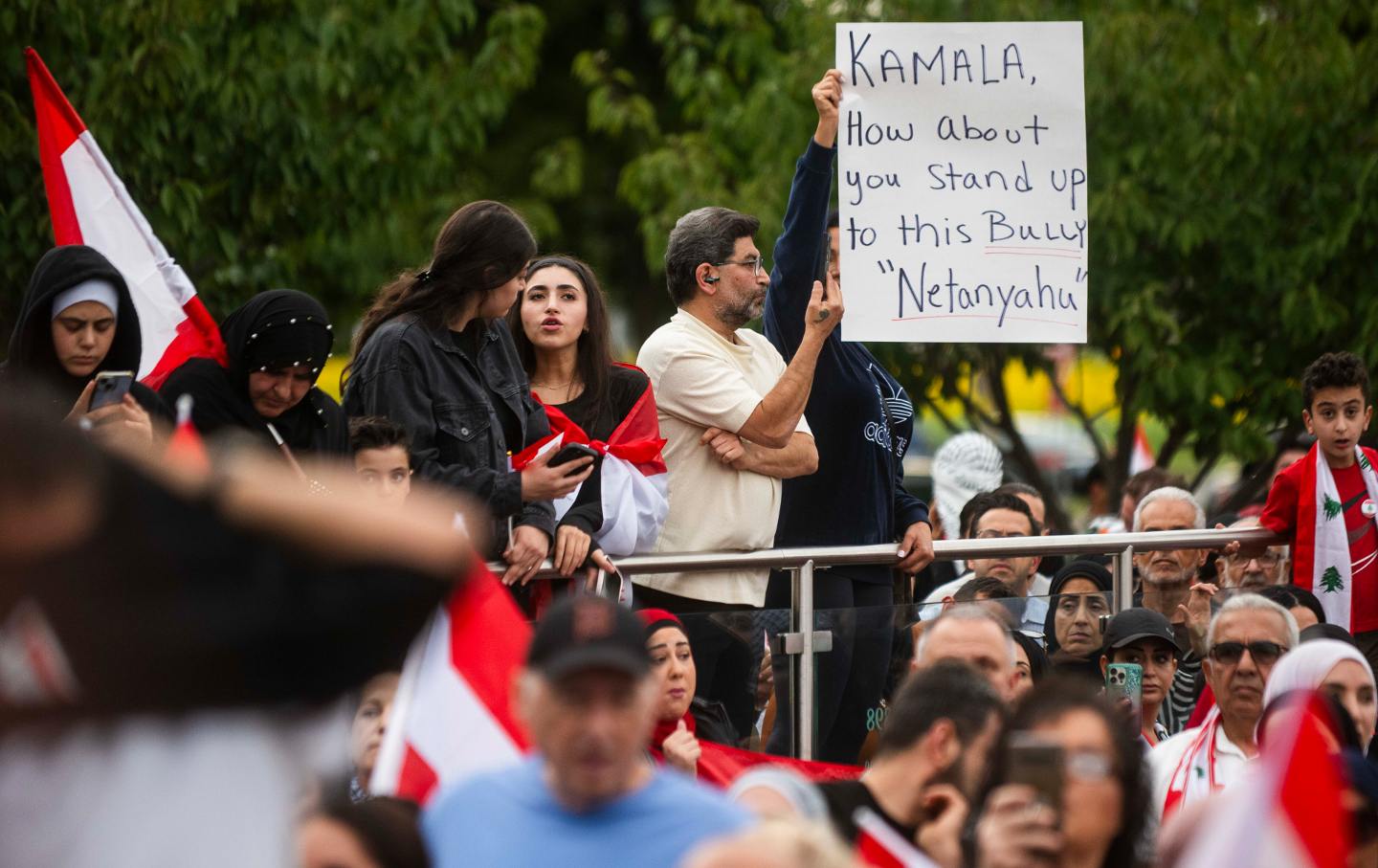
Hundreds gather for a rally in support of Lebanon in light of recent Israeli strikes that killed hundreds, on Wednesday, September 25, 2024, in front of the Henry Ford Centennial Library in Dearborn, Michigan.
(Katy Kildee / Detroit News via AP)There’s been a lot of discussion over the past few years about Black men slowly moving away from the Democratic Party or Latino voters in places like South Texas shifting rightward. But a similar exodus has been brewing among Arab American and Muslim voters, especially in states like Michigan, with far less attention. And, as new polling out this week from the Arab American Institute emphasizes, Gaza has accelerated this shift at breakneck speed.
But while Kamala Harris has made aggressive efforts to stabilize her Black and Latino support, she appears uninterested in doing the same for Arab American voters. With the presidential election on a knife edge, the question is not why Harris is losing Arab American voters but why she won’t even try to win them back.
For years, Arab American voters were a reliable part of the Democratic coalition, especially in Michigan. Michigan is home to Arab and Muslim American Democratic elected officials up and down the ballot. But as Israel’s assault on Gaza rages on and expands to Lebanon and the West Bank, these voters are turning their backs on a party that they feel has abandoned them. The latest AAI poll, taken before Israel’s recent bombing of Lebanon and released on Wednesday, shows that Arab Americans are now virtually tied between Harris and Trump. The Biden-Harris administration’s unrestricted weapons transfers for Israel, in the face of a growing humanitarian crisis, has eroded what little trust was left. So why won’t the Harris campaign take this seriously?
The refusal to engage Arab American voters is glaring. There’s been talk about outreach to Black men, Latinos, and other key constituencies, but when it comes to Arab Americans, the silence is deafening. Even supporters of Dick and Liz Cheney are getting more attention from the Harris campaign than Arab voters. Abbas Alawieh, my colleague in the Uncommitted campaign, put it bluntly on CNN, asking why Vice President Harris won’t sit down with Lebanese and Palestinian Americans, and why she won’t meet with families directly impacted by the bombs falling in Gaza. The absence of that dialogue is not just political malpractice; it’s a moral failure.
The latest poll numbers tell a stark story. A majority—55 percent—of Arab Americans told the AAIA that they would be more likely to support Harris if the DNC had allowed a Palestinian American to speak at the convention. But Harris and the DNC refused. More than 56 percent of Arab Americans said they would support Harris if she called for an end to arms shipments to Israel. But she hasn’t. Instead, the Harris campaign has offered little more than platitudes, virtual staff meetings, and a refusal to engage with the urgency that this moment demands.
This isn’t about misunderstanding the stakes; the stakes are clear. Michigan is a critical battleground state, and Arab American voters have played a decisive role in the past. But the Harris campaign is not making the same effort to persuade them as they are with other disillusioned groups. It’s as if they’ve written off these voters, even as they scramble to address shifts in other demographics. The loss of Arab American voters is seen as collateral damage, rather than an opportunity to build bridges.
Gaza isn’t just a distant foreign policy issue for these voters—it’s personal. The war has torn American families apart, and the Democratic Party’s unwavering insistence on supplying weapons for Israel’s military assault has only deepened the wounds of dehumanization. Yet, instead of addressing these concerns head-on, the Harris campaign continues to ignore them. It’s as if they’re hoping Arab Americans will simply return to the fold because of the fear of Trump without having to put in the work. But that clearly isn’t happening.
Biden reportedly believes that Netanyahu is extending the war in Gaza to help Trump win the November election, yet his administration’s actions seem to do little to counteract that. Even as pressure mounts within the Democratic Party to distance itself from Netanyahu, Biden’s instinct has been to uphold the US-Israel alliance, despite the obvious political implications. It’s a paradox—recognizing Netanyahu’s motives but still refusing to take the necessary steps to halt the violence or break from unconditional support. It’s not just political negligence; it’s an ideological commitment to the status quo, even if it weakens his own party and jeopardizes Kamala Harris’s chances.
Harris and her team are running out of time. Arab American voters in Michigan, who once turned out in droves for Democrats, are on the verge of walking away from this campaign and party in what would be a historic realignment of an important voting bloc in Michigan. The question that hangs over this election isn’t whether Harris can win back these voters. It’s whether she even wants to.
Support independent journalism that does not fall in line
Even before February 28, the reasons for Donald Trump’s imploding approval rating were abundantly clear: untrammeled corruption and personal enrichment to the tune of billions of dollars during an affordability crisis, a foreign policy guided only by his own derelict sense of morality, and the deployment of a murderous campaign of occupation, detention, and deportation on American streets.
Now an undeclared, unauthorized, unpopular, and unconstitutional war of aggression against Iran has spread like wildfire through the region and into Europe. A new “forever war”—with an ever-increasing likelihood of American troops on the ground—may very well be upon us.
As we’ve seen over and over, this administration uses lies, misdirection, and attempts to flood the zone to justify its abuses of power at home and abroad. Just as Trump, Marco Rubio, and Pete Hegseth offer erratic and contradictory rationales for the attacks on Iran, the administration is also spreading the lie that the upcoming midterm elections are under threat from noncitizens on voter rolls. When these lies go unchecked, they become the basis for further authoritarian encroachment and war.
In these dark times, independent journalism is uniquely able to uncover the falsehoods that threaten our republic—and civilians around the world—and shine a bright light on the truth.
The Nation’s experienced team of writers, editors, and fact-checkers understands the scale of what we’re up against and the urgency with which we have to act. That’s why we’re publishing critical reporting and analysis of the war on Iran, ICE violence at home, new forms of voter suppression emerging in the courts, and much more.
But this journalism is possible only with your support.
This March, The Nation needs to raise $50,000 to ensure that we have the resources for reporting and analysis that sets the record straight and empowers people of conscience to organize. Will you donate today?