Ada Deer Was an Epic Figure in US History
The late Indigenous leader forced the government to recognize tribal sovereignty and broke through a staggering number of barriers.
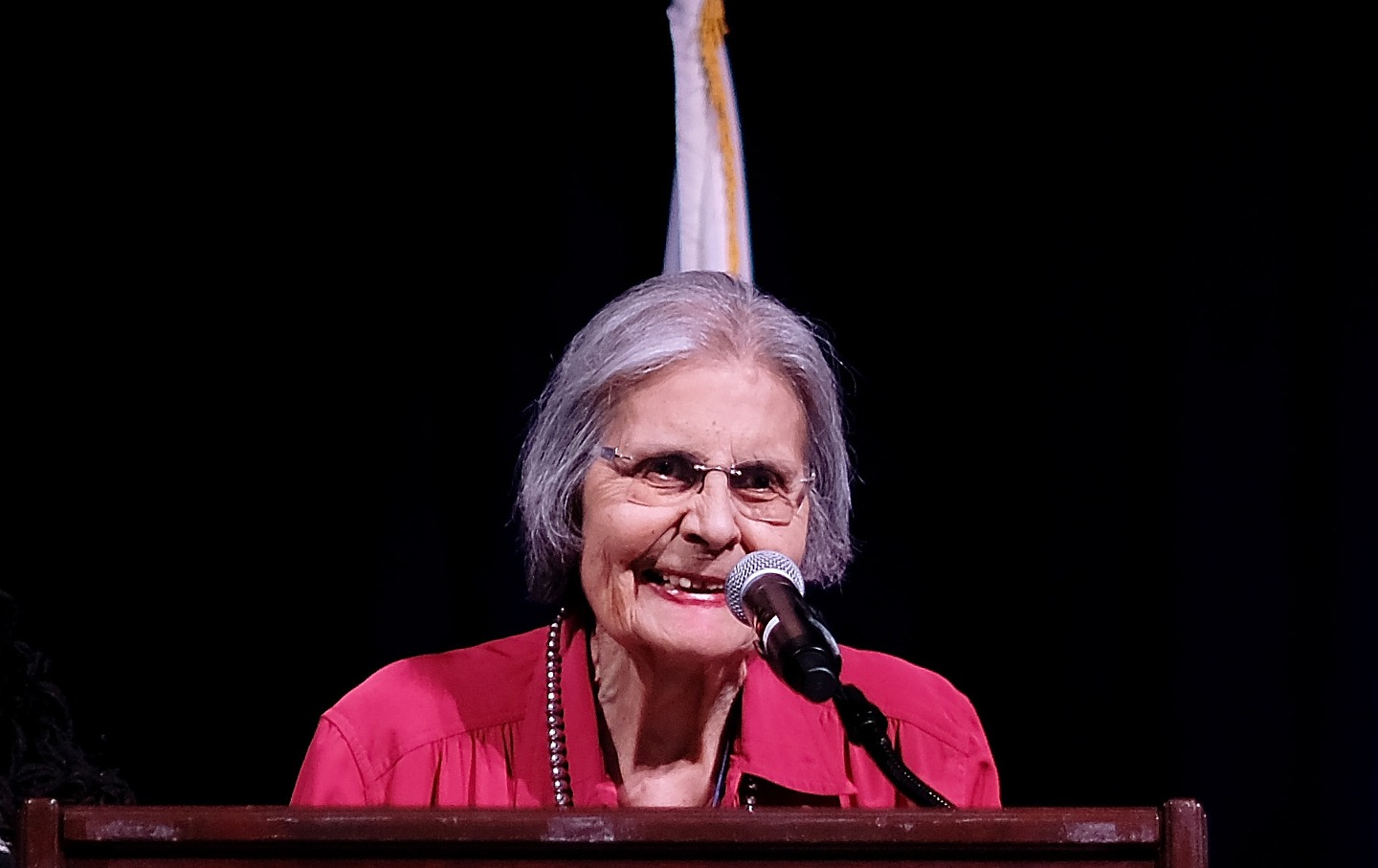
Ada Deer onstage during the Wisconsin Democrats 2023 Convention on June 10, 2023, in Green Bay, Wis.
(Alex Wroblewski / Getty Images for Democratic Party of Wisconsin)Ada Deer knew injustice. Even more importantly, she knew how to address injustice. Born into the Menominee Indian Tribe of Wisconsin in 1935, Deer, who died on Tuesday at age 88, came of age in the 1950s, as the US Congress was pursuing a cruel strategy of ending recognition of tribes and actively undermining their sovereignty. She saw through the lies that underpinned the federal government’s “termination” agenda, rejected the pressure to abandon historic commitments and values, and set out to bend the arc of history toward justice for indigenous peoples. Eventually, she and her allies succeeded in writing a new chapter in the history of Native Americans.
Deer was an epic figure in the history of her tribe, her state, and her nation. She broke through a staggering array of barriers, becoming the first member of the Menominee Tribe to graduate from the University of Wisconsin and receive a master’s degree, the first woman to serve as tribal chair, the first Native American woman to run for statewide office in Wisconsin and the second Native American woman to bid for Congress. Eventually, she would become the first Native American woman to head the federal Bureau of Indian Affairs (BIA).
Her accomplishments as an academic, a social worker, and a congressional candidate who upended the Democratic establishment in Wisconsin earned Deer international recognition, yet she often recalled that she got her start as a member of a tribe that had been forced to fight for its right to exist in the eyes of the United States. That memory inspired her to use her clout, especially at the BIA, to promote the recognition and empowerment of the hundreds of federally recognized tribes in the country—and of the tribes and communities that continue to struggle for recognition, respect, and sovereignty.
Deer’s understanding of these fights was rooted in her own life experience. Her tribe, the Menominee, dates back more than 10,000 years, and has deep roots in the Great Lakes region—especially in Wisconsin. But its experience with the United States was a bitter one. “At the start of the Treaty Era in the early 1800’s, the Menominee occupied a land base estimated at 10 million acres; however, through a series of seven treaties entered into with the United States Government during the 1800’s, the Tribe witnessed its land base erode to little more than 235,000 acres today,” recalls a tribal history. “The Tribe experienced further setbacks in the 1950’s with the US Congress’s passage of the Menominee Termination Act, which removed federal recognition over the Tribe and threatened to deprive Menominee people of their cultural identity.”
Many tribes faced termination in the 1950s and ’60s. But the Menominee experience was especially stark. Before Congress terminated recognition of the Menominee, the tribe had maintained successful forestry and lumbering operations and a measure of stability. But the federal intervention upended all of that. Tribal property was transferred to a corporation, Menominee Enterprises Inc. (MEI), and the Menominee reservation was designated as Wisconsin’s Menominee County.
The corporation quickly experienced a financial crisis and the county became the poorest in Wisconsin. The reservation hospital closed, as did schools and social service programs.
In response, Deer and another young activist, James White, took inspiration from the civil rights struggles of the 1960s and formed a new group, Determination of Rights and Unity for Menominee Stockholders (DRUMS), which organized protests against schemes to sell off and develop tribal land for the second homes of wealthy people from Milwaukee and Chicago. DRUMS activists also ran for and won seats on the board of the MEI corporation and began to undo the worst of the board’s development policies. At the same time, they waged court battles and lobbied Congress to reverse the termination act.
Deer was dispatched to Washington, where she declared, “Mainly, I want to show people who say nothing can be done in this society that it just isn’t so. You don’t have to collapse just because there’s federal law in your way. Change it!” And change it she did. Deer’s lobbying played a critical role in convincing Congress and the Nixon administration to approve legislation that in 1973 restored the Menominee tribe’s status as a federally recognized tribe—and that provided a model for other tribes to do the same.
Thus began the restoration period for the Menominee, with the then-39-year-old Deer serving as the new chair of tribe—the first woman ever to obtain that title. Twenty years later, after Deer had mounted a history-making 1992 bid for Congress (with the slogan “Run Like a Deer”), she was called to Washington by newly elected President Clinton. Clinton chose Deer to serve as assistant secretary of the interior for Indian affairs, an appointment that put her in charge of the BIA. Deer went to work immediately on recognition issues—supporting efforts to secure federal recognition for tribes in California and Michigan, along with 226 Alaska Native villages, as well as American Indian tribes in Michigan and California.
Just as Deer refused to let her Menominee tribe be terminated, so she battled to ensure that all Native Americans would have recognition, respect, and sovereignty.
“As Menominee, we collectively discovered the kind of determination that human beings only find in times of impending destruction,” Deer explained to the Senate Committee on Indian Affairs during her 1993 confirmation hearing.
Against all odds, we invented a new policy—restoration. This legislation is a vivid reminder of how great a government can be when it is large enough to admit and rectify its mistakes. It is also indicative of my tribe’s spirit, tenacity, and ability to hold other sovereign entities accountable.