Warren Buffett Is a Climate-Wrecker
Los Angeles Times climate columnist Sammy Roth scoops his business beat colleagues.
Warren Buffett Is a Climate-Wrecker
Los Angeles Times climate columnist Sammy Roth scoops his business beat colleagues.
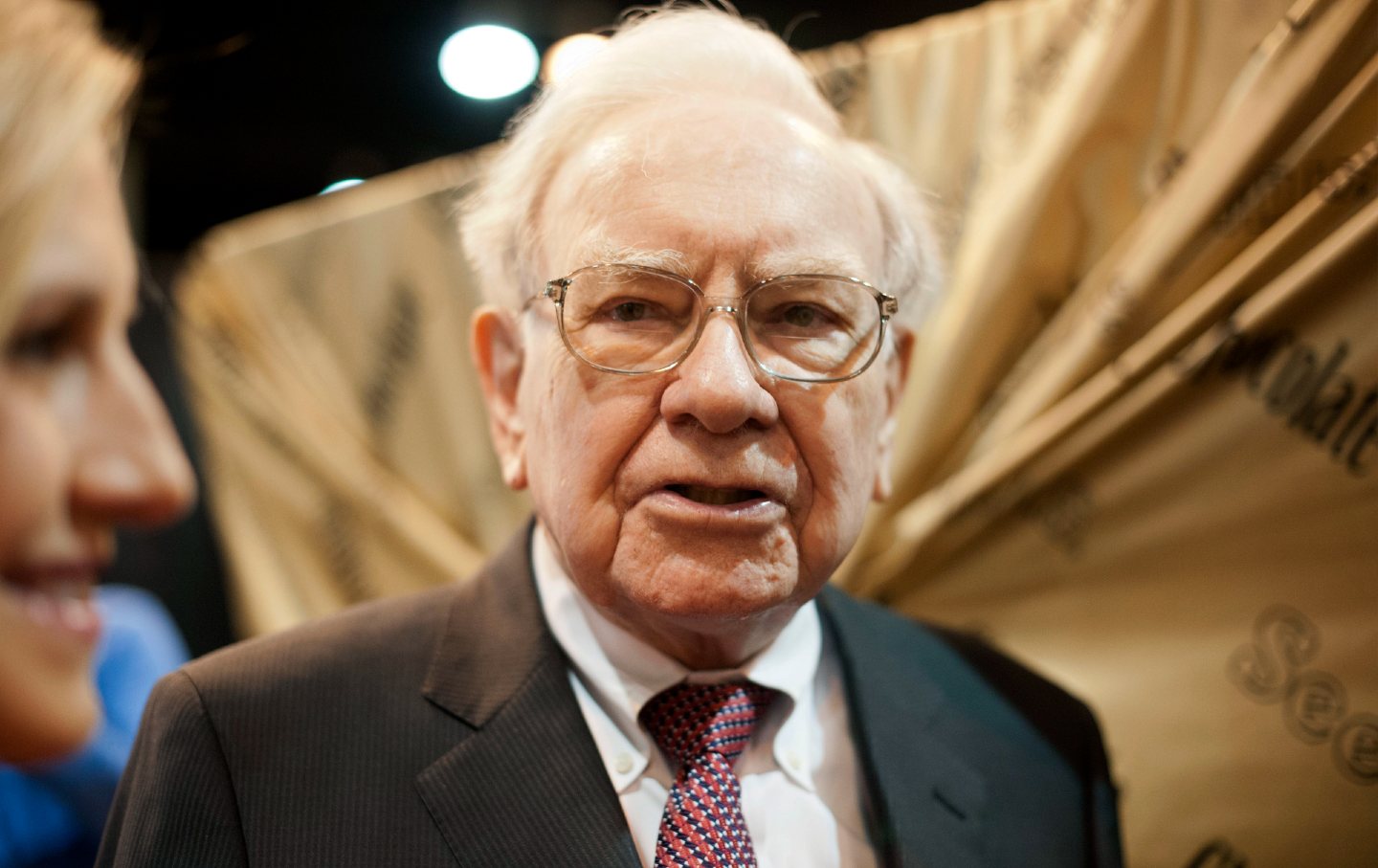
Warren Buffett, chairman of Berkshire Hathaway, tours the exhibition floor prior to the Berkshire Hathaway shareholders meeting in Omaha, Nebraska, on May 3, 2014.
(Daniel Acker / Bloomberg via Getty Images)
When legendary investor Warren Buffett recently named Greg Abel his designated successor as CEO of Berkshire Hathaway, journalists swarmed the story. Most of them reiterated Buffett’s reputation as a Wall Street “sage” and highlighted his confidence in Abel, who leads Berkshire’s energy division. Reporters noted Buffett’s criticism of President Donald Trump’s tariffs, which he called “a big mistake,” and chronicled the devoted investors who flock, cult-like, to Berkshire’s annual meeting in Omaha.
But little of that coverage mentioned that the beloved Buffett ranks as one of the world’s biggest financiers of climate change.
But Sammy Roth’s column in the Los Angeles Times confronted the matter head-on. His lede didn’t mince words: “Warren Buffett has invested tens of billions of dollars in fossil fuels, propping up some of the nation’s dirtiest coal plants as well as major oil and gas suppliers even as the climate crisis threatens human civilization.”
Drawing on his decade of covering energy news for the LA Times and, previously, The Desert Sun, Roth reported that Abel began his career as a supporter of renewable energy. But as Abel rose through the ranks at Berkshire, he shifted to backing coal, the dirtiest, most carbon-intensive conventional fossil fuel.
“Once I saw the announcement that Buffett was retiring and Abel would replace him,” Roth told Covering Climate Now, he remembered, “Hmm, Abel used to work on renewables. I think I know something here that no one else outside [Berkshire Hathaway] does.”
It’s that kind of deeply informed reporting, combined with elegant, plain-spoken prose, that have made Roth’s “Boiling Point” column required reading for anyone serious about US climate news.
Roth learned journalism as a reporter and editor at his high school and college newspapers. “It’s a lot cheaper than grad school,” he joked. He isn’t surprised that business reporters in other newsrooms missed the climate angle of the Buffett story. “Whether it’s a business, or a politics, or some other kind of story where climate is involved, the climate angle often gets left out,” he said. “It’s a huge oversight.”
To rectify it, Roth has two pieces of advice for fellow journalists: First, read more climate journalism. “You don’t have to read dense scientific reports to know enough about climate change to include a decent paragraph or two in whatever story you’re doing. Just read your colleagues.”
Second, don’t be scared of making the climate connection. “I get the sense from some colleagues [on other beats] that they’re afraid of being called an activist or getting cut off by their sources if they include climate in their stories. But I write these kinds of stories all the time, and it doesn’t cut me off from the companies. Making these kinds of connections is just part of your job as a reporter.”
Support independent journalism that does not fall in line
Even before February 28, the reasons for Donald Trump’s imploding approval rating were abundantly clear: untrammeled corruption and personal enrichment to the tune of billions of dollars during an affordability crisis, a foreign policy guided only by his own derelict sense of morality, and the deployment of a murderous campaign of occupation, detention, and deportation on American streets.
Now an undeclared, unauthorized, unpopular, and unconstitutional war of aggression against Iran has spread like wildfire through the region and into Europe. A new “forever war”—with an ever-increasing likelihood of American troops on the ground—may very well be upon us.
As we’ve seen over and over, this administration uses lies, misdirection, and attempts to flood the zone to justify its abuses of power at home and abroad. Just as Trump, Marco Rubio, and Pete Hegseth offer erratic and contradictory rationales for the attacks on Iran, the administration is also spreading the lie that the upcoming midterm elections are under threat from noncitizens on voter rolls. When these lies go unchecked, they become the basis for further authoritarian encroachment and war.
In these dark times, independent journalism is uniquely able to uncover the falsehoods that threaten our republic—and civilians around the world—and shine a bright light on the truth.
The Nation’s experienced team of writers, editors, and fact-checkers understands the scale of what we’re up against and the urgency with which we have to act. That’s why we’re publishing critical reporting and analysis of the war on Iran, ICE violence at home, new forms of voter suppression emerging in the courts, and much more.
But this journalism is possible only with your support.
This March, The Nation needs to raise $50,000 to ensure that we have the resources for reporting and analysis that sets the record straight and empowers people of conscience to organize. Will you donate today?