
The Single Most Dangerous Expansion of Fossil Fuel in the World
America’s growing exports of liquefied natural gas pose a grave climate danger.
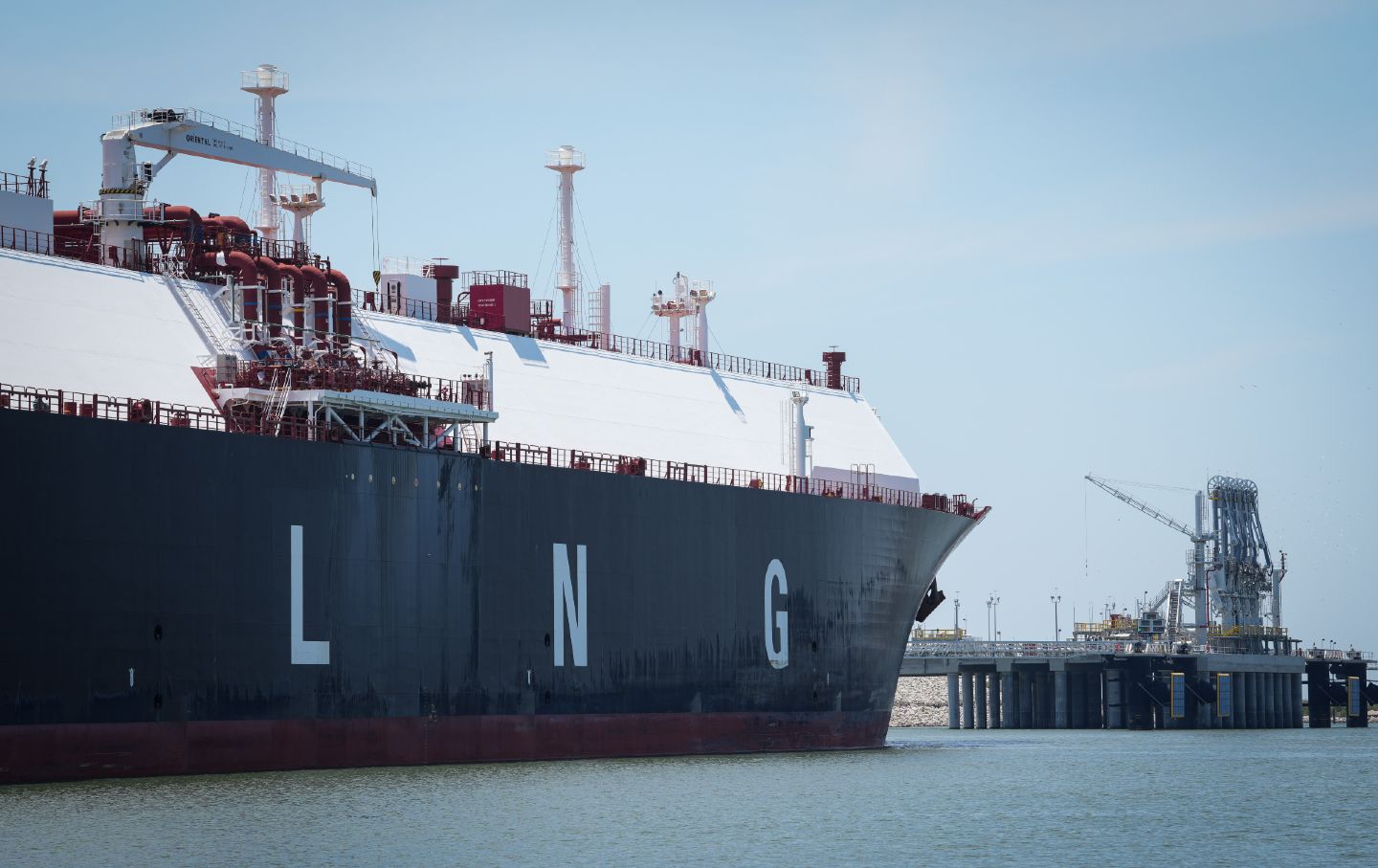
The climate crisis is going to be hard enough to solve if everyone acts in good faith; right now, a crucial arm of the federal government is deliberately using bad data to bolster the single most dangerous expansion of fossil fuel in the world.
Here’s the story. Last Tuesday, a bevy of elected officials, led by Oregon Senator Jeff Merkley, joined environmental activists like me for a press conference calling for a halt to LNG exports based in part on new research findings on methane. That may sound like a topic too arcane to interest politicians, but in fact it couldn’t be more crucial. Robert Howarth, a Cornell professor and the dean of methane science, last month released a new paper showing that America’s growing exports of liquefied natural gas represent a grave climate danger. Between the carbon released when the LNG is burned, the methane that leaks along the way, and the energy that it takes to ship it, he found that exported LNG is much worse for the climate even than burning coal—in many cases, twice as bad. This is huge news—and it builds on the superb work that frontline groups have been doing along the Gulf, from Port Arthur to Lake Charles, documenting the damage that these enormous export terminals are doing.
You’d think that would interest the Department of Energy, which is in charge of granting export licenses for LNG plants—indeed it’s licensed seven that are already up and running, certifying that they were in “the public interest” and in the process making America the largest natural gas exporter on Earth. But industry has proposed 20 more of these giant terminals; if it gets its way, in a few years America’s exports of natural gas will produce about as much greenhouse gas as everything that happens in Europe—every car and house and factory. This LNG expansion is the largest fossil fuel growth plan on planet earth. It matters more than any single other thing to our climate future.
But instead of immediately halting new approvals for export facilities, or even asking Howarth for more details, the DOE issued a statement saying, “Both [a] 2014 and 2019 analysis concluded that that the use of US LNG exports for electricity generation in European and Asian markets will not increase GHG [greenhouse gas] emissions from a life cycle perspective, when compared to regional coal extraction and consumption for electricity generation.”
To translate: Don’t bother us with new facts; we like the old ones.
But here’s what’s happened since 2014 (when even the old analysis showed that this LNG was little better than coal).
1. We’ve got a far more precise handle on methane leakage, which is Howarth’s specialty. There are now hundreds of studies showing that the gas seeps out of the process at every turn, and when it does it traps heat with extraordinary efficiency; his newest twist is examining the giant ships carrying this dangerous cargo.
2. We’ve watched the price of renewable energy plunge by 90 percent. It no longer makes sense to compare gas with coal anyway: The proper comparison is with sun and wind and batteries, which now provide the cheapest power for most of the world.
3. We’ve watched the temperature of the earth soar. It’s almost unbelievable that the DOE is sticking to its ancient science in 2023, a year when we’ve seen the highest temperatures in 125,000 years on this plant, with all the attendant destruction.
It’s especially depressing to watch DOE take this fingers-in-ears stand because, in other parts of its D.C. headquarters, officials are presiding over truly revolutionary change. They’re figuring out how to take the hundreds of billions the Inflation Reduction Act provides for clean energy, and use it to jump-start revolutions in everything from transportation to home heating. Renewables scientists and engineers are on the bleeding edge of the technology.
But on the other side of the DOE building, its staff is busy protecting the status quo, which happens to be highly profitable for the gas industry. Exxon, for instance, just purchased the biggest fracking company in the country; it’s clearly doubling down on gas production, and counting on the federal government to go on helping them.
This dereliction of duty isn’t yet President Biden’s fault; he can’t be expected to micromanage every civil servant. But it soon will be, because environmentalists across the country are finally joining with those long-standing Gulf Coast advocates to focus on this LNG export issue, launching a massive campaign that will run from social media to the streets. We know, for instance, that the next proposed plant—a mammoth export terminal called CP2 planned for the Louisiana coast—would be associated with greenhouse gas emissions 20 times larger than the Willow oil complex the president approved earlier this year. That Willow approval cost the president huge amounts of credibility with young people; a TikTok campaign had collected millions of petition signatures, which he ignored.
Popular
“swipe left below to view more authors”Swipe →Energy Secretary Jennifer Granholm can’t let the president walk into another political trap—especially since exporting LNG is not just a climate disaster but also a potent source of inflation. As even utilities have made clear, keeping that gas at home would reduce the price for Americans still dependent on it; polling makes clear that people don’t want to see America fracked only to send the gas abroad.
In fact, Granholm could set the president up for a massive political win. Thanks to the IRA, he already can take credit for doing more to advance the clean energy revolution than any president before him. If he halts new approvals for LNG export licenses, then he will be able to credibly say he has also done more to halt dirty energy than any occupant of the White House. Imagine the press conference where he’s joined by the Louisiana and Texas advocates who have been fighting these projects for years. Biden rode into office on the back of young people eager for action on climate and environmental justice; the footprint of this proposed LNG buildout is so enormous that if he stands up to it, he can deliver those backers an enormous victory. He can literally cut the fuse to the biggest climate bomb currently ticking on planet earth.
Or he can pretend we’re back in the old days of 2014 or 2019. But nostalgia is a bad look for this president in particular, at least when it comes to this most cutting-edge of issues. There’s still time to seize the future instead.
Support independent journalism that does not fall in line
Even before February 28, the reasons for Donald Trump’s imploding approval rating were abundantly clear: untrammeled corruption and personal enrichment to the tune of billions of dollars during an affordability crisis, a foreign policy guided only by his own derelict sense of morality, and the deployment of a murderous campaign of occupation, detention, and deportation on American streets.
Now an undeclared, unauthorized, unpopular, and unconstitutional war of aggression against Iran has spread like wildfire through the region and into Europe. A new “forever war”—with an ever-increasing likelihood of American troops on the ground—may very well be upon us.
As we’ve seen over and over, this administration uses lies, misdirection, and attempts to flood the zone to justify its abuses of power at home and abroad. Just as Trump, Marco Rubio, and Pete Hegseth offer erratic and contradictory rationales for the attacks on Iran, the administration is also spreading the lie that the upcoming midterm elections are under threat from noncitizens on voter rolls. When these lies go unchecked, they become the basis for further authoritarian encroachment and war.
In these dark times, independent journalism is uniquely able to uncover the falsehoods that threaten our republic—and civilians around the world—and shine a bright light on the truth.
The Nation’s experienced team of writers, editors, and fact-checkers understands the scale of what we’re up against and the urgency with which we have to act. That’s why we’re publishing critical reporting and analysis of the war on Iran, ICE violence at home, new forms of voter suppression emerging in the courts, and much more.
But this journalism is possible only with your support.
This March, The Nation needs to raise $50,000 to ensure that we have the resources for reporting and analysis that sets the record straight and empowers people of conscience to organize. Will you donate today?
More from The Nation
The Silencing Power of Big Oil’s Climate Lies The Silencing Power of Big Oil’s Climate Lies
A new report suggests that the majority of people think new economic rules are required to curb climate change. The issue is that those majorities think they are a minority.

Why Climate Activists Are Protesting Their Favorite Sports Teams Why Climate Activists Are Protesting Their Favorite Sports Teams
Climate change is rendering the future of many sports more dangerous or impossible. But many teams are still taking fossil fuel dollars.
Russ Feingold’s New Mission: Preserving Nature to Save the Planet Russ Feingold’s New Mission: Preserving Nature to Save the Planet
The former senator has given up campaigning for office to campaign for the natural world.
Fortress America Is Now Our Main Climate Policy Fortress America Is Now Our Main Climate Policy
The US spends trillions not to prevent climate catastrophe but to crack down on climate refugees and prepare for climate conflicts.
Rep. Summer Lee: The Fight for Environmental Justice Is Far From Over Rep. Summer Lee: The Fight for Environmental Justice Is Far From Over
The Trump administration’s destructive environmental policies will cost us all. But we must not give up.
A World on Fire Needs More Climate Reporting—Not Less A World on Fire Needs More Climate Reporting—Not Less
War is a climate story, but billionaire media owners don’t want to tell it.

