Can Solar Energy Save Us?
Bill McKibben’s new book argues that sun power can displace fossil fuels.
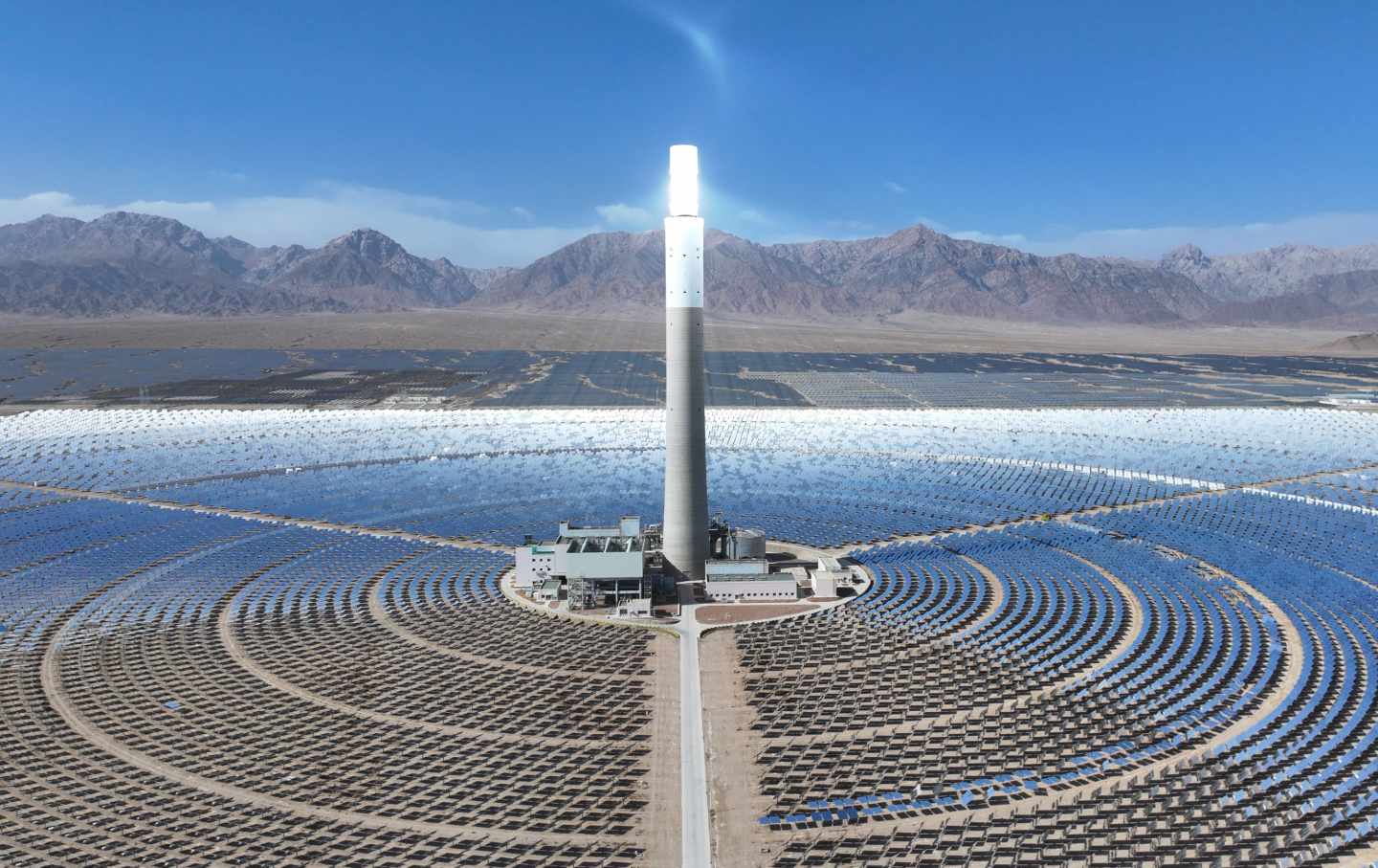
An aerial view of the CGN Delingha Solar Thermal Plant, a 50 megawatt energy storage project, on April 15, 2025 in Qinghai province, China.
(Ma Mingyan/China News Service / VCG via Getty Images)
No journalist has covered the climate story longer or better than Bill McKibben. In 1989, as a 27-year-old staff writer at The New Yorker, he published the first mass-market book on the subject, The End of Nature. Since then, he has reported from around the world, covering all aspects of the issue—science, economics, politics, ethics—with an output other writers can’t help but envy. He has done his share of calling out the fossil fuel chieftains and their government and financial enablers, but he has also paid special attention to the scientists, activists, and other civil society representatives pushing against climate breakdown.
Indeed, almost 20 years ago, McKibben did something traditional journalists frown upon: He became an activist himself. With some of his students at Middlebury College in Vermont, he formed 350.org, a group named after the atmospheric level of carbon dioxide known to be compatible with civilization as we know it. When 350.org was founded in 2008, Earth’s atmosphere contained 385 parts per million of CO2. Today, it’s 427 ppm—the highest in at least 3 million years—and rising fast.
In his new book, Here Comes the Sun, McKibben wears both his journalist and activist hats. His core argument is that the sun’s rays, transformed into electricity, might still help humanity to escape the worst of climate change. It won’t be easy, but shifting from fossil fuels to solar energy fast enough “to stay on anything like a survivable path” is “on the bleeding edge of the technically possible.”
That path, scientists have said, requires slashing emissions by half over the next five years. That could happen, McKibben suggests, because of a game-changing but underappreciated economic development. “Sometime in the early part of the 2020s,” he writes, civilization “crossed an invisible line where the cost of producing energy from the sun dropped below the cost of fossil fuel. That’s not yet common knowledge”—mainly because “so much of [the solar revolution] is taking place in China”—but it makes a rapid, global phase out of fossil fuels not just technically possible but economically advantageous.
But if economics now favor solar, politics remain a towering challenge. The entrenched interests behind fossil fuels intend to burn “every last molecule of oil and gas” beneath the earth’s crust, Vicki Hollub, the CEO of Occidental Petroleum, said in 2024. So, citizen activism, McKibben adds, remains imperative.
All this and more makes Here Comes the Sun an essential read for anyone interested in where the climate story is heading. McKibben’s reporting is thorough and thought-provoking. He investigates a number of concerns about solar—are there enough raw materials and land to produce all the panels and electricity needed?—and concludes that such concerns are overstated. (More solar will indeed mean more mining for lithium and other minerals, he notes, but it will also put a halt to the vastly greater amount of mining for coal, gas, and oil.)
For journalists, Here Comes the Sun proffers a cornucopia of story ideas and a bracing re-evaluation of the future of the climate fight. It refutes the notion that society can’t afford to stop burning fossil fuels, while emphasizing that the decisive question is how quickly those fuels get left behind. “I have little doubt we will run the world on sun and wind 40 years from now,” McKibben writes, “but if it takes us anything like 40 years to get there, then it will be a broken planet; our energy sources will hardly matter.”
Support independent journalism that does not fall in line
Even before February 28, the reasons for Donald Trump’s imploding approval rating were abundantly clear: untrammeled corruption and personal enrichment to the tune of billions of dollars during an affordability crisis, a foreign policy guided only by his own derelict sense of morality, and the deployment of a murderous campaign of occupation, detention, and deportation on American streets.
Now an undeclared, unauthorized, unpopular, and unconstitutional war of aggression against Iran has spread like wildfire through the region and into Europe. A new “forever war”—with an ever-increasing likelihood of American troops on the ground—may very well be upon us.
As we’ve seen over and over, this administration uses lies, misdirection, and attempts to flood the zone to justify its abuses of power at home and abroad. Just as Trump, Marco Rubio, and Pete Hegseth offer erratic and contradictory rationales for the attacks on Iran, the administration is also spreading the lie that the upcoming midterm elections are under threat from noncitizens on voter rolls. When these lies go unchecked, they become the basis for further authoritarian encroachment and war.
In these dark times, independent journalism is uniquely able to uncover the falsehoods that threaten our republic—and civilians around the world—and shine a bright light on the truth.
The Nation’s experienced team of writers, editors, and fact-checkers understands the scale of what we’re up against and the urgency with which we have to act. That’s why we’re publishing critical reporting and analysis of the war on Iran, ICE violence at home, new forms of voter suppression emerging in the courts, and much more.
But this journalism is possible only with your support.
This March, The Nation needs to raise $50,000 to ensure that we have the resources for reporting and analysis that sets the record straight and empowers people of conscience to organize. Will you donate today?