The False Promise of Nuclear Power
A new book by Joe Romm explains why nuclear is not much of a climate solution.
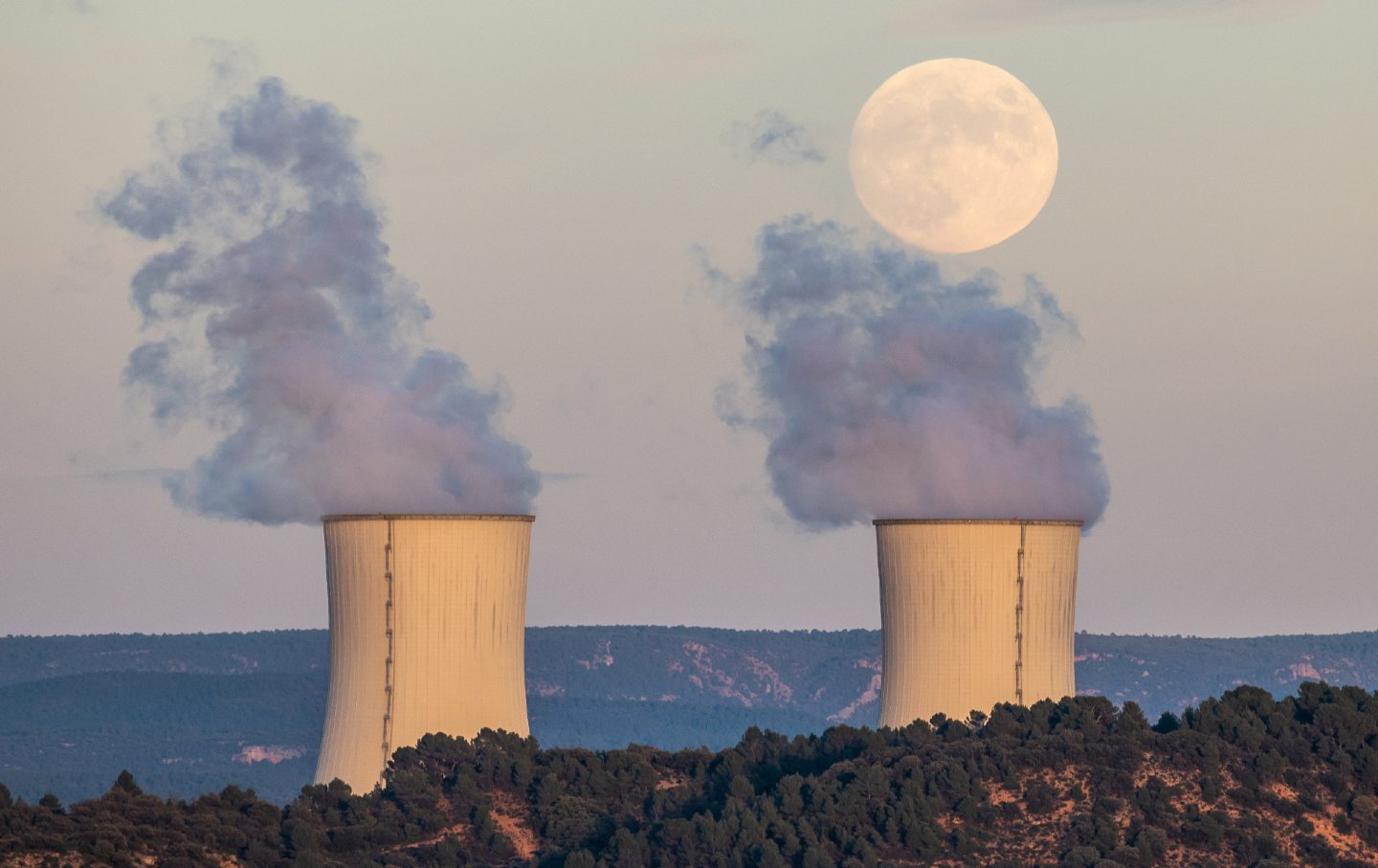
A dollar invested in renewables delivers much more carbon-free electricity than a dollar invested in nuclear, writes Mark Hertsgaard.
(Marcos del Mazo / LightRocket via Getty Images)
Donald Trump often disparages former President Joe Biden’s climate and energy policies, but last week demonstrated that Trump and Biden agree on something unexpected: nuclear power.
Biden’s Inflation Reduction Act boosted nuclear power, which Biden framed as a climate solution because splitting atoms doesn’t release planet-warming gases like burning coal does. Trump, for his part, likes nuclear for economic reasons. Last week, he signed four executive orders “aimed at accelerating the construction of nuclear power plants in the United States,” Brad Plumer reported in The New York Times, which, one order said, would “generate American-led prosperity.”
For journalists and others tracking the issue, Trump’s nuclear plans are a major story studded with political, local, and economic angles.
Politically, nuclear power enjoys bipartisan support in Congress, where Republicans are trying to pass a sprawling budget bill that rescinds nearly all of the IRA’s clean energy subsidies but provides tax breaks for nuclear.
Locally, Trump’s stated goal of quadrupling how much electricity the United States gets from nuclear power would require building hundreds of nuclear plants. That implies that each of the country’s 50 states would host at least one plant, and some states even more. Reporters can ask residents, government officials, and business leaders what they think about that scenario, amid lingering safety concerns about nuclear power.
But journalists equally need to focus on economics. A new book explains why it is above all economics, not safety, that undercuts nuclear as a climate solution. The Hype About Hydrogen, by former US Department of Energy official Joe Romm, describes nuclear and hydrogen energy as “false solutions” to the climate crisis.
The only two nuclear plants built in the United States this century—the Vogte reactors in Georgia—suffered construction delays that ballooned the cost to a staggering $35 billion, Romm notes. That translates to $15 million per megawatt of produced electricity—“vastly higher” than the electricity that solar and wind produce, Romm told Covering Climate Now. And the small, modular reactors Bill Gates and others have championed turn out to be even more expensive, Romm added. These price differentials mean that a dollar invested in renewables delivers much more carbon-free electricity—and greenhouse gas emissions cuts—than a dollar invested in nuclear.
Crucially, renewables also deliver those cuts much sooner. The main reason nuclear is so expensive (despite receiving much larger subsidies than renewables have throughout the decades since the nuclear industry’s creation in the 1950s) is that it takes at least a decade to get a nuclear plant up and running. That long lead time imposes massive capital borrowing costs that make any “nuclear renaissance…from certain,” the Financial Times reported.
Nuclear power’s long lead times are ultimately what disqualify it as a climate solution. Scientists emphasize that to avoid catastrophic impacts, humanity must slash greenhouse gas emissions starting now, not a decade from now. To prioritize nuclear—or hydrogen, for that matter—when renewables displace fossil fuels much cheaper and faster, Romm writes, “is unlikely to be a practical, affordable, or scalable strategy.”
Become a Sustaining Donor This September
Between the reemergence of right-wing red-baiting and Donald Trump’s use of the chilling National Security Presidential Memorandum–7 to criminalize left political organizing, we’re seeing McCarthyism reborn before our eyes.
This assault on democracy cannot be ignored or wished away. Resisting it requires bravery in the face of threats and repression, a steadfast commitment to the truth, and the unwavering belief that we can—and will—overcome this darkness.
We must have an independent media that sets the record straight, unearths corruption and abuses of power, and advances a politics of justice and dignity for all if we’re to win this fight.
That’s why I’m writing to you today. This September, The Nation needs to add 100 monthly donors to sustain our progressive journalism. Your contribution makes the next investigative report, the next truth-speaking column, and the next pathbreaking essay all possible.
I hope you’ll support our work with a recurring donation today. If you donate $10 or more a month, we’ll send you a brand new “Hands Off the Free Press!” sticker to recognise your commitment to our cause. Please, donate today.
Onward,
Katrina vanden Heuvel
Editor and Publisher, The Nation