The Climate Costs of War
Scientific analyses show that the Ukraine and Middle East wars have unleashed staggering amounts of planet-warming emissions.
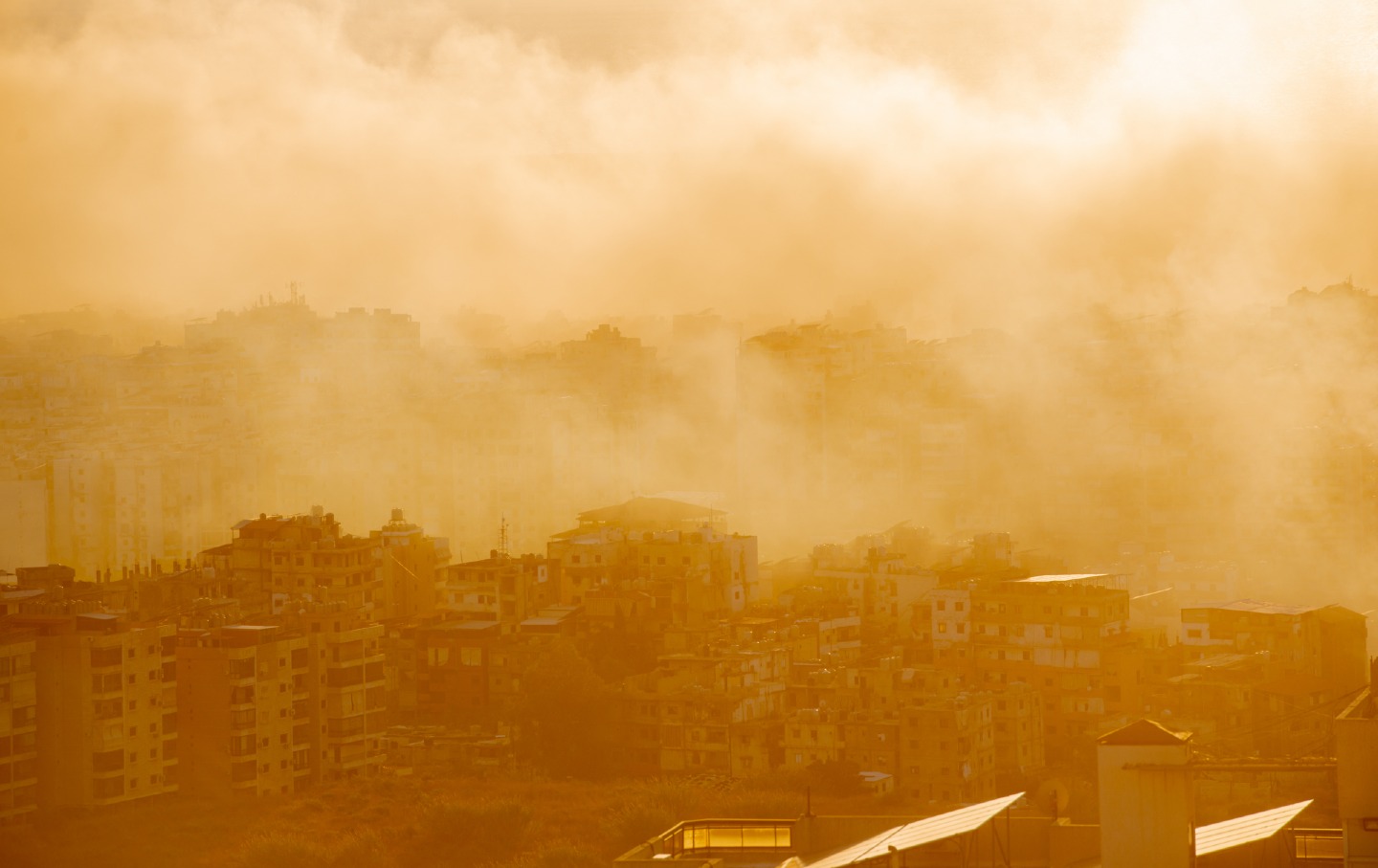
Smoke fumes cover a neighborhood in Beirut following an Israeli air strike on October 19, 2024.
(adel Itan / Middle East Images / AFP via Getty Images)On the ground, “more than 50,000 children have reportedly been killed or injured since October 2023” in Gaza alone, UNICEF lamented last month. In Ukraine, more than 42,000 civilians have been killed or wounded, the UN Human Rights Commission reported. Countless more people are threatened by this week’s air strikes between Israel and Iran, not to mention last month’s hostilities between India and Pakistan.
Brave journalists on the ground risk their lives to tell the outside world what’s happening in these war zones. Less common is to tell the world what modern wars do to the sky—not only the sky over the war zones but the sky all people everywhere share.
Scientific analyses have consistently concluded that military operations in general—transporting troops, testing weapons, maintaining bases (the United States has more than 700 worldwide)—and modern war in particular are the most carbon-intensive activities on Earth. The gargantuan amounts of oil and other fossil fuels used to fly planes, launch missiles, drive tanks, propel ships, and power supply vehicles emit staggering amounts of planet-warming carbon dioxide.
That’s partly because the fuel efficiency of most war equipment is vanishingly small. “We’re talking gallons per mile, not miles per gallon,” Neta C. Crawford, a professor at the University of Oxford and author of The Pentagon, Climate Change, and War, told a Covering Climate Now press briefing last year. Emissions also spike when adversaries attack one another’s fossil-fuel infrastructure, as Israel, Iran, Russia, and Ukraine have reportedly done.
Routine military operations—separate from war fighting—account for an estimated 5.5 percent of the world’s annual CO2 emissions. “If the world’s militaries were a country, this figure would represent the fourth largest national carbon footprint in the world—higher than Russia,” Nina Lakhani reported in The Guardian. The 5.5 percent figure is only an estimate, Crawford told Lakhani, because a loophole the United States inserted into the Kyoto Protocol in 1997 exempts all militaries from disclosing their emissions—meaning the world’s total emissions are significantly higher than officially recognized.
A growing body of research by independent scholars is filling in the blanks, enabling journalists to report war’s long-term climate costs as well as its immediate human costs.
“The carbon footprint of the first 15 months of Israel’s war on Gaza will be greater than the annual planet-warming emissions of a hundred individual countries,” Lakhani wrote, summarizing one recent study. A separate study found that the war in Ukraine has a carbon footprint seven times larger—230 million tons of CO2 equivalent, Manuel Planelles reported in El País, just short of the 270 million tons that all of Spain emitted in 2023.
As casualties continue to mount, journalists unfortunately will have plenty of opportunities to make the climate connection to the wars in Ukraine and the Middle East. Meanwhile, climate-driven weather disasters are growing more frequent and severe around the world even as some governments are boosting military spending. “Emissions go up in step with military spending,” Crawford notes, “and this is exactly the wrong time to be doing this.”
Support independent journalism that does not fall in line
Even before February 28, the reasons for Donald Trump’s imploding approval rating were abundantly clear: untrammeled corruption and personal enrichment to the tune of billions of dollars during an affordability crisis, a foreign policy guided only by his own derelict sense of morality, and the deployment of a murderous campaign of occupation, detention, and deportation on American streets.
Now an undeclared, unauthorized, unpopular, and unconstitutional war of aggression against Iran has spread like wildfire through the region and into Europe. A new “forever war”—with an ever-increasing likelihood of American troops on the ground—may very well be upon us.
As we’ve seen over and over, this administration uses lies, misdirection, and attempts to flood the zone to justify its abuses of power at home and abroad. Just as Trump, Marco Rubio, and Pete Hegseth offer erratic and contradictory rationales for the attacks on Iran, the administration is also spreading the lie that the upcoming midterm elections are under threat from noncitizens on voter rolls. When these lies go unchecked, they become the basis for further authoritarian encroachment and war.
In these dark times, independent journalism is uniquely able to uncover the falsehoods that threaten our republic—and civilians around the world—and shine a bright light on the truth.
The Nation’s experienced team of writers, editors, and fact-checkers understands the scale of what we’re up against and the urgency with which we have to act. That’s why we’re publishing critical reporting and analysis of the war on Iran, ICE violence at home, new forms of voter suppression emerging in the courts, and much more.
But this journalism is possible only with your support.
This March, The Nation needs to raise $50,000 to ensure that we have the resources for reporting and analysis that sets the record straight and empowers people of conscience to organize. Will you donate today?