AI Is Going to Kill Everyone You Love. The Surprise Is How.
It’s not hostile super robots you should worry about—it’s the heat they’ll generate.
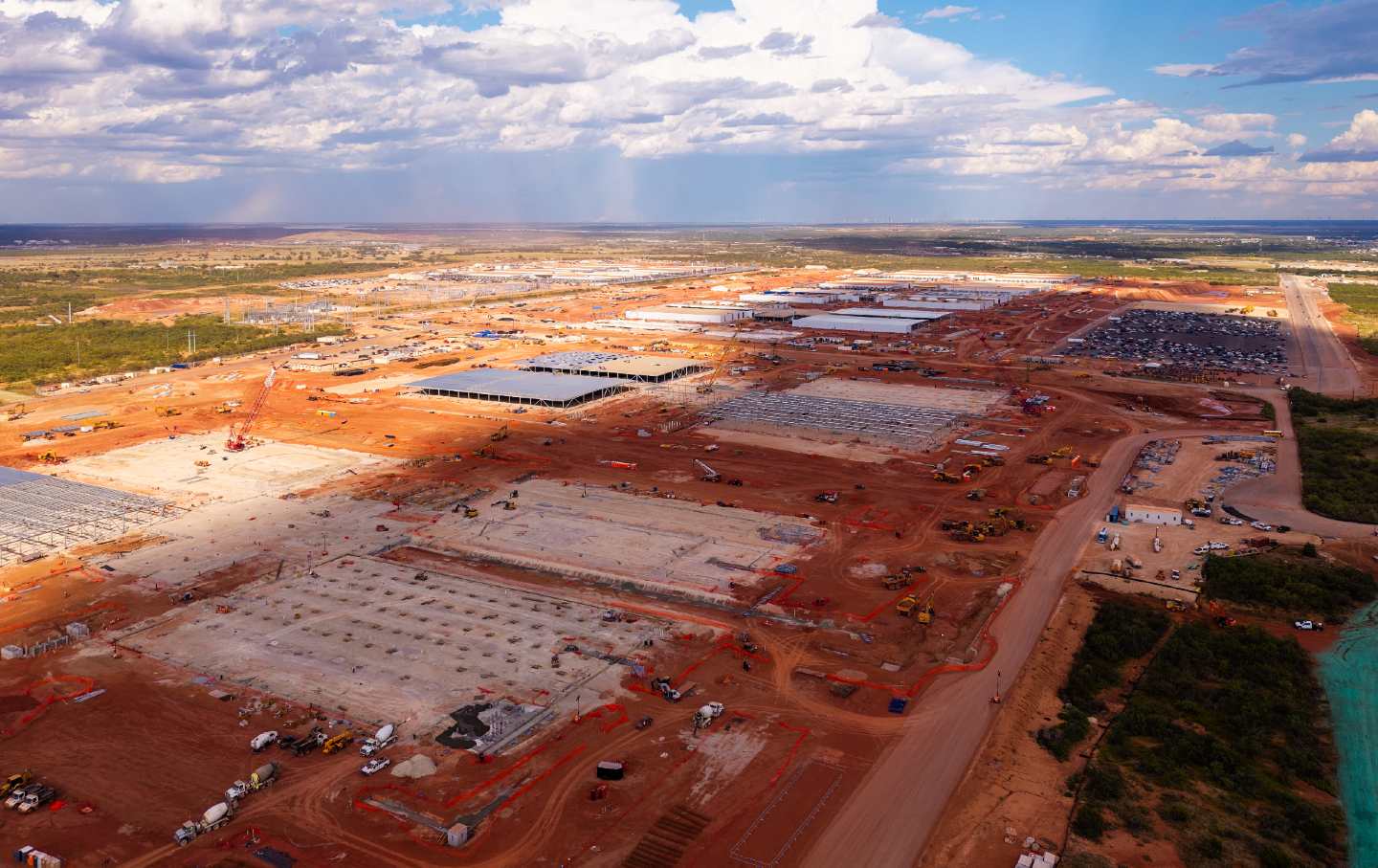
The Stargate AI data center under construction in Abilene, Texas, on September 23, 2025.
(Kyle Grillot / Bloomberg via Getty Images)
Under the baking heat of a Louisiana sun, our killers are slowly rising from the leveled earth, humming darkly. Here, in Richland Parish, Meta is constructing a data center so large Mark Zuckerberg says the footprint would cover Manhattan from Harlem to Union Square. The behemoth will suck up 2.3 gigawatts of power—twice what New Orleans uses on its hottest days. And to keep it running, the utility company Entergy is building three new gas plants, its first new ones in decades.
The same story is unfolding across the country: more AI begetting more gas and oil. In the United States, power demand is growing for the first time in over a decade. Trump even wants to bring back coal, all to air-condition data centers: those vast banks of whirring, dark, liquid-cooled processing units. Big oil is giddy. Op-eds in Fortune advise us not to divest from fossil-fuel companies, since the large language models we call “artificial intelligence” will be “forcing a reassessment of the clean energy transition.” And yet we are ever reassured: Recent reporting from The Washington Post suggested that individual “AI” queries really only use negligible amounts of power.
But those statistics are misleading (notably, the columnist offering them worked with Planet FWD, a company that offers “AI-powered lifecycle carbon assessments”). For one, it leaves AI-generated videos, which are highly energy-intensive, out of the comparison. But it’s no surprise to see this downplayed by a publication whose owner, Jeff Bezos, is up to his neck in AI-data-center investments.
Instead, we are put at ease: AI will solve the climate crisis. For now it requires oodles of dirty energy and billions in resources, but it will eventually revolutionize society for the better, even if Big Tech can’t exactly explain how. Big Tech’s near-term promises are a little less exciting: putting Marilyn Monroe on a CGI dragon or ChatGPT’s foray into porn. We hear ill-defined terms like “superhuman” and “superintelligence” that anthropomorphize the algorithms, even as study after study warns that the use of these tools erodes our own cognitive and writing abilities.
We are told, repeatedly, that we need to generate more electricity for this revolution. But it may well be the other way around: Data centers are an excuse to squeeze a few more years of fossil-fuel profits from an exhausted planet. Just as renewables seemed on track to gain permanent ground, AI arrived, and as a result, says the gleeful CEO of the American Petroleum Institute, there’s now a “political imperative” to fast-track new gas-fired power. It’s no coincidence. There will always be another excuse. In fact, just a few years ago, the excuse was Ukraine.
When Russia invaded Ukraine in 2022, Europe stopped importing Russian-piped gas. This caused something of a panic: Germany was going to run out of power! Berlin would freeze to death! Fortunately, the United States would save the day by building massive, Death Star-sized liquid natural gas (LNG) terminals across the Gulf Coast.
Fast-forward and Berlin never froze to death, but now LNG terminals are crushing Louisiana coastal communities, and the United States has gone from exporting zero LNG to becoming the largest exporter on earth. Even as Germany shifts toward sustainable energy, the damage has been done: It is locked into LNG import contracts and will transship the gas to countries in Southeast Asia. Just as it became clear there would be no gas shortages requiring US LNG—presto, power-hungry data centers began to multiply.
Today, Entergy builds its gas plants; Elon Musk’s xAI has spun up dozens of unpermitted gas turbines in Memphis; OpenAI is planning Stargate in Texas, with 10 data centers that could each demand more power than the state of New Hampshire. Big Tech’s vision of the future is orderly, grandiose, and largely free of the messiness of human need: “I do guess a lot of the world gets covered in data centers over time,” Sam Altman recently mused on a right-wing podcast.
This vision benefits fossil-fuel companies because in the world of data centers, speed and reliability are key. Solar and wind would require massive battery capacity to supply enough nonstop energy—which can be expensive—and a lot of land area. Gas plants are relatively quick to build, and enjoy subsidies from the Trump administration. As a result, gas, not renewables, has become the go-to power source for AI slop-bots and Grok’s white supremacy posts. And that means the electricity used by data centers is dirty—about 48 percent more carbon-intensive than the US average. Even if promises of future efficiency come through, it’ll be too late: Once these plants are built, there’s no going back. The three gas plants that’ll power Meta’s AI data center in Louisiana are built to operate for 30 years. By the time the plants are retired, most of Miami-Dade County will already be submerged by rising seas.
Each new piece of infrastructure locks us in for decades of emissions, at a time when—the science is overwhelmingly clear—we cannot go on building fossil-fuel infrastructure and have a livable planet. The threat, in Louisiana, is not abstract. It is immediate.
My neighbors die of heat. My city is shrinking as homes become uninsurable, as the sea rises ever faster. Back-to-back monster hurricanes make recovery exhausting, impossible, and cause some coastal communities to shrink to almost nothing. Whole barrier islands that I once planned to visit no longer exist.
But the AI overlords tell us with a straight face that their products, which cannot draw an accurate map of the United States, will somehow solve this crisis, if only we let them make it worse first.
The danger of AI is not that it will achieve consciousness and hit the big red button. The end is much less flashy, far more stupid: The resource-intensive advertisement tools of AI will increasingly overtax the grid, leaving us to cook alive in sweltering darkness. The AI hype is part of a larger, false narrative justifying fossil fuel expansion. Let’s not get fooled.
Support independent journalism that does not fall in line
Even before February 28, the reasons for Donald Trump’s imploding approval rating were abundantly clear: untrammeled corruption and personal enrichment to the tune of billions of dollars during an affordability crisis, a foreign policy guided only by his own derelict sense of morality, and the deployment of a murderous campaign of occupation, detention, and deportation on American streets.
Now an undeclared, unauthorized, unpopular, and unconstitutional war of aggression against Iran has spread like wildfire through the region and into Europe. A new “forever war”—with an ever-increasing likelihood of American troops on the ground—may very well be upon us.
As we’ve seen over and over, this administration uses lies, misdirection, and attempts to flood the zone to justify its abuses of power at home and abroad. Just as Trump, Marco Rubio, and Pete Hegseth offer erratic and contradictory rationales for the attacks on Iran, the administration is also spreading the lie that the upcoming midterm elections are under threat from noncitizens on voter rolls. When these lies go unchecked, they become the basis for further authoritarian encroachment and war.
In these dark times, independent journalism is uniquely able to uncover the falsehoods that threaten our republic—and civilians around the world—and shine a bright light on the truth.
The Nation’s experienced team of writers, editors, and fact-checkers understands the scale of what we’re up against and the urgency with which we have to act. That’s why we’re publishing critical reporting and analysis of the war on Iran, ICE violence at home, new forms of voter suppression emerging in the courts, and much more.
But this journalism is possible only with your support.
This March, The Nation needs to raise $50,000 to ensure that we have the resources for reporting and analysis that sets the record straight and empowers people of conscience to organize. Will you donate today?