
The Political Economy of Trumpism
Though he started by threatening Mexico, Canada, and China, Trump’s tariffs mean the US will drain Europe as Ukraine fades.
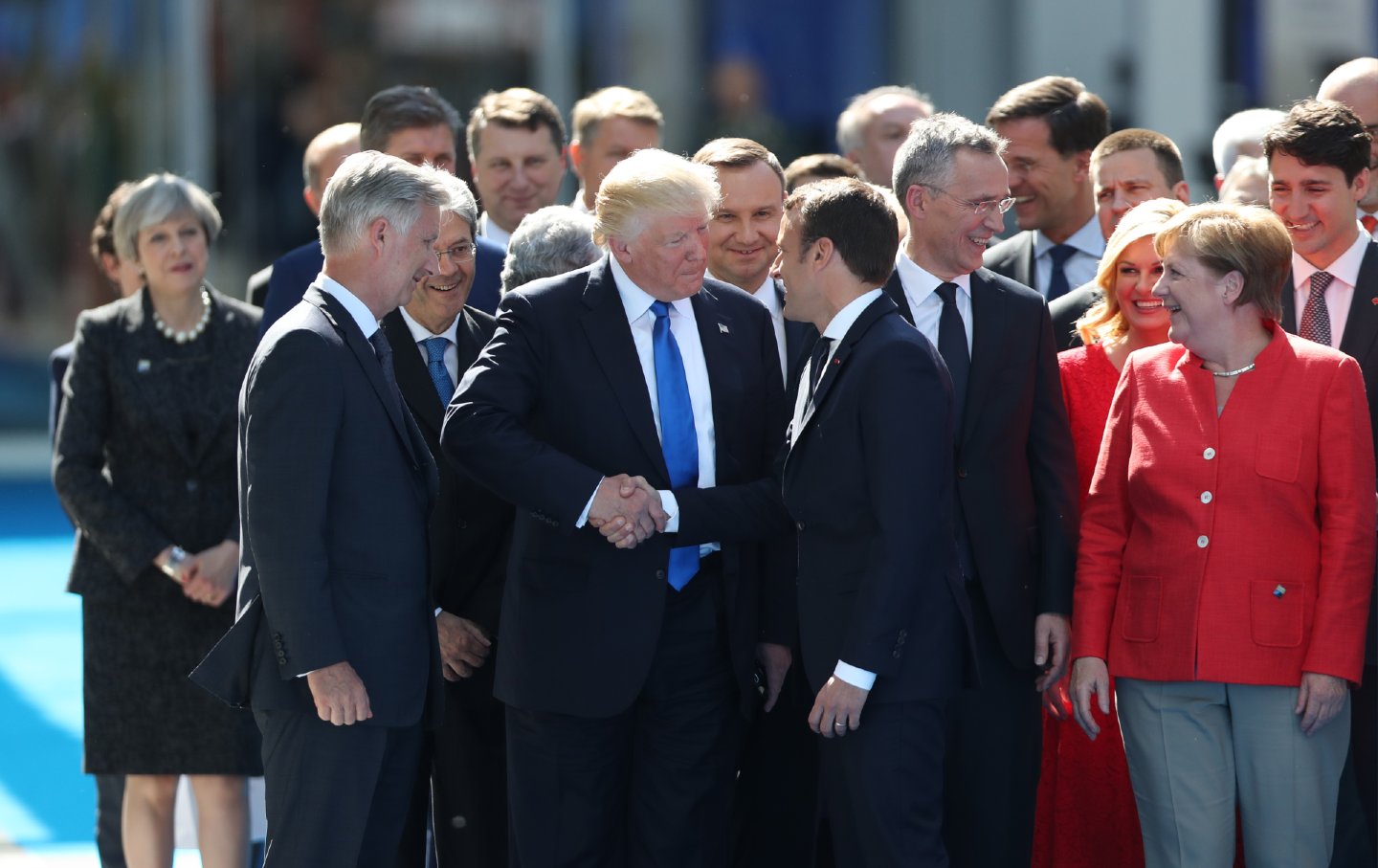
Last fall, Donald Trump threatened to impose stiff new tariffs on Mexico, Canada, and China. Recently he added the European Union to the target list, unless its member nations “make up their tremendous deficit with the United States by the large scale purchase of our oil and gas.”
What, exactly, do all these impending tariffs portend?
Economists tend to evaluate tariffs as good or (mostly) bad according to general precepts of economic theory. But as Trump definitely understands, in the real world they also serve political goals.
With regard to Mexico and Canada, Trump’s political motives are fairly transparent. He wants to compel Mexican President Claudia Sheinbaum to seal the border, block migrants from heading north, and accept deportees from the United States—including many who will not be Mexicans. She may well agree to some version of this. As for Canada, one evident goal was to humiliate and destroy Prime Minister Justin Trudeau. That mission is now moot, but the threat of tariffs will hang over Trudeau’s successors—rubbing Canadian noses in Trump’s point that Canada is no longer an independent country, in any important sense of the word.
And if the tariffs on Mexico and Canada apply to hydrocarbons—a major import from both countries—that will spur drilling in the Permian Basin of the southwestern United States, boosting prices and profits and thus helping to fulfill the third part of Trump Treasury secretary pick Scott Bessent’s “3-3-3” plan by increasing domestic energy production. (The other parts are faster GDP growth and reduced budget deficits, both of which could conceivably also be aided by energy tariffs.)
In the case of China, however, new tariffs can’t do very much. China has a vast economy, and its exports are competitive throughout the world; the days when it was dependent on the US market are past. President Xi Jinping could, if he chose to, offset new tariffs by devaluing the renminbi, but he will (probably) not let currency devaluation go too far, to avoid triggering a destabilizing rise in speculative capital movements and higher prices for imported food and fuel. More likely, China will shift—even further—toward non-US markets, and the United States will increase its imports from Vietnam, Bangladesh, Thailand, Indonesia, the Philippines, and other Asian nations. US consumers will lose out mainly by being deprived of Chinese products they’ve never seen, such as BYD electric cars (which are already selling in Mexico for about $21,000) and Huawei phones. On more consequential matters, like the competition over control of the world semiconductor supply chain, there is the small fact that China—not the US—holds high cards called gallium, germanium, antimony, cobalt, and many other essential minerals.
Yet tariffs against China will surely be raised—not because they will be successful, but because US politics will demand it. Washington’s China hawks will be happy, and China’s march to the front ranks of world technology and industry will continue. This is what is sometimes called a “win-win”—a propaganda win for America and an economic win for China.
The linchpin of Trump’s tariff policy, however, is not Mexico, Canada, or China, but Europe. A tariff wall, combined with the United States’ cheap and reliable domestic energy, lower interest rates, low union density, steady economic growth, and a strong research and development base, will draw Europe’s industrial corporations—especially those based in Germany—to build new factories here, even as they shrink their operations in their now-unprofitable homelands. Gradually, their own supply chains will also shift—especially for Italian producers tied to Germany—to North America. This process is already underway; the Trump-Bessent policies, taken as a whole, seem tailor-made to speed up the process.
What will happen next for Europe as Russia continues to advance in Ukraine? Trump seems to be adjusting his once-confident view that he can freeze the war and end the fighting in a day. He probably already knows that sanctions have failed. He may realize soon enough that Moscow is undeterred by threats and bluffs. Given the enormous stockpile of nuclear weapons on both sides, it would be suicidal for the United States to resort to the nuclear option—and one can only hope that Trump also understands this.
It follows then that given the imbalance of resources and territory between Russia and Ukraine, the war in Ukraine will end, sooner or later, in a victory for Russia regardless of what Trump does. Will Vladimir Putin then go on to threaten, or attack, any NATO country? Short answer: Definitely not. Trump and his team may grasp that Russia’s interests stop at NATO’s borders—indeed, that Russia’s interest in Europe is by now no greater than our own.
What would the defeat of Ukraine mean for the United States? Economically, almost nothing. The main cost of reconstruction will fall on Russia in the territories it has annexed, which is where the war was largely fought and the damage is the greatest. The western part of Ukraine, unoccupied but defeated, will become a problem for its neighbors, especially Poland. Refugees will mostly go to Europe—and to Russia, where many have already gone. Military contractors will lose a market, but they have many others. It seems unlikely that any of these prospects bother Trump very much.
If Europe and the United Kingdom sink into recession, social disorder, poverty, and crises of demography and migration, including from Ukraine, what is that to Trump—or to his America First advisers? This decline is already underway. Europe has few natural resources—and not much technical superiority worth working to preserve. Besides, the British and French empires disappeared long ago, and what remains of French influence in Africa is unraveling now. Moreover, if London declines as a financial center, New York will gain. If Airbus fails, Boeing will have a chance to recover. If the euro collapses, the dollar will strengthen even more. As Germany’s Energiewende (energy transition) disintegrates, the market for US natural gas will increase—as Trump is demanding that it should—just to keep the lights on and homes from freezing.
Popular
“swipe left below to view more authors”Swipe →Looking ahead and putting the pieces together, what could a US grand strategy under Trump look like? First, perhaps, it will aim to consolidate Israel’s recent gains after the fall of Assad in Syria, weakening Iran as much as possible, ignoring the plight of the Palestinians, and strengthening the US position in the Persian Gulf. If Iran falls—possible, although unlikely—then Russia would lose an ally and China would take a hit on its energy supplies and costs. Second, such a strategy would seek to secure the “Indo-Pacific” ring around China, building trade and military relations and agitating to keep China preoccupied with Taiwan, Xinjiang, and other nearby troubles in order to curtail Beijing’s reach into the Western and Southern hemispheres. Third, it would actively contest Russian and Chinese influence in Africa and Latin America while squeezing Venezuela and Cuba hard, in the hope that those regimes might finally collapse. A breakthrough in any of these sectors would count as a big victory—offsetting the hard knock on Ukraine.
And so, as the war in Ukraine winds down, the geopolitical chessboard will shift to Asia, the Middle East, and the rest of the world. NATO has little use outside of Europe—and Trump seems to have little use for Europe. It was Joe Biden who tried to restore America’s role as the leader of its “traditional allies” and “fellow democracies.” Does Trump care? In an interview with NBC on December 6, he clearly indicated that he does not. Why not let the Europeans handle the Ukraine debacle themselves if they can?
Trump’s proposed tariffs show that he sees Europe, first and foremost, as a mark to be drained for American profit. And—from his point of view—he’s not wrong.
Support independent journalism that does not fall in line
Even before February 28, the reasons for Donald Trump’s imploding approval rating were abundantly clear: untrammeled corruption and personal enrichment to the tune of billions of dollars during an affordability crisis, a foreign policy guided only by his own derelict sense of morality, and the deployment of a murderous campaign of occupation, detention, and deportation on American streets.
Now an undeclared, unauthorized, unpopular, and unconstitutional war of aggression against Iran has spread like wildfire through the region and into Europe. A new “forever war”—with an ever-increasing likelihood of American troops on the ground—may very well be upon us.
As we’ve seen over and over, this administration uses lies, misdirection, and attempts to flood the zone to justify its abuses of power at home and abroad. Just as Trump, Marco Rubio, and Pete Hegseth offer erratic and contradictory rationales for the attacks on Iran, the administration is also spreading the lie that the upcoming midterm elections are under threat from noncitizens on voter rolls. When these lies go unchecked, they become the basis for further authoritarian encroachment and war.
In these dark times, independent journalism is uniquely able to uncover the falsehoods that threaten our republic—and civilians around the world—and shine a bright light on the truth.
The Nation’s experienced team of writers, editors, and fact-checkers understands the scale of what we’re up against and the urgency with which we have to act. That’s why we’re publishing critical reporting and analysis of the war on Iran, ICE violence at home, new forms of voter suppression emerging in the courts, and much more.
But this journalism is possible only with your support.
This March, The Nation needs to raise $50,000 to ensure that we have the resources for reporting and analysis that sets the record straight and empowers people of conscience to organize. Will you donate today?
More from The Nation
Larry Summers, We Knew Ye Too Well Larry Summers, We Knew Ye Too Well
The former Harvard president and Treasury secretary has resigned over humiliating disclosures in the Epstein files. But will that be enough to keep an ardent neoliberal down?

Binance’s MAGA-Branding Strategy Binance’s MAGA-Branding Strategy
The world’s largest crypto exchange often operates beyond the reach of the law. Now it’s helping to enrich the Trump family.

How Brothel Workers in Nevada Just Made Labor History How Brothel Workers in Nevada Just Made Labor History
The courtesans at Sheri’s Ranch were staring down a horrifying new contract. So they did what workers everywhere do: They got organized.
Don’t Let Trump Fool You. The Economy Is Bad, and He Is to Blame. Don’t Let Trump Fool You. The Economy Is Bad, and He Is to Blame.
The Trump administration’s efforts to distract from the bad economy just divert attention from one dumpster fire to another.
Why Elon Musk’s Latest Mega Merger Is Little More than Vaporware Why Elon Musk’s Latest Mega Merger Is Little More than Vaporware
The tech mogul and would-be space pioneer is mashing up his properties once more in a deal that's unlikely to achieve escape velocity .

The Farmland Revolt The Farmland Revolt
America’s farmers are fuming over Trump’s tariffs. Democrats need to channel their anger.

