
A New Golden Age for Labor? Not So Fast
Although there’s been an uptick in labor organizing in recent years, it hasn’t been the “resurgence” that many commentators claim it is.
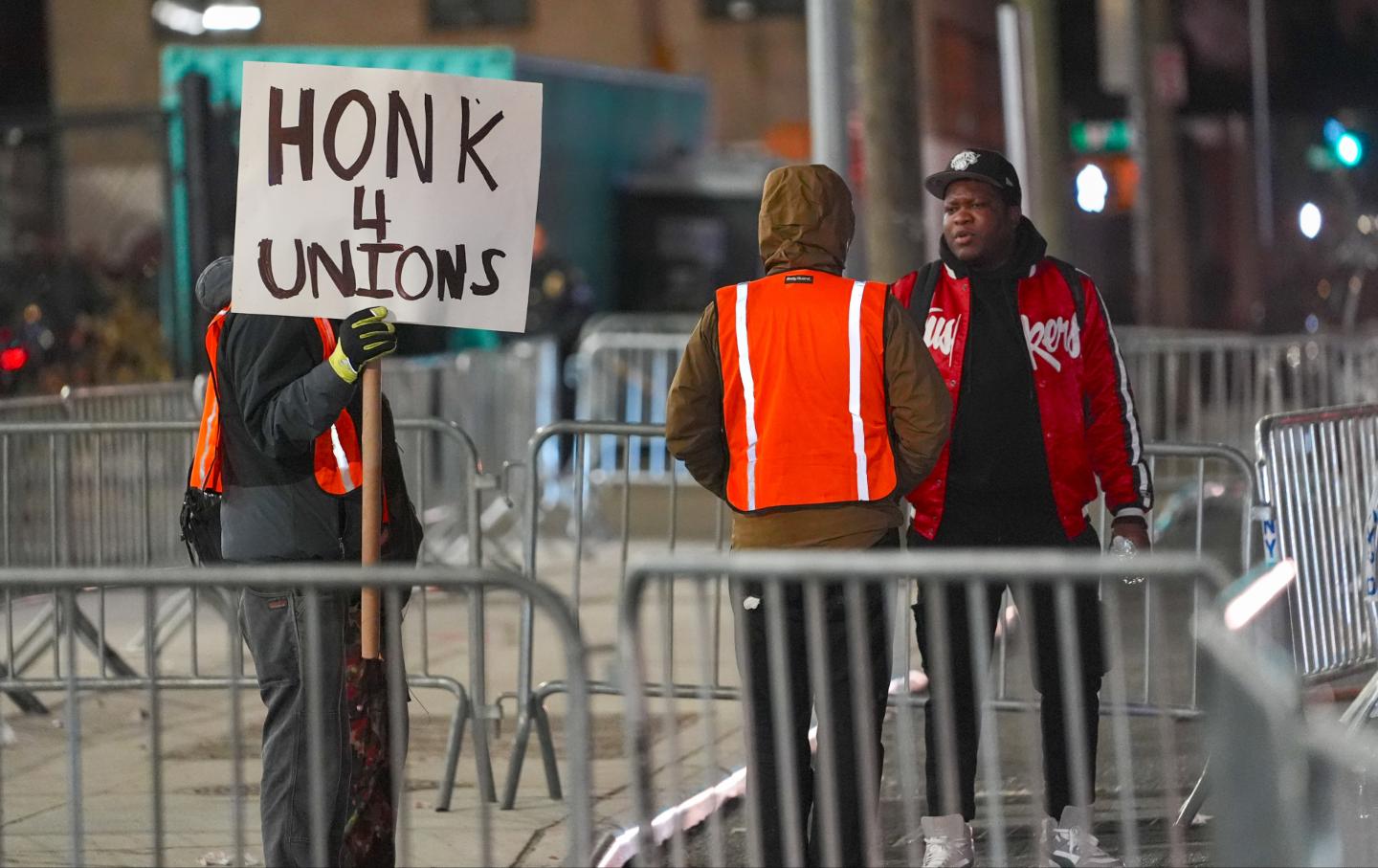
Amazon workers affiliated with the Teamsters Union continue a strike at the company’s delivery hubs in Maspeth, Queens, on December 20, 2024.
(Selcuk Acar / Anadolu via Getty Images)The noticeable uptick in labor organizing in the wake of the Covid pandemic has led many journalists and academics to make big claims about where the union movement might be heading. In such accounts, a “restive” labor movement coming off of “landmark” wins is poised to ride its current “organizing and bargaining momentum” to a true resurgence. These bold claims—now admittedly dampened by the reality of the new Trump administration—give the appearance that labor’s at least been on the right path, and that what it needs is simply a whole lot more of what we’ve seen in recent years, but with more resources behind it.
The numbers, however, give us good reason to question inflated talk about labor’s recent “banner years” and “historic victories.” Despite renewed interest in unionization and high public approval of unions, union density continues its seemingly inexorable decline, reaching a record low of 9.9 percent in 2024. Even with increases in National Labor Relations Board elections and the rate of union victories in those elections, the number of workers being organized every year is not keeping pace with labor market growth or compensating for union member losses elsewhere, either through plant closings or decertifications. As labor journalist Hamilton Nolan pointed out when these numbers were released in January, “Over the course of the most pro-union presidency in my lifetime, not only did union density not rise—it declined into single digits.”
This numbers problem is no secret. Though often pushed into the subconscious for much of the rest of the year, it lurks uncomfortably behind all the cheerleading labor coverage.
If the percentage of people in unions shrinks, something clearly is not working. But that’s not the only reason we should question the idea that labor just needs to keep doing what it’s been doing. There’s also been a notable shift in who is joining unions, and where they’re joining them—and that shift contains worrying trends of its own.
From one angle, it makes perfect sense that union membership composition would be changing, given the continued decline of heavy industry and the growth in service work. But union composition is not simply changing to match the overall composition of the workforce; rather, union membership is growing in a few key sectors—mostly among urban workers in academia and healthcare—and shrinking or not keeping up with labor market growth just about everywhere else.
If we look, for instance, at a list of large-unit labor elections, i.e., NLRB elections involving 250 or more eligible voters over the past decade, this trend becomes clear. Unions have been running and winning such elections at a much higher clip since the pandemic, but this has only exaggerated the dominance of academic and healthcare elections. In 2023, 51,814 academic and healthcare workers became union members through large-unit elections, while only 6,537 workers in all other sectors did so. We are unlikely to see such an exaggerated disparity in future years, but it’s still indicative of a marked compositional evolution. Through the lens of large-unit elections, the much-vaunted recent “resurgence” in labor activity is a decidedly segmented phenomenon.
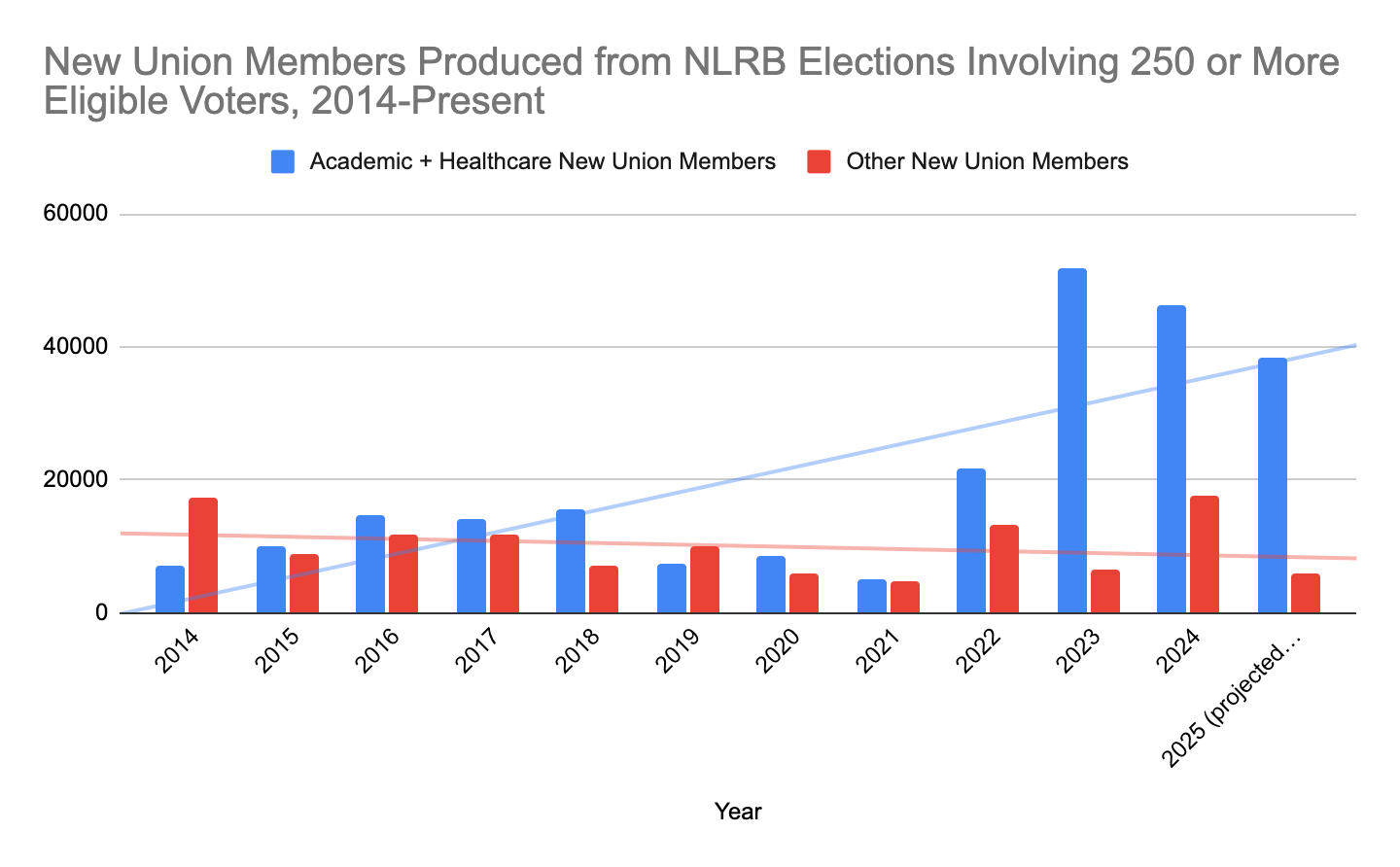
Those looking for evidence that the uptick in academia and healthcare is spilling into other sectors might take some solace from 2024, when there were more workers outside of those sectors organized into unions through large-unit elections than in any other year in the past decade. But that 2024 count involved only 251 more workers than in 2014—hardly anyone’s “banner year” for labor organizing—and it was still dwarfed by academia and healthcare organizing. Projecting out from the first three months of 2025, it’s unlikely that that outcome will be repeated this year.
The overall Bureau of Labor Statistics union numbers tell a less dramatic but similar story. From 2014 to 2024, the private-sector industry with by far the largest growth in union membership was Education and Health Services, with 299,000 new members, the next being Transportation and Utilities at 68,000. Just since 2022, union membership in Education and Health Services has grown by 186,000; if that trend continues, fully one-third of all private-sector union members in the United States will be in education or healthcare by 2028.
In addition to being mostly confined to two sectors, which, according to the Bureau of Labor Statistics, comprise 15 percent of all employment in the country, recent union growth has also been a predominantly urban phenomenon. To determine this, I took Jed Kolko’s zip code classification data and applied it to all NLRB elections in 2014, 2019, and 2024. This exercise bears any number of caveats, including the key one that this data only tells us where workplaces are and that workers often travel from very far away to get to work. Still, there’s a pretty noticeable difference in the election composition in 2024, which tilts heavily urban. More or less all of the growth in labor activity after the pandemic is happening in urban settings.
| 2014 | 2019 | 2024 | |
| Total Elections | 1707 | 1401 | 2218 |
| % Rural Elections | 12.10% | 12% | 9.60% |
| % Suburban Elections | 47% | 48.30% | 47.20% |
| % Urban Elections | 40.90% | 39.70% | 43.20% |
| Total New Members Unionized | 70,856 | 65,408 | 117,484 |
| % Rural New Members | 14% | 11.50% | 6.60% |
| % Suburban New Members | 42.80% | 43.90% | 28.80% |
| % Urban New Members | 43.30% | 49.10% | 65% |
| Rural Elections | 206 | 168 | 212 |
| Suburban Elections | 803 | 677 | 1048 |
| Urban Elections | 698 | 556 | 958 |
| Rural Win % | 71.40% | 66.10% | 72.60% |
| Suburban Win % | 68.70% | 75.30% | 75.80% |
| Urban Win % | 65.80% | 78.10% | 80.80% |
| Rural New Members | 9906 | 4,580 | 7,749 |
| Suburban New Members | 30,302 | 28,698 | 33,850 |
| Urban New Members | 30,648 | 32,130 | 75,885 |
Some might find no issue with labor growing disproportionately in academia and healthcare, and in urban settings, but we should nonetheless be clear when we talk about the supposed “labor resurgence” that this is a particular phenomenon, and not one that applies to the whole of organized labor.
But there’s good reason to see this trend as a problem to be overcome rather than as a neutral fact or something to be celebrated. To understand why, let’s look at a project that, as Jonathan Rosenblum and I have argued before, is existential for the labor movement: organizing Amazon workers.
In 2023, Amazon leapfrogged UPS in terms of total package volume; if Amazon continues to eat UPS’s lunch, the Teamsters are going to have a very difficult time maintaining their current UPS contract when it comes up for negotiation in 2028. The effects of a round of concessionary bargaining for this contract, the largest in the country, will resound throughout the union world. The only way for the labor movement to take fate into its own hands is to go all-in on organizing UPS’s primary competitive threat.
I ran the same zip code analysis on all Amazon Inbound Cross-Docks, Fulfillment Centers, and Sortation Centers, the big employment clusters in Amazon’s distribution network, and 92.4 percent of them are in rural or suburban areas. This is to say that the direction of the supposed “momentum” generated in the past few years is pointing away from the key facilities of this massive existential threat to labor. There is simply no vector from where we’ve been to where we need to be; organizing a company like Amazon requires a divergence from the activity of recent years rather than a continuation of it.
To be clear, it’s terrific that academic and healthcare workers have been organizing at such a rapid clip. The problem comes in seeing that organizing as representative of something broader than it is. In addition, there are other concerns to be raised about labor’s recent compositional evolution: The values and political orientations of academic and healthcare workers in predominantly urban areas are likely very different than those of rural and suburban construction or manufacturing workers. If the former becomes the face of the labor movement, will it act as a vanguard or a limitation? Will it revitalize unions or stir internal conflict? These are still open questions that will be decided in the coming years.
Popular
“swipe left below to view more authors”Swipe →But to my mind, the primary problem here for the moment is simply to think that with labor heading in the right direction, all that is needed is to pour union resources into letting “a thousand organizing flowers bloom,” in labor scholar Eric Blanc’s words. That is a recipe for lopsided growth that targets the low-hanging organizing fruit and does not substantively affect 85 percent of the workforce, i.e., those workers outside of education and healthcare.
Fortunately, it is becoming clear to many people in the union movement not only that we need to organize Amazon and exert some control over rapidly changing logistical networks in the United States, but also that we need to devote resources to the problem that are an order of magnitude larger than have thus far been invested. Such a campaign is an absolute necessity at the present moment, but it is one that requires strategic prioritization that disrupts recent trends rather than furthers them along.
Support independent journalism that does not fall in line
Even before February 28, the reasons for Donald Trump’s imploding approval rating were abundantly clear: untrammeled corruption and personal enrichment to the tune of billions of dollars during an affordability crisis, a foreign policy guided only by his own derelict sense of morality, and the deployment of a murderous campaign of occupation, detention, and deportation on American streets.
Now an undeclared, unauthorized, unpopular, and unconstitutional war of aggression against Iran has spread like wildfire through the region and into Europe. A new “forever war”—with an ever-increasing likelihood of American troops on the ground—may very well be upon us.
As we’ve seen over and over, this administration uses lies, misdirection, and attempts to flood the zone to justify its abuses of power at home and abroad. Just as Trump, Marco Rubio, and Pete Hegseth offer erratic and contradictory rationales for the attacks on Iran, the administration is also spreading the lie that the upcoming midterm elections are under threat from noncitizens on voter rolls. When these lies go unchecked, they become the basis for further authoritarian encroachment and war.
In these dark times, independent journalism is uniquely able to uncover the falsehoods that threaten our republic—and civilians around the world—and shine a bright light on the truth.
The Nation’s experienced team of writers, editors, and fact-checkers understands the scale of what we’re up against and the urgency with which we have to act. That’s why we’re publishing critical reporting and analysis of the war on Iran, ICE violence at home, new forms of voter suppression emerging in the courts, and much more.
But this journalism is possible only with your support.
This March, The Nation needs to raise $50,000 to ensure that we have the resources for reporting and analysis that sets the record straight and empowers people of conscience to organize. Will you donate today?
More from The Nation
How Trump’s Economy Is Crushing Everyday Americans How Trump’s Economy Is Crushing Everyday Americans
As costs surge and safety nets shrink, millions of Americans are struggling to afford the basics.
How Larry Ellison’s Acquisition Binge Began in Hawaii How Larry Ellison’s Acquisition Binge Began in Hawaii
In 2012, the Oracle CEO bought most of the island of Lānaʻi. What happened next doesn’t bode well for his new empire of media properties.

Larry Summers, We Knew Ye Too Well Larry Summers, We Knew Ye Too Well
The former Harvard president and Treasury secretary has resigned over humiliating disclosures in the Epstein files. But will that be enough to keep an ardent neoliberal down?

Binance’s MAGA-Branding Strategy Binance’s MAGA-Branding Strategy
The world’s largest crypto exchange often operates beyond the reach of the law. Now it’s helping to enrich the Trump family.

How Brothel Workers in Nevada Just Made Labor History How Brothel Workers in Nevada Just Made Labor History
The courtesans at Sheri’s Ranch were staring down a horrifying new contract. So they did what workers everywhere do: They got organized.

Don’t Let Trump Fool You. The Economy Is Bad, and He Is to Blame. Don’t Let Trump Fool You. The Economy Is Bad, and He Is to Blame.
The Trump administration’s efforts to distract from the bad economy just divert attention from one dumpster fire to another.

