
Illuminations
Susan Choi’s big novel of history.
Susan Choi’s Big Novel of History
In Flashlight, Choi examines the tragedies—past and present—that haunt a family living in Japan.
Susan Choi’s characters are at their best when unhinged. Undone by love, lust, revenge, torture, paranoia, mad hope, hopelessness—this is when they really come to life. Choi’s novels are also at their best in the midst of all of this emotional chaos. Her plots can be melodramatic, plucking these characters seemingly out of nowhere and putting them in the right circumstances to blossom into their maddest selves, but this also gives her novels a certain bravado and, at times, an unexpected grandeur. Choi’s characters need not have rigorous backstories or fully fleshed-out pasts; in fact, the more unmarked and unexplained their arrival, the better. The proximity to such incomprehensible, even unlikable characters is essential for the kinds of studies in desperation that Choi offers: She pulls us into the world of characters we may not particularly like or agree with, sweeping us up into a maelstrom of big, dramatic emotions that makes us wonder if we would comport ourselves in a more dignified manner, given the same situation.
Books in review
Flashlight: A Novel
Buy this bookAt least that was the case until now. Choi’s sixth novel, Flashlight, has the makings of another histrionically propulsive book that walks the tightrope between realist novel and melodramatic soap opera with aplomb. Yet where her earlier work—from her flawed but compelling 1998 debut, The Foreign Student, to her 2019 Trust Exercise—is thrillingly chaotic, Flashlight is controlled almost to a fault. At 464 pages, it is Choi’s longest and most ambitious work to date. Flashlight is a serious novel, and by dint of that designation, it tends to focus primarily on serious topics, including (but not limited to) the death of a parent, thwarted family relationships, chronic illness, and North Korean spycraft. There is plenty of intrigue here, but not the messy chaos that made so much of Choi’s earlier work so magnetic.
Flashlight tells the story of a small and unhappy family torn further asunder by tragedy. We meet Serk, a Japanese-born Korean man, and Anne, his white American wife, who are living in Japan for the year. Often ill-matched as a couple, they are held together by their child, Louisa, whom they both love with a desperate hunger.
At the beginning of the novel, everything seems to be going as well as can be expected; Serk and Anne aren’t exactly the first couple who don’t see eye to eye much of the time yet still find a way to make it work for the sake of their offspring. But then a fourth character takes the stage: Tobias, Anne’s child from a previous dalliance, who, after having a brain tumor removed, reappears in her and her family’s life as a kind of would-be itinerant holy man.
Unbeknownst to Anne, Tobias has also moved to Japan, hoping to get closer to her, and in the process he has fallen deeply, strangely in love with the country. Meanwhile, Serk is secretly occupied with his own familial ulterior motives: He wants to bring his ailing parents back to Japan from North Korea, where they emigrated after the Korean War, but he has trouble making sense of the few, clearly censored communications he receives from them. Then Anne falls mysteriously ill, her body failing her as she succumbs to loneliness in a country where she does not speak the language or have any friends. Throughout all of this, Louisa is preoccupied by the dramas of the uprooted child, not comprehending what either of her parents is going through.
So a lot of moving parts are already grinding away. Questions about racial and ethnic belonging work their way through Serk’s and Louisa’s stories, while the desperation of losing control of one’s body is examined with painful scrutiny in Anne’s, and the question of what Tobias, a white man “gone native” in Asia, is really seeking remains unanswerable, perhaps even by him.
All sorts of other unanswered questions abound as well. The history of North Korea is briefly outlined in a fascinating chapter about Serk’s childhood, which is divided by World War II, when he is forced to assimilate to Japanese-ness, then derided by his family for not being sufficiently Korean. There is also the question of what really happened to his parents and younger siblings: What have their lives actually been like after their decision to eagerly “repatriate” to North Korea?
To complicate matters still further, Choi presents her narrative through multiple perspectives. Its story emerges gradually out of chapters that focus on a single character’s experience: We get accounts of Serk’s and Anne’s origin stories; we read of Louisa’s angst and confusion while living in Japan; we witness Tobias’s yearning for closeness, whether to his new family or his new culture. There are at least three or four different potential novels present just in Flashlight’s first two parts.
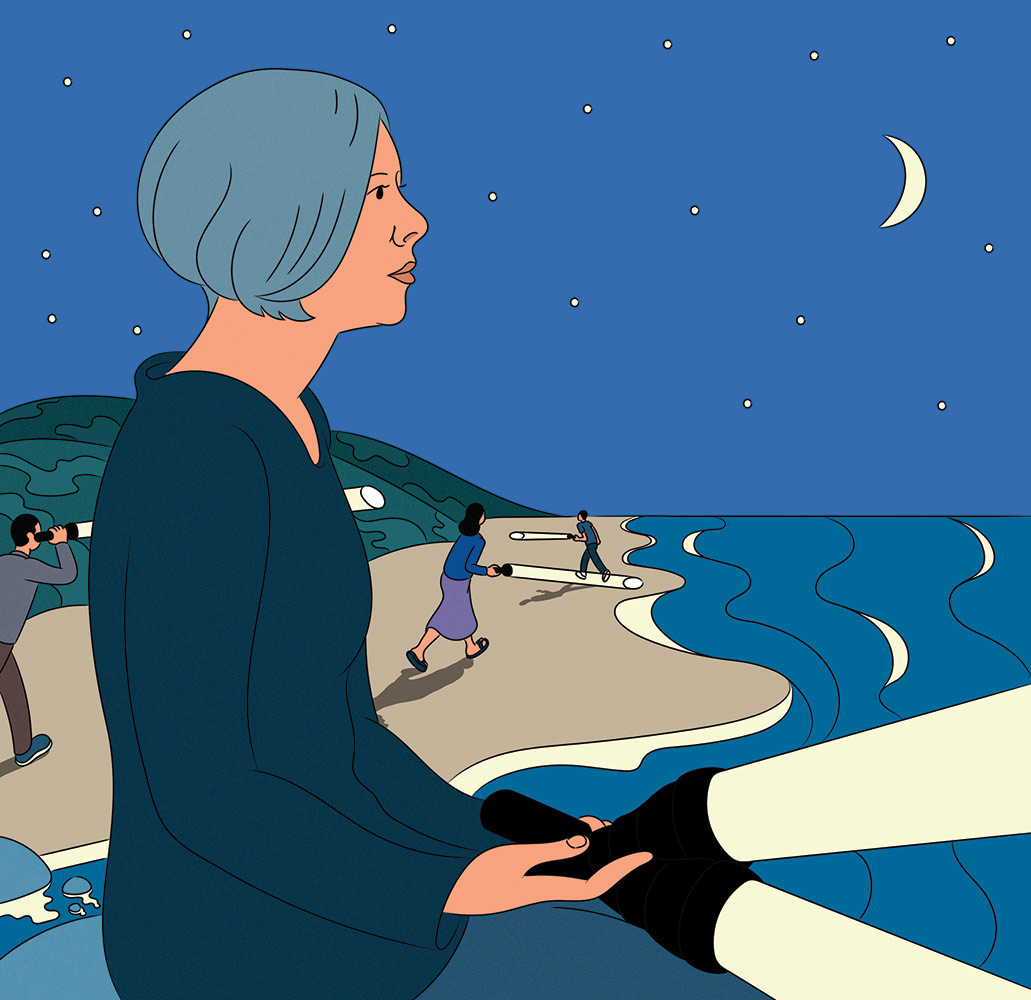
All of these disparate elements are drawn together by a tragic central event that occurs at the end of the novel’s first third: Serk and Louisa, walking on Japan’s western shore by moonlight, are mysteriously swept out to sea. Louisa, barely alive, makes it back to shore. Serk, who cannot swim, doesn’t; his body is never found. What happens later in the book—I refuse to give away a necessary twist here—is foreshadowed with a heavy-handedness that is scrupulous, if not artful, through a cat, presumed dead but never found, and more instances of the word flashlight (not counting the title) than I could keep track of. And all of this is before Part IV!
The first Choi novel I read was her 2013 My Education, a tale of lust, adultery, and graduate school that I devoured in a feverish frenzy appropriate to the book’s claustrophobic passions. In it, the rules that govern both our institutional and our personal relationships crumble at an alarming rate, leaving new, unfamiliar structures built on desire, jealousy, and desperation. As I reread the novel recently, I found that I didn’t remember it all that well, but I liked it enough to wonder again about a question that is one of my favorite obsessions: How does a once-beloved author produce something that disappoints the passionate fans of their previous work? It feels like a weirdly personal betrayal to discover that you and a favorite artist have parted ways. Perhaps someday they will return to you, but perhaps not. Was this what was happening here? Or was My Education the aberration, the one Choi novel whose sly sense of humor and crazed, outsize emotions really resonated with me?
As it turned out, Choi’s knack for emotional bombast balanced by compulsive readability and sometimes dismaying relatability plays out in her other novels as well. In Trust Exercise, she unsentimentally dissects adolescent desires—for sex, for adulthood, for understanding. A Person of Interest presents a psychological thriller of sorts that occasionally dips into the Nabokovian university farce. American Woman is loosely based on the Patty Hearst kidnapping, while in Choi’s first novel, The Foreign Student, we witness an unlikely romance sprout out of the cold ground of past traumas.
In each of these earlier works, Choi ends up concerned less with the viability of her plot points or even her characters and more with the quality of their emotions, which we recognize, sometimes with a distressing clarity, as akin to our own. In their very messiness and madness, these characters not only force us to contend with their feelings but remind us of those times that we have felt similarly; Choi draws on our own experiences of jealousy, of paranoia, of drug-like lust.
Choi allows us to get close to her main characters, then often pushes us uncomfortably closer than we’d like. Take, for instance, Regina Gottlieb, the protagonist of My Education. We learn the bare minimum about her—she’s a first-year grad student; she studies 20th-century English literature; she’s half-Asian—before we are plunged headlong into a fiercely passionate and destructive affair between her and an older woman, a junior faculty member who happens to be the wife of Regina’s mentor in the department. Regina makes one stunningly bad choice after another, but even though we may disapprove—if not actually dislike her—we’re in it with her from page one.
Our experience of Regina is fleshily tangible, full of the smells, the feel, the heat of sexuality. So too with many of Choi’s other characters; her books often have a physicality that verges on the tactile, sometimes unpleasantly so. This is one of the aspects of her writing that I missed in Flashlight. Her novels are best when they’re disagreeably, at times even disturbingly embodied—yet despite its emphasis on the body in pain, the new book is oddly bloodless. Louisa is repelled by her sudden feeling that her ailing mother is “an eerie tableau, a waxwork,” yet that is what the novel itself feels like at times: a Madame Tussaud’s version of the book (or books) it might have been.
But what Flashlight lacks in uncomfortable, unavoidable physicality, it makes up for in creative possibility. After reading or rereading Choi’s earlier novels in preparation for it, I began to see the similarities as well as the distinct differences. Choi continues to be refreshingly (in this case, somewhat relentlessly) unsentimental. The characters in Flashlight, for the most part, refuse to fall into the easy categories available to them: doting, tragic father; mourning mother; lost, half-orphaned child. The limited history given on the formation of the two Koreas piques the imagination and makes one want to learn more, as does the descriptions of Koreans living in Japan before and after the war. This is a book that wants to be more than it is; it thrums with ambition and interest.
Yet throughout these historical and characterological explorations, one does miss the rawness and rough-cut honesty of Choi’s earlier fiction. Some of the jagged edges, it seems, have been sanded off her work over time—those very jagged edges that made it cut so keenly in the first place. A novel abounding with many novels, Flashlight has been polished down to a nub—a 464-page nub, but a nub nonetheless. The same impulse toward authorial control and restraint is partly visible in Trust Exercise, which at times also feels too carefully crafted—but by the end of its high-wire second act, we realize this reserve has been in the service of a performance of authorship and domination. By strategically withholding the feelings that we most frequently associate with youthful desire—giddiness, an exhilarating lack of control—Trust Exercise ultimately proves its moral point about what we, as readers and as people, do and do not consent to, with a suitably theatrical flourish.
Popular
“swipe left below to view more authors”Swipe →Flashlight does not conscript its readers as audience members in the same kind of elaborate performance. In a way, one is grateful for Choi’s decision not to conclude her new book with a trick that exposes its apparatus too cleanly. But in a novel so full of different ideas, histories, unanswerable questions, unknowable feelings, insoluble puzzles and mysteries, one feels that everything is resolved in the end with a bit too much control, too much craft and artifice. The antinomies one finds throughout life often get lost in the tangle of plots and half-told stories—here, love does not always come with hate, absurdity with pathos, comedy with tragedy.
More from The Nation
Can the Dictionary Keep Up? Can the Dictionary Keep Up?
In Stefan Fatsis’s capacious, and at times score-settling, personal history of the reference book, he reveals what the dictionary can still tell us about language in modern life
Why We Misunderstand the Chinese Internet Why We Misunderstand the Chinese Internet
Journalist Yi-Ling Liu’s The Wall Dancers traces how the Internet affected daily life in China, showing how similar this corner of the Web is to the one experienced in the West.
The Bad Vibes of “Wuthering Heights” The Bad Vibes of “Wuthering Heights”
Keeping its distance from the novel, Emerald Fennell’s film ends up offering us a mirror of our own times.

Has Contemporary Fiction Ignored the Working Class? Has Contemporary Fiction Ignored the Working Class?
Claire Baglin’s bracing On the Clock gives its readers a close look at work behind the fry station, and in the process asks what experiences are missing from mainstream letters.

Werner Herzog Between Fact and Fiction Werner Herzog Between Fact and Fiction
The German auteur’s recent book presents a strange, idiosyncratic vision of the concept of “truth,” one that defines how he sees the world and his art.
Do Humans Really Understand the World’s Disorderly Rivers? Do Humans Really Understand the World’s Disorderly Rivers?
In James C. Scott’s last book, In Praise of Floods, he questions the limits of human hegemony and our misplaced sense that we have any control over the Earth’s depleted watershed....

