
In Fred Moten’s Music, Theory Is Put Into Practice
In the poet’s recent musical projects, he has pushed the sonic potential of verse to its limits.
In the introduction to his 2003 essay collection In the Break, Fred Moten lays out the importance of sound in his theoretical writing. He refers to a short parenthetical embedded in a scene from Narrative of the Life of Frederick Douglass in which the author recounts being forced to watch his Aunt Hester being whipped. Douglass describes witnessing the brutality as the event that opened his eyes to slavery’s innate cruelty. His mercilessly frank retelling refers to Aunt Hester’s “heart-rending shrieks.” It was those shrieks—specifically what Douglass heard—that stirs Moten to explore the bridge between the solidity of text and the ephemerality of sound. In his own words, he’s trying to get at “the implications of the breaking of such speech, the elevating disruptions of the verbal that takes the rich content of the object’s/commodity’s aurality outside the confines of meaning.” In my reading, Moten wants his work to tap into the moments when words aren’t enough, and when sound—a shriek, a note—is the only way to express the complexity of being human.
“Aunt Hester’s shriek,” then, becomes the lodestar for an expedition on which Moten, over the course of nearly 20 books, visits difficult questions of race, culture, authenticity, and aesthetics. Moten, a cultural theorist and poet, uses music as the inroad for essays exploring everything from Karl Marx’s concept of the speechless commodity and Theodor Adorno’s troubling music criticism to his peer Nathaniel Mackey’s mythopoeism.
Moten’s essay “The New International of Rhythmic Feel/ings,” from 2017’s Black and Blur, is one of the most stunning examples of his spinning of multiple theoretical ideas from a musical source. In a mid-1960s interview, the jazz bassist, composer, and notorious grump Charles Mingus called out the free jazz of Ornette Coleman as “calypso.” As far as disses go, it feels tame, but word choice matters, and “calypso” was Mingus’s way of accusing Coleman of being inauthentic, un-American, unhip. In the essay, this modest moment in jazz history launches Moten toward the discussion of a collection of topics, including but not limited to Afro-diasporism, multiple mid-century interpretations of Beethoven’s Fifth Symphony, the late writings of Martin Heidegger, and the “politics, aesthetics, and erotics of liberation.” These are gathered into a loose, referential fugue of ideas that relate in one way or another to the essay’s central theme: a comparison of precision (rules, strictness, tempo) and looseness—the organic, the human, the groove.
“The New International of Rhythmic Feel/ings” is a virtuosic example, but many of Moten’s essays perform similar feats, building lofty philosophical structures from the roots of Black American music. This methodology grows out of an established practice of using Black musical traditions to stimulate and inform Black poetry, political activism, and philosophical critique. It’s a tradition that goes back at least as far as W.E.B. Du Bois’s The Souls of Black Folk, with its notated excerpts of spirituals, or “sorrow songs,” that preface each essay. Amiri Baraka used jazz as a means of contemporary political critique in his prose and poetry, most notably in “The Burton Greene Affair,” his piece on authenticity in free jazz. And Mackey, another American poet working intensively with sound, fills his work with musical references, both overt and covert. It’s a deep history that also includes James Baldwin, Toni Morrison, and Richard Wright as well as a new generation of writers like Brent Hayes Edwards, Saidiya Hartman, Robin D.G. Kelley, and JJJJJerome Ellis. (Of course, my telling of this history is reductive, rife with missing links and bypassed voices, but even this cursory list is important when contextualizing the clearly sonic aspect of Moten’s intellectual commitments.)
Given this commitment to the aural, it is only natural that Moten has started a band. It may be more surprising that he is not alone; Moten is part of a growing movement of American poets collaborating with improvising musicians. Susan Howe and guitarist David Grubbs, Eileen Myles and drummer Ryan Sawyer, Nathaniel Mackey and the Creaking Wind Ensemble—all have been making their own experiments with words as sound, utilizing the melodic, rhythmic, and timbral aspects of their words as if they were just another instrument in an ensemble. Of course, combining words with music in song is an ancient practice, but what distinguishes this movement is the poet’s desire to meet the musician on their footing by adjusting the meter and pacing of their reading to fit inside the music rather than floating on top of it. For these poets, the word no longer has supremacy over the music but acts as a counterpart, like a single voice in a complex fugue.
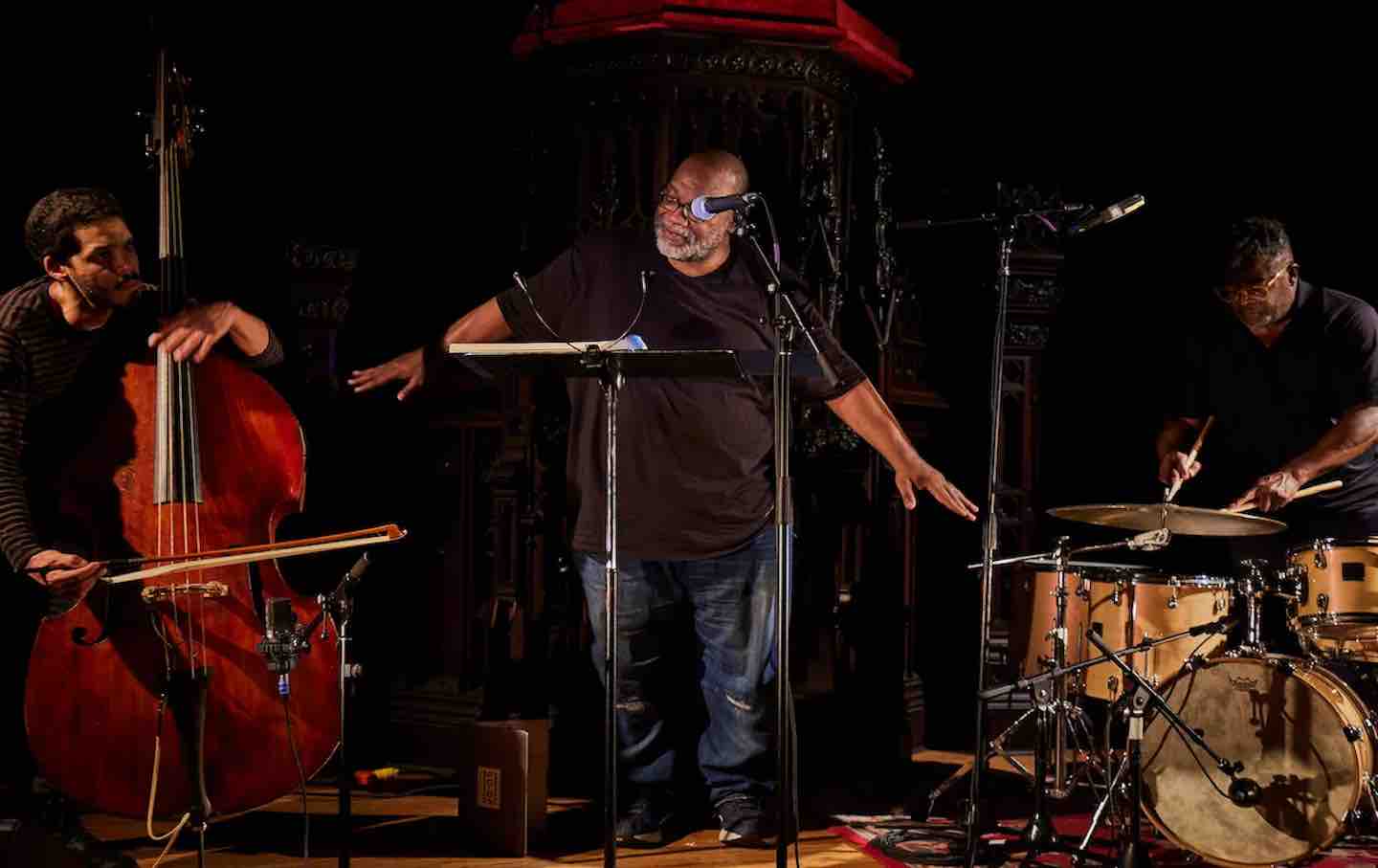
Moten’s unique contribution to this trend is the recent album the blacksmiths, the flowers on Brooklyn’s Reading Group label. It documents a live 2023 performance by Moten with bassist Brandon Lopez and drummer Gerald Cleaver. This is his second recording for the label.
“Ensemble” is a term Moten often uses to describe the component parts of an artist’s greatness. For example, in the essay “Sound in Florescence (Cecil Taylor Floating Garden),” also from In the Break, Moten argues that a true grasp of Taylor’s work must come from an understanding of all the elements in the pianist’s album Chiampas: poetry, movement, composition, and improvisation—in other words, Taylor’s “ensemble.” Gracing Moten with the same treatment, he must now be seen as an artist capable of musical depth as well as a writer of syncopated poetry and lyrically composed, referentially dense essays. As Moten’s “ensemble” has evolved, making music has become the necessary result of his writings. If Black and Blur contains Moten’s theory of “aurality outside…meaning,” then the trio is that theory put into practice.
When one first listens to the blacksmiths, the flowers, it’s only natural to follow Moten’s words, but attempting to grasp their meaning requires the listener to step off a musical ride that’s operating at a hair-raising height and exhilarating speed. This is not a poetry record; Moten doesn’t read like a poet. He phrases a melody much like Glenn Gould (or Cecil Taylor) would, as a contrapuntal voice in conversation with other musicians, each playing in their own individual way in order to arrive at a combined sound that is vibratory, unfolding, and complex.
The other two members of the trio are worthy partners. Lopez is a powerful young voice in the New York underground scene, combining Latin rhythms with, as he puts it, the “urban slurry” of New York City. Cleaver is midcareer and already a legend: He is widely regarded as one of the most creative and hardest-swinging drummers anywhere. Working at the highest level of musical risk, the trio is adept at steering clear of the obvious. They set up expectations only to have one or two or all of the members swerve away from the inevitable at the last second. The resulting novelty and surprise makes writing about it damned hard: What does it sound like? Who does it sound like? Any list of influences is immediately met with a counterexample, and describing it in purely musical terms misses the point.
The trio materializes out of near silence into a slow arrhythmia produced on the wooden body of Lopez’s bass and the metal rims of Cleaver’s drums. This initial knocking is muted, but it quickly develops into the sparks of an approaching conflagration. Moten, as if to confirm our suspicions, warns of the coming heat:
Our damage is pyrofloral
pyrolitic
the heating of our organic biomass such as
In the absence of oxygen
In the wake of summer
In the hottest days of all time
These are visceral words. And this is visceral music. The trio radiates velocity and danger. At any moment, Lopez sounds like two bass players at once. He drops low, persistent bass notes under simultaneous dancing, kalimba-like high harmonics. Cleaver prods and tugs his beat ahead of and behind Lopez and Moten, creating a jittery pocket of energy. Moten isn’t shy, either; his reading takes on the lion’s share of responsibility for ratcheting up the music’s intensity. He spins lines off a repeated phrase—“my baby’s black representational space is…”—increasing the music’s wildness despite the silence surrounding his words.
But it is not merely the words that make the record jump; the tension of looseness and precision here is heightened by the rhythmic interplay between voice, bass, and drums. Moten’s “The New International” refers to Mingus’s concept of “rotary perception” as the idea that the beat we feel is not an exact dot on a timeline but a wide circle that can and should be occupied by someone on its front side (rushing) and another someone on its back side (laying back). In jazz, hip-hop, and rock music, this is what creates the friction that we call the “beat” or the “groove.” It’s what makes us want to shake our butts. On the blacksmiths, the flowers, it’s this tug-of-war between bass and drums that sweeps us up in the trio’s energy, a feeling of the hailstorm that comes before a hurricane.
Cleaver is well-known in jazz circles for his ability to subvert musical expectations. I once saw him play a long, frenzied solo that threatened to explode and then suddenly… stopped, leading to three long minutes of silence that mesmerized his bandmates (and me). His work on the blacksmiths, the flowers is no less inspiring. He treats the music—all 80 minutes of it—as the unfolding of one continuous crescendo. The initial restraint of his off-kilter playing evolves into, in Moten’s words, “a palimpsest of snare and ride.” Cleaver fills up more and more space, overtaking Lopez and Moten and climaxing when Moten evokes James Brown’s “Give the drummer some!” But “some” isn’t enough: Cleaver’s virtuosic release of potential energy is seemingly the ecstatic peak of the record, until Moten jumps into the fray and we find out just how far the trio can go. Lopez grimly bows low chords while poet and drummer spar, trading polyrhythmic combinations of words and snare hits. It’s Moten who wins the round, and the fight. All that’s left is to pick up the pieces. Moten speaks over a giving-way and slowing decrescendo back into silence. The trio spirals while opening up new and raw territory. They hum and sing, audibly breathe, and tunelessly whistle. Moten reads:
We time in layers and flower in the sediment of our
Second time and again
As Cecil says again and again
As Ramses says again and again and again and again
Through the absence in fingered presence
Of our three
We the blacksmiths, we the flowers
…as Lopez’s bass becomes a kalimba (again). And Cleaver jitters around the beat (again).
As the music comes to an end, Moten whispers “pyrolitic” (again)—a remembrance of the fire and storm of the blacksmiths, the flowers, and a proof of Fred Moten’s evolving “ensemble.” Unlike poets who work with music to experiment with the presentation of their written work, Moten seems to be committing himself to music as a way of removing the page and placing words into air as an intellectual confrontation. It’s a move that feels necessary but risky: Making the step from theorizing about sound in print, with copious cross-references and historical precedents to sustain your ideas, to actually going onstage with those ideas is difficult, but wading into the sound itself with some of the most skilled improvisers in the world is a brave act of engagement. This is Fred Moten putting his money where his mouth is. And the result will make you think, make you feel—and, above all, make you dance.
More from The Nation

The Cinema of Societal Collapse The Cinema of Societal Collapse
This year’s Oscar-nominated international feature films—especially The Secret Agent and Sirāt—tackle what it means to live and die under tyranny.
Can the Dictionary Keep Up? Can the Dictionary Keep Up?
In Stefan Fatsis’s capacious, and at times score-settling, personal history of the reference book, he reveals what the dictionary can still tell us about language in modern life

Why We Misunderstand the Chinese Internet Why We Misunderstand the Chinese Internet
Journalist Yi-Ling Liu’s The Wall Dancers traces how the Internet affected daily life in China, showing how similar this corner of the Web is to the one experienced in the West.
The Bad Vibes of “Wuthering Heights” The Bad Vibes of “Wuthering Heights”
Keeping its distance from the novel, Emerald Fennell’s film ends up offering us a mirror of our own times.
Has Contemporary Fiction Ignored the Working Class? Has Contemporary Fiction Ignored the Working Class?
Claire Baglin’s bracing On the Clock gives its readers a close look at work behind the fry station, and in the process asks what experiences are missing from mainstream letters.
Werner Herzog Between Fact and Fiction Werner Herzog Between Fact and Fiction
The German auteur’s recent book presents a strange, idiosyncratic vision of the concept of “truth,” one that defines how he sees the world and his art.

