
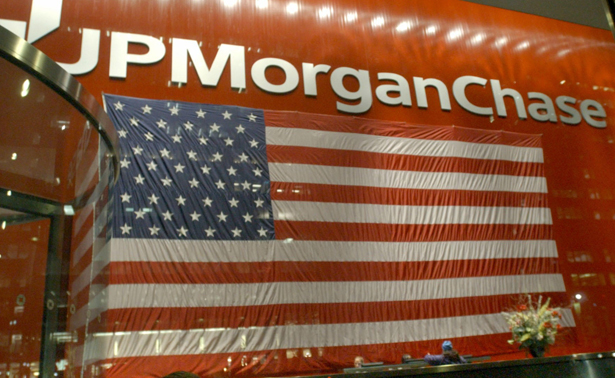
A sign is seen inside the JP Morgan building on Park Avenue in New York. (AP Photo/Bebeto Matthews)
This story originally appeared at Truthdig. Robert Scheer is the author of The Great American Stickup: How Reagan Republicans and Clinton Democrats Enriched Wall Street While Mugging Main Street (Nation Books).
“I am not a crook,” Jamie Dimon might as well have been insisting in his five telephone calls these past two weeks with US Attorney General Eric Holder, asking that a criminal investigation of JPMorgan Chase be dropped as part of a plea deal on what has turned out to be a $13 billion fine on civil charges.
Nope, said Holder, who finally has found the backbone to stand up to the CEO of the nation’s biggest bank who was also once a strong supporter of the president for whom Holder works. Friday night, Dimon folded and accepted the record-breaking civil settlement while the rare criminal investigation into the allegedly fraudulent claims at the heart of the mortgage based banking securities that have wrecked the economy proceeds.
Although the $13 billion fine on the civil charges, which includes $4 billion in direct assistance to swindled homeowners, mostly in depressed inner city neighborhoods, is to be applauded, it represents about half of the profit JPMorgan garnered last year. The company’s stock price, which has increased by 23 percent since January despite a barrage of crises and fines, has not been damaged by the latest settlement.
But for the bank to admit that it committed a crime, as the Justice Department sought, was thought by Dimon to be far more threatening to JPMorgan’s legal position, and it was only Friday night that he agreed to go for the deal without the bank enjoying immunity on possible criminal charges.
The criminal case arose from an FBI-obtained email from a JPMorgan employee in Sacramento, California, who warned higher-ups at the bank that they were grossly exaggerating the value of the mortgage backed securities being marketed. That employee is now cooperating with the government and a trial on the matter will go to the heart of the origins of the economic crisis in which JPMorgan played a leading role.
Although JPMorgan and its CEO have attempted to dismiss the myriad financial market scandals confronting the bank as the consequence of its acquisition of Bear Stearns and Washington Mutual during the financial crisis, the Sacramento criminal case has nothing to do with those other banks.
Popular
"swipe left below to view more authors"Swipe →
Many of the wounds suffered by JPMorgan are self-inflicted, including the Libor scandal and the derivative scams of the “London Whale”; charges of bribing Chinese officials and failing to report what it knew about the Bernard Madoff Ponzi scheme; alleged energy price rigging; and the bank’s acceptance of fines on its credit operations.
The point of accountability for the bank’s failing is crucial because Dimon has been a leading opponent of tougher banking regulations since before even the 2008 crisis. In the 1990s, Dimon had worked with Sanford I. Weill of Citigroup in gutting the sensible restraints of the Glass-Steagall law, and once those restrictions on too-big-to-fail banks were removed, Dimon built JPMorgan Chase into what is now the biggest US financial institution by assets. Dimon has been an outspoken opponent of even minor attempts to stiffen such regulations during the hearings on the Dodd-Frank legislation.
Dimon denounced the tepid efforts of his old Chicago buddy-turned-president to bring a modicum of oversight to the financial industry and pointedly soured on the Democrats in the last election. This despite the fact that Obama had appointed former JPMorgan executive William Daley to be his chief of staff and that then–Treasury Secretary Timothy Geithner had more frequent contact with Dimon than with any other financial industry executive.
It had been Geithner, in his previous capacity as head of the New York Fed, who had worked with Dimon, a NY Fed board member, on the deal to acquire Bear Stearns that the Fed financed with $55 billion in aid and an additional $25 billion in TARP money for JPMorgan Chase. Dimon had long been the poster boy for Democrats eager to rival Republicans in sucking up to Wall Street, and his current disgrace might offer them a much needed wake-up call, but not likely.
In one of the more obscene moments in the conversations between Holder and Dimon, between Mr. Justice and Mr. Hustler if you will, according to The Wall Street Journal’s interviews with those knowledgeable about the discussions, the two wanted part of the settlement to aid distressed urban areas beginning with bankrupt Detroit: “Both agreed they would like to see Detroit-area homeowners helped.… Mr. Dimon noted that the bank had long had a big presence in that area and that he would like some of the assistance to go there.” How special.
Obama once referred to his buddy Dimon as “one of the smartest bankers we got,” but clearly his administration is now less impressed. JPMorgan has been shameless and, as The New York Times reports, “At least seven federal agencies, several state regulators and two foreign countries are investigating the bank.” But the betting in the business press is that Dimon will survive quite nicely, secure in his roughly $20 million pay and backed by a handpicked board of directors focused on the bank’s still buoyant stock price. What the Street knows is that the banksters win even when they appear to lose.
William Greider writes, “The $13 Billion JPMorgan Settlement Is a Good Start—Now Someone Should Go to Jail.”

