Trump’s Outreach to the Libertarians Was an Absolute Train Wreck
No matter what you think of Libertarians, they had the good sense to answer Trump’s appeal for support by saying, “I would rather eat my own foot out of a bear trap.”
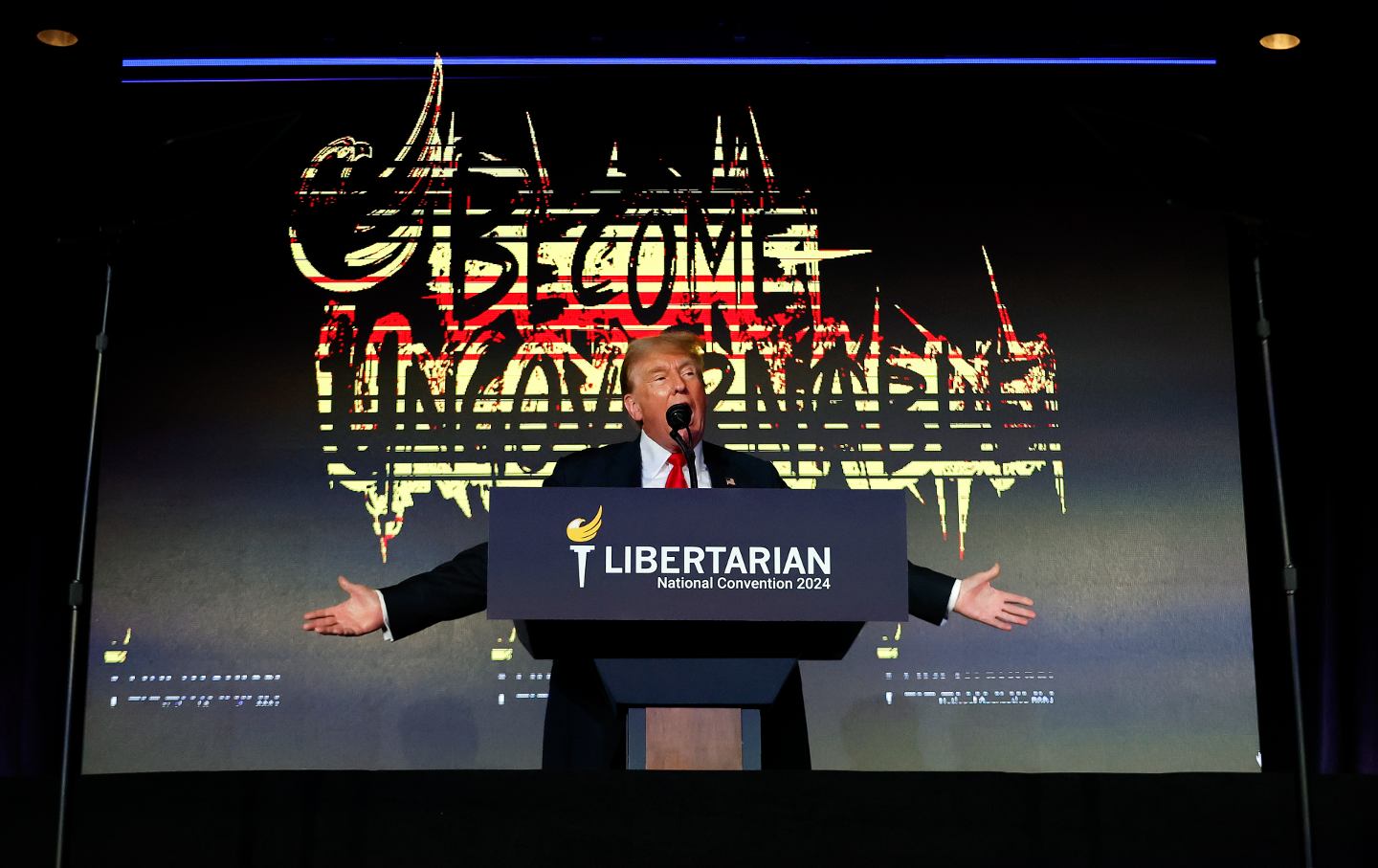
Donald Trump addresses the Libertarian Party National Convention at the Washington Hilton on May 25, 2024, in Washington, DC.
(Chip Somodevilla / Getty Images)It is nothing short of amazing that no one informed Donald Trump before he made a desperate personal appeal for the support of the Libertarian Party that Libertarians have never particularly liked him. But Trump got the message loud and clear when he appeared Saturday at the party convention in Washington and was greeted by boos, shouts of “hypocrite,” and a sign that declared, “No wannabe dictators.”
Trump put himself in a bizarre position when he showed up for the Libertarian convention at the Washington Hilton. Asking for an endorsement from a party that he refused to join, even though that refusal disqualified him from being the party’s actual nominee, was definitionally weird. Yet a woefully ill-prepared Trump seemed to believe that his mere presence would win the delegates over.
He got that call dramatically wrong.
By the time the convention balloting began Sunday, Trump barely registered. He won just six write-in votes in the first round of votingfor 0.65 percent of the total. This scorching rebuke came despite the former president appearing at the convention in front of a giant “Become Ungovernable” banner, promising to appoint a Libertarian to his cabinet, and claiming that, with his many recent indictments, “If I wasn’t a Libertarian before, I sure as hell am a Libertarian now.”
Libertarians weren’t just opposed to endorsing Trump—many of them were opposed to even being in the same room with the man. When asked whether the party should consider the former president, a delegate told NBC News, “I would rather eat my own foot out of a bear trap.” Chase Oliver, the Georgian whom the party nominated as its candidate for the presidency after multiple rounds of balloting on Sunday, said, “I don’t like having a war criminal on this stage. I don’t feel he deserves a spot on this stage. While I think it was a mistake to have invited Donald Trump, I’m glad he got to see a glimpse of what a real Libertarian reception feels like.”
Trump’s big play to expand his base became an exercise in futility and delusion.
The Republican was invited to address the convention in Washington—along with independent candidate Robert F. Kennedy Jr., who fared only modestly better with the delegates—as part of an effort to heighten the visibility of the third party, which has struggled to gain media attention and to have its candidates included in national debates. “For 50 years, we’ve been trying to get our candidates on the main stage with major party POTUS candidates,” declared Libertarian National Committee chair Angela McArdle. Now, she announced, “we’ve finally succeeded in bringing one to our stage.”
It was not shocking that the Libertarian Party engaged in a stunt to get publicity for its candidates and its platform. That’s standard operating procedure in American politics generally and for third parties in particular. What was shocking was that Trump agreed to go along with the exercise, apparently imagining that his Art of the Deal negotiating powers would somehow sway a majority of the most ideologically committed activists in American politics.
From the moment he took the stage, it was clear that Trump and his campaign team had miscalculated monumentally. The booing was so intense at times that Trump paused, in seeming disbelief. The authoritarian contender, who has promised to serve as an all-powerful “dictator for a day” if he wins a second term, provoked laughter from the crowd of civil libertarians and small-government enthusiasts when he promised to be a “true friend to Libertarians in the White House.” His announcement that he had come to the convention “asking for the Libertarian Party’s endorsement, or at least lots of your votes” was met with robust jeering.
When Trump seemed to suggest that the 2024 election offers only a binary choice between the Democratic and Republican lines—not a popular assertion with activists who have spent decades building an alternative to the two main parties—things got even messier. “Combine with us in a partnership. We’re asking that of the Libertarians. We must work together. Combine with us,” he pleaded, over a rising chorus of boos. The jeering only grew louder as Trump said, “You have to combine with us. We cannot give crooked Joe Biden four more years.”
As the miserable charade wore on, so did the jeering. There were shouts of “Panderer!” And “Liar!”
Eventually, a loud rhythmic chant of “Hypocrite! Hypocrite! Hypocrite!” echoed through the hotel ballroom, overwhelming the voices of a cadre of non-Libertarian Trump loyalists who had grabbed seats in the room.
Clearly shaken by the crowd response, Trump was reduced to begging. “Nominate me or at least vote for me,” pleaded the Republican, who told the crowd. “It’s very important because we have to get rid of the worst president in history.”
When the booing continued, Trump made a last desperate attempt to portray supporting him as the party’s last best hope for 2024. “Only do that if you want to win; if you want to lose, don’t do that. Keep getting your 3 percent every four years,” he griped.
Popular
“swipe left below to view more authors”Swipe →The Libertarians, who won 3.28 percent of the national vote when they nominated former New Mexico governor Gary Johnson for the presidency in 2016, seemed to be willing to take the risk—as long as they didn’t have to deal with Trump.
But Trump is apparently not done wooing the party. He’s signaling that he will keep trying to stake a claim on Libertarian votes, as he and many Republicans believe they could be critical in an election where battleground states such as Wisconsin, Georgia, and Arizona have been won or lost by under 25,000 votes.
Trump even claimed after the convention fiasco that all had gone according to plan. “The reason I didn’t file paperwork for the Libertarian Nomination, which I would have absolutely gotten if I wanted it (as everyone could tell by the enthusiasm of the Crowd last night!), was the fact that, as the Republican Nominee, I am not allowed to have the Nomination of another Party,” he announced on his Truth Social platform. “Regardless, I believe I will get a Majority of the Libertarian Votes.”
But that’s even more delusional thinking. While Republicans such as former Wisconsin governor Scott Walker have long claimed that Libertarian candidates have cost Trump election wins, by drawing away voters who would otherwise back the GOP nominee, that’s never been the case. There are, to be sure, some small “l” libertarians who might vote for Trump if the big “L” Libertarian Party weren’t on the ballot. But there have always been just as many—or more—who have been open to the Democrats, especially since the party has begun to embrace some libertarian criminal justice reforms, including drug law changes.
A Cato Institute assessment of the Libertarian vote from 2016, when Johnson was the party’s candidate, and 2020, when Clemson University professor Jo Jorgensen secured 1.9 million votes as the nominee, noted, “In 2016, a CBS exit poll asked Johnson supporters who they would have voted for in just a two-candidate race. Twenty-five percent said Hillary Clinton, 15 percent Trump, and 55 percent said they wouldn’t have voted at all.” In October of 2020, Cato added,
a Pew Research poll asked people who had voted for a third‐party candidate in 2016 what they planned to do in 2020: 49 percent said they leaned toward or supported Biden, while 26 percent said they supported Trump. A quarter said they planned to vote for a third‐party candidate again in 2020. If we assume that the 3/4 of voters who voted Green in 2016 but not in 2020 most likely voted for Biden, that might leave libertarians fairly evenly split among Biden, Trump, and Jorgensen. The New York Times exit poll of 15,590 voters showed that of the 5 percent of respondents who voted third‐party in 2016, 60 percent said they preferred Biden and 25 percent went Trump, leaving about 15 percent sticking with a third‐party vote.
Why have so many Libertarians—be they small “l” or big “L”—been so resistant to Trump for so long? Former party chair Nicholas Sarwark sums it up when he says, “Donald Trump is not a Libertarian, because Donald Trump is an authoritarian.”