
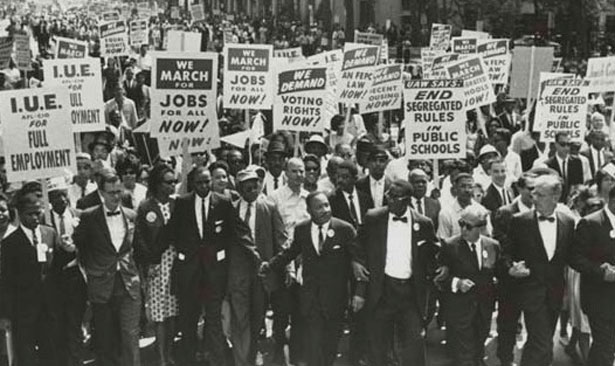
Rev. Martin Luther King joins hundreds of thousands during March on Washington, 1963. (American Jewish Historical Society via Wikimedia Commons)
As the anniversary of the March on Washington approached, Senator Bernie Sanders returned to the Lincoln Memorial where hundreds of thousands of Americans gathered on August 28, 1963. “I remember that very well, not by simply seeing it on TV or reading about it,” explained Sanders. “I was one of the several hundred thousand people who was here. I came in on a bus from the University of Chicago, where I was then going to school.”
The independent senator from Vermont heard Rev. Martin Luther King Jr. address the crowd that day. And he heard the message that the organizers of the March intended.
“What King was talking about was not only racial justice,” recalled Sanders. “He was talking about economic justice.”
Those economic themes were central to King’s “I Have a Dream” speech, in which the civil rights leader declared:
Five score years ago, a great American, in whose symbolic shadow we stand, signed the Emancipation Proclamation. This momentous decree came as a great beacon light of hope to millions of Negro slaves who had been seared in the flames of withering injustice. It came as a joyous daybreak to end the long night of captivity.
But one hundred years later, we must face the tragic fact that the Negro is still not free. One hundred years later, the life of the Negro is still sadly crippled by the manacles of segregation and the chains of discrimination. One hundred years later, the Negro lives on a lonely island of poverty in the midst of a vast ocean of material prosperity. One hundred years later, the Negro is still languishing in the corners of American society and finds himself an exile in his own land. So we have come here today to dramatize an appalling condition.
In a sense we have come to our nation’s capital to cash a check. When the architects of our republic wrote the magnificent words of the Constitution and the Declaration of Independence, they were signing a promissory note to which every American was to fall heir. This note was a promise that all men would be guaranteed the inalienable rights of life, liberty, and the pursuit of happiness.
Popular
"swipe left below to view more authors"Swipe →
It is obvious today that America has defaulted on this promissory note insofar as her citizens of color are concerned. Instead of honoring this sacred obligation, America has given the Negro people a bad check, which has come back marked ‘insufficient funds.’ But we refuse to believe that the bank of justice is bankrupt. We refuse to believe that there are insufficient funds in the great vaults of opportunity of this nation. So we have come to cash this check—a check that will give us upon demand the riches of freedom and the security of justice.
The Americans who converged on the National Mall on that August day in 1963 came to challenge racial injustice.
But they also came to challenge economic injustice.
It was the “March on Washington for Jobs and Freedom.”
That reference to jobs was not a casual one.
The 1963 march was called by a labor leader, A. Philip Randolph, the head of the Brotherhood of Sleeping Car Porters and the first African-American to serve on the executive council of the American Federation of Labor. Along with allies like King and the great organizer Bayard Rustin, Randolph framed the message of the March.
One of the nation’s most prominent socialists and longest-serving labor leaders, Randolph recognized the March on Washington as a pivot point—not the culmination of journey but a place at which to define the demands of that struggle. Yes, there would be a call for voting rights in the South. And for civil rights in the whole of the republic. But there would also be a clear call for economic rights.
“We will need to continue demonstrations,” declared Randolph on the day following the March. And in the months and years afterward, Randolph, Rustin and King worked together to develop and promote a groundbreaking “Freedom Budget,” which proposed:
1. The abolition of poverty.
2. Guaranteed full employment.
3. Full production and high economic growth.
4. Adequate minimum wages.
5. Farm income parity.
6. Guaranteed incomes for all unable to work.
7. A decent home for every American family.
8. Modern health services for all.
9. Full educational opportunity for all.
10. Updated (and expanded) Social Security and welfare programs.
11. Equitable tax and money policies.
It was the fight for the Freedom Budget, which began with White House meetings but eventually moved to the streets, that led King to propose a radical intervention in the status-quo politics of the late 1960s: the Poor People’s Campaign.
In arguing for protests by the poor and working people, King said: “Timid supplication for justice will not solve the problem. We have got to confront the power structure massively.”
No one imagined that confrontation would be won with one march, or with one campaign. That is why so many Americans who marched in Washington in August 1963 are still marching today.
For those who marched, and who went on to become champions of economic justice, the understanding of that necessity extends beyond a mere sense of duty to address inequity. There is a sense that by addressing that inequity, it might eventually be possible to achieve the full transformation that A. Philip Randolph and Bayard Rustin and Rev. Martin Luther King Jr. imagined.
David Newby, who marched in Washington in 1963, went on to teach at Alabama’s Tuskegee Institute and work with the Student Nonviolent Coordinating Committee. Then he joined the union movement, serving for sixteen years as president of the Wisconsin AFL-CIO and joining the same national labor executive board on which A. Philip Randolph sat. Newby is still marching— as the head of the Wisconsin Fair Trade Coalition and a leading figure in national groups such as the Labor Campaign for Single Payer Healthcare and U.S. Labor Against the War.
The other day, I heard Newby at a Veterans for Peace convention, telling the crowd: “Together, we can transform our country into one which values human rights, civil rights, workers’ rights. It can be done, if we act in coalition and solidarity.”
Fifty years changes a lot of things.
But some visions transcend time.
It was right to believe in not just the necessity but the possibiliy of transforming the America of 1963.
It is right to believe in not just the necessity but the possibility of transforming the America of 2013.
“We have come a long, long way in a lot of areas in fulfilling some of the visions that this great man had,” Bernie Sanders said as he reflected on Dr. King and the march he attended fifty years ago. “But, on the other hand, let us not forget for one second that a lot of what he talked about, a lot of his dreams, still have not been fulfilled. So we have got a lot of work that remains in front of us if, in fact, we are going to fully honor and give respect to this very, very great man.”
John Nichols is the author of The S Word (Verso), which recounts the role played by A. Philip Randolph, Bayard Rustin and other radicals in organizing the March on Washington for Jobs and Freedom, and in advancing the Freedom Budget.

