
This Minnesota Winter Is the New Prague Spring
I’ve studied Czechoslovakia in 1968. I live in Minneapolis. The similarities between the historic invasion and the current ICE “surge” are scary.
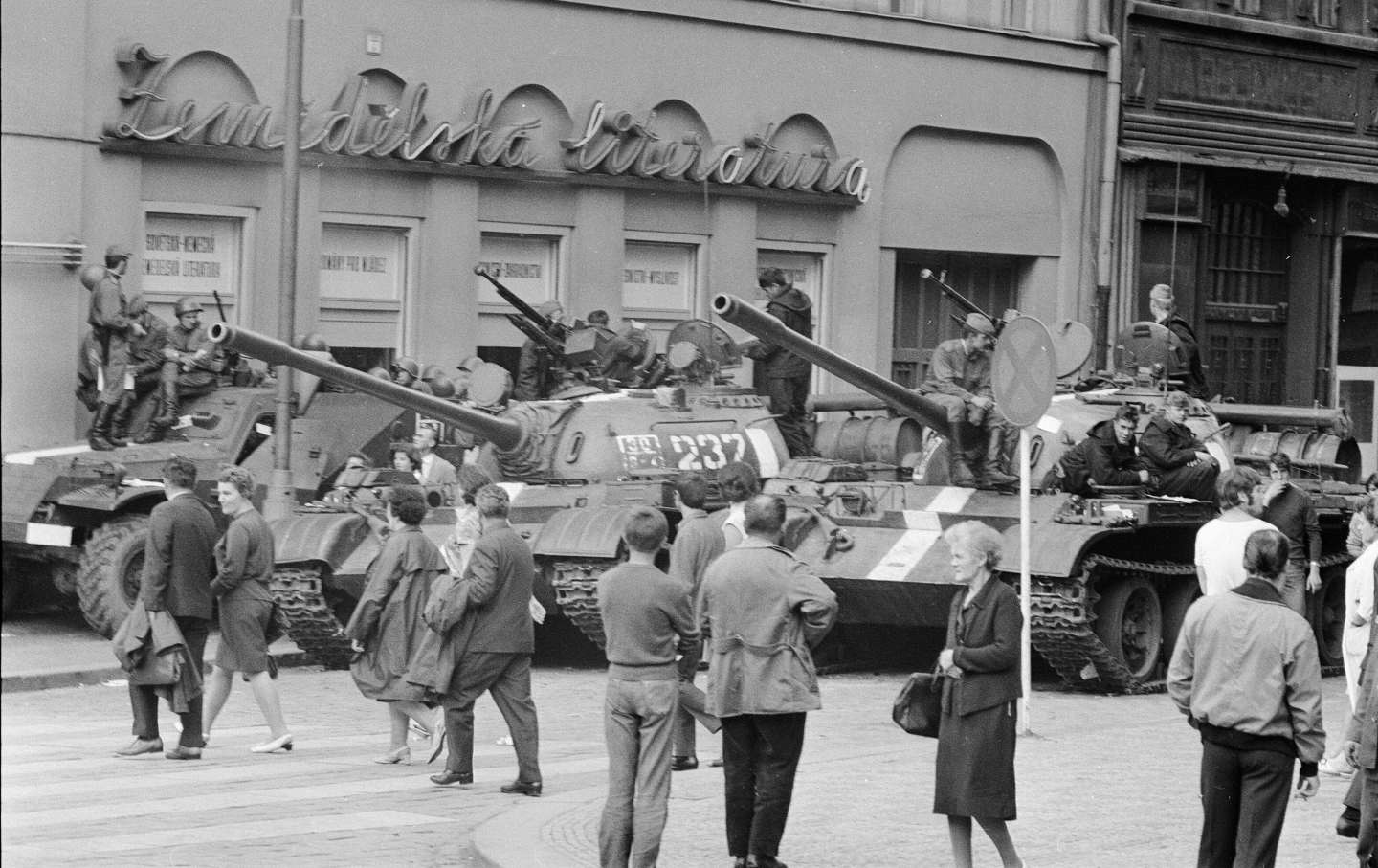
The Soviet-led Warsaw Pact invasion that ended the Prague Spring, a period of political liberalization in Czechoslovakia during the era of its domination by the Soviet Union after World War II. Warsaw Pact tanks patrol in Wenceslas Square as locals walk by. August 1968.
(Mirrorpix via Getty Images)(Daily Mirror / Mirrorpix via Getty Images)
In Czechoslovakia on August 21, 1968, radio was the sound of invasion: midnight broadcasts announcing that tanks had crossed the border and were lumbering toward Prague. In Minneapolis, in the winter of 2026, it’s whistles and car horns, sharp and urgent—warnings not about tanks but about SUVs rented from companies like Enterprise, the same cars you might drive on vacation. ICE is here, the whistles say. Stay inside if you’re vulnerable; come out if you can. All eyes, all ears.
The ICE invasion has other sounds: words, for instance. The US government uses the euphemism “surge” for the 3,000 federal agents it sent to Minnesota in January, a metaphor of tides and currents that’s been part of the military-political lexicon since at least the Second Gulf War. In the same way, “brotherly assistance” was sent, in the form of 5,000 Warsaw Pact tanks and 200,000 troops, to weed out the reform socialism that flourished in Czechoslovakia during the Prague Spring.
I’ve studied Czechoslovakia in 1968; I live in Minneapolis. There are similarities between the two invasions, from the code words used to describe them to how time feels within them, to the sounds and images that define them. And sounds and images from Czechoslovakia, 1968 are as much a prefiguration of what’s happened in the Twin Cities this winter as they are a lesson for us—in Minnesota and the United States—now.
The Prague Spring didn’t begin in 1968. Its seeds were planted years earlier, in the early 1960s, when Czechoslovakia’s economy floundered and its third five-year plan (scheduled to run from 1961 to 1965) was abandoned in its second year. As economists began to look past central management, change accelerated in other spheres. Victims of the Stalinist show trials of the early 1950s were quietly rehabilitated. Citizens were allowed to travel freely, even to the West. By June 1968, censorship had been abolished.
Throughout the reform years, and especially in 1968, many Czechs and Slovaks had the sense that they were in on an exhilarating experiment. As historians Rosamund Johnston and Paulina Bren have written, much of this played out on radio and television, where topics (such as the 1950s) that couldn’t be broached publicly before were suddenly fair game, discussed in documentary programs and live interviews with public figures and people on the street, bringing new voices to the receiver and the screen. But this was nothing compared to the week after August 21, when across the country, people came out in astonishing numbers to protest the invasion. In Prague, everyone was in the streets, and it seemed like everyone had a camera. Photographs and films from that week (like Jan Němec’s documentary Oratorio for Prague, whose footage was repurposed for Philip Kaufman’s 1988 Unbearable Lightness of Being) show a city transformed: people stopping invading tanks in their tracks, clambering on top of them, berating soldiers in the Russian they’d had to learn in school. Encouraged by radio broadcasts (clandestine, after troops took over the radio headquarters), protesters removed signs from Prague’s notoriously labyrinthine streets to confound the invaders.
During this winter’s onslaught, the Twin Cities have been transformed, too. Even though Tom Homan announced a “drawdown” (another euphemism) in early February and the media’s attention has drifted away, lulled by the relative absence of pepper spray and riot police, little seems to have changed. Detentions continue, and people are still out observing, patrolling, and protesting, as they have been for months, on sidewalks crusted with strata of snow and ice. Just as Czechs and Slovaks did in 1968, Minnesotans are trying to reason with the invaders (think of Renee Good speaking calmly through the window of her car to the officer who shot her). Stop signs have been amended with the word “ICE,” water poured on frozen sidewalks. And as was the case in Czechoslovakia in 1968, the alliances that are being built feel unlikely and powerful, like a true popular front: Retirees stand watch outside markets and daycares alongside college students, bus drivers, corporate workers, teachers, and nurses. Like other popular fronts, this one hangs together because its message is so simple: Go away, ICE. Get out.
There are differences, of course. In Prague, the invasion played out almost entirely on the streets, but in Minnesota, the streets are the mirror of a whole world inside, thousands of people whose lives have narrowed to the walls of their homes, because this is as much an invasion as it is an occupation, a siege. The number of those in hiding is vast, and their needs are immense: medical care, grocery deliveries, legal aid, safe transport, money to pay the mortgage or rent on a house or apartment that it’s no longer safe to leave.
Whether inside or out, however, a sense of time has settled over the Twin Cities that’s common to invasions. Czechs and Slovaks have shown me diaries from August 1968; one was a sea of black pen until the entry for the 21st, which was scrawled in red, the beginning of something new. Things changed so dramatically after the tanks arrived—from day to day, hour to hour—that some chroniclers of the period gave up on any kind of overview, and resorted to simply listing what happened. Even documentary filmmakers, the 1960s self-styled chroniclers of the everyday, couldn’t keep up. Instead, the invasion remained the high-water mark of radio and television: the media not just of the Prague Spring, but also of the invasion’s perpetual present tense, the now captured in the photographoverlooking Wenceslas Square that Josef Koudelka famously took on August 22 at precisely 5:01 pm, shown by his wristwatch in the foreground.
This perpetual present has been visible and audible in Minnesota this winter—even if it feels quaint, now, to think of radio or television as any kind of media vanguard. Like Alex Pretti, everybody has a phone; our phones are also our cameras and microphones, and these devices are fast. They fragment what’s happening in the city into thousands of nows scattered across Instagram, Reddit, and Signal, calling those down the block, across town, to come watch. Perhaps it’s because of this—because of the brutality and solidarity that they document, because of how quickly they’re able to gather people—it’s reported that federal agents have taken observers’ and protesters’ phones. This was also why, in 1968, Warsaw Pact forces made a beeline for the radio building when they arrived in Prague, and it was why, at some point later, a Soviet soldier stopped filmmaker Karel Vachek by the Prague Castle, forced open his 16mm camera, and unspooled the film until sunlight guaranteed that no one would ever see what he’d shot. Of course, by the time the soldier got to it, Vachek’s footage was already out of date.
Alongside this, there’s another kind of time, subtler but unmistakable: the conditional, the tense of would, could, might. Those of us on the outside can only imagine the agony of the conditional for those whose family members have been wrenched away and rushed to detention, to Texas, or for those who must take unthinkable measures to avoid what might happen, what could happen. Outside, though, things are also in the conditional: In January, I awoke several nights convinced that constantly circling helicopters—whose hum of low-grade dread stems from the same militarized policing that gave us the word “surge”—were the threatened Alaskan paratroopers finally arriving. No one knows when it will be safe for every child to go to school in person again, or how long our neighbors will need essentials delivered. The conditional is a friend to rumor. There’s one going around that DHS has booked local hotels through June.
As intolerable as it is, the conditional might be what we need, because it means that what happens next isn’t foretold. The Twin Cities are in a state of suspension. Pediatricians’ offices, normally busy in the winter months, have empty waiting rooms and too-quiet hallways. The line at the DMV is alarmingly short. Restaurants and shops open cautiously, sometimes with locked doors and watchful eyes, and classrooms are only partly full. This isn’t a world most of us want to live in, and while it may be an exception now, if we stop, if we slacken, we know it will become the norm—for the United States as a whole, not just the Twin Cities.
There’s another parallel to Prague, 1968 here, a cautionary one. The Czechoslovak resistance to the Warsaw Pact invasion took pride in its dignity and restraint. Like its Minnesota counterpart, it was resolutely nonviolent. The Czechoslovak Army was ordered to the barracks even as tanks of the “brotherly armies” ran over people in the streets and foreign soldiers shot civilians, even teenagers. This doesn’t mean that people weren’t outraged and heartbroken; they were. But as the weeks and months went on, they also got tired. The demands of daily life were impossible to ignore forever, and the protests petered out. At the same time, in a futile attempt to preserve the movement of which they were the faces, reformist politicians accommodated Soviet demands—inch by inch, until there was no more room for reform. Then, on January 16, 1969, a student at Prague’s Charles University named Jan Palach sat in the middle of Wenceslas Square, where Koudelka had taken his photograph five months earlier, doused himself in gasoline, and set himself on fire. He died three days later. Palach was the first of four students to commit the act that year, and for each student, the point was this: that the debates about reform swirling in the pages of Czechoslovak literary and political magazines weren’t enough. Reform required action, by both politicians and people.
Yet when Czechoslovak citizens poured into downtown Prague a week after Palach’s death, on January 25, 1969, it wasn’t for a protest or a general strike, like the ones that filled the streets of Minneapolis this January. It was for Palach’s funeral procession, and once again, the filmmakers and photographers were out. One of them was the director Ivan Balad’a, who, with a group of cameramen, filmed the crowd as a sea of figures standing stricken, bundled against the cold, necks craning to see Palach’s coffin and the student honor guard protecting it. The film that Balad’a made from this footage, Forest (Les), also captures what happened after the procession was over, as the crowds dispersed and the city emptied out. Though this is the film’s ending, for Balad’a, it was its heart. As he told me in an interview in 2008, people were sad—they were overwhelmed with grief—but when the funeral procession ended, they “went home quickly, as if from a soccer match.” What he didn’t say was what others have noted since: that if they had stayed in the streets, if the reformers had had the courage to stand up to Moscow, things might have turned out differently in Czechoslovakia, where Palach’s funeral procession was both an echo of 1968 and its death knell. Winter 1969 turned to spring, ushering in the politically and culturally straitened era of “normalization,” and the public sphere that had emerged so vibrantly during the Prague Spring fell into a prolonged retreat.
As exhaustion sets in and resources stretch thin, this is the risk we run in Minnesota now, and it’s a risk that the country runs, too. Don’t go home, the whistles and car horns warn. All eyes, all ears; stay out, stay out.
More from The Nation
Eric Schmitt Deserves to Be Mocked Forever Eric Schmitt Deserves to Be Mocked Forever
In this week’s Elie v. U.S., our justice correspondent relives the senator’s glorious face-plant. Plus: why John Roberts also deserves our mockery.

The Moral Clarity of Tennessee Gubernatorial Candidate Jerri Green The Moral Clarity of Tennessee Gubernatorial Candidate Jerri Green
Even before her state botched another execution, gubernatorial candidate Jerri Green was telling Tennesseans that “the death penalty has always been inhumane, expensive, and biase...
Draw Peace, Defy Censorship Draw Peace, Defy Censorship
Censorship targets those who dare to challenge power. Yet cartoonists keep drawing. Every line is an act of courage and freedom and a step toward peace.
Reclaiming Worker Power in the Age of AI Reclaiming Worker Power in the Age of AI
When every price and wage is personalized, organizing gets harder. Here’s how we’re fighting back in New York City.
Trump Is Trusting Tech Companies to Self-Police AI. What Could Go Wrong? Trump Is Trusting Tech Companies to Self-Police AI. What Could Go Wrong?
Trump’s refusal to heed the warnings from within the tech industry might end up being his most asinine legacy.

