
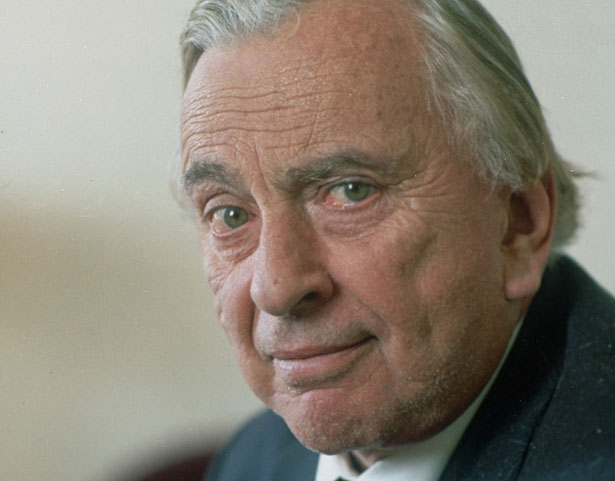
Gore Vidal. (AP Photo/file)
Victor Navasky tells one of the most revealing stories about Gore Vidal, who died July 31 in Los Angeles at age 86. In 1986, Gore wrote an essay for the magazine’s 120th anniversary issue. Shortly after it was published, Victor was invited to lunch by the publisher of Penthouse magazine, Bob Guccione, at his East Side townhouse, famous for its $200 million art collection. “We had barely consumed the amuse gueules when Bob asked me how much it cost to get Gore Vidal to write his essay,” Victor recalled. “When I told him we had paid each contributor to that issue $25 and Gore got the same $25 that everyone else got, he almost choked on his Chateau Margaux and told me he had offered Vidal $50,000 to write an article for Penthouse and Vidal declined.”
Gore, who had accepted Victor’s invitation to join the magazine in 1981 as a contributing editor, published forty-one articles in The Nation at those rates. Some of his most memorable quotes appeared in The Nation: “We are the United States of Amnesia,” he wrote in 2004. “We learn nothing because we remember nothing.” In that same essay he called the US a place where “the withered Bill of Rights, like a dead trumpet vine, clings to our pseudo-Roman columns.”
Gore was a great talker as well as a great writer, and I interviewed him many times—in front of live audiences, on the radio and for print—and in many places. The most memorable was at his legendary cliffside house in Ravello, on the Amalfi coast of Italy, where lots of people visited him. We arrived a few days after historian Eric Foner departed; he told me his daughter had played in Gore’s famous swimming pool with the children of Susan Sarandon and Tim Robbins. Gore sent my wife to sit by the pool with Howard Austen, his lifelong partner—she had a wonderful time with Howard—while Gore talked about his life and work in the deep shadows of his downstairs study.
In that interview, for the Radical History Review, Gore described his campaign to introduce the term “American empire” into the political discourse—and, later, the concept of “the national security state”—both of which were firmly rejected at the time by establishment thinkers. Indeed much of his writing for The Nation was devoted to elucidating those two ideas—and empire was also the theme with his six-volume series of historical novels “Narratives of Empire,” which included number-one bestsellers Burr (1973) and Lincoln (1984).
Popular
"swipe left below to view more authors"Swipe →
In that interview he also talked about his transformation from right to left, his path to The Nation. In the beginning he had opposed US entry into WWII. “My radicalization begins in 1948 with The City and the Pillar,” he said—one of the first American novels about a gay man—with the “rough” treatment it received in the New York Times. Next, he said, came the Hollywood blacklist—he was working in Hollywood, and although never a Party member, was “horrified” to see his friends banned from the industry. The third step came in 1968, when he published the wild sex farce Myra Breckinridge, debated Willliam F. Buckley Jr. on TV during the Democratic National Convention, and then helped found the anti-war New Party, and then the People’s Party, which he co-chaired with Benjamin Spock from ’68 to ’72. Then in 1980 Victor invited him to become a contributing editor, and he promptly accepted.
His first article in The Nation, in 1981, was “Some Jews & the Gays,” a caustic response to several anti-gay articles in Commentary, the conservative Jewish magazine edited by Norman Podhoretz. His first big cover story for The Nation, “Requiem for the American Empire,” was published in 1986 as Gorbachev was beginning to reform the Soviet system. Gore proposed that the US and the USSR—he called them “the white race”—should unite to fight off the economic threat from “one billion grimly efficient Asiatics.”
The Asiatics didn’t complain, but two months later, some Jews did, after Gore wrote that Norman Podhoretz’s “first loyalty would always be to Israel,” and that he and his wife Midge Decter therefore constituted “an Israeli Fifth Column Division" inside the United States.
Many of us took that as another satiric barb, but Podhoretz had his associate editor at Commentary write to thirty people on the Nation masthead who had Jewish-sounding names asking whether they had protested the magazine’s publication of “the most blatantly anti-Semitic outburst in an American periodical since the Second World War.” (Nobody on the masthead resigned.) Arthur Carter, the Wall Street figure who had recently become publisher of the magazine, told Victor that the head of the Anti-Defamation League had complained to him about Gore’s piece. Carter replied, “What do you think we are? It’s The Nation, not the Jewish Federation Newsletter.” Victor called that “passing the Gore test.”
Gore was glorious before live audiences. At the Los Angeles Times Book Festival at UCLA in 2007, Royce Hall was packed with two thousand of what can only be called “adoring fans.” Onstage, I asked him what he had said to Susan Sarandon and Tim Robbins when they asked him to be the godfather of their son. His answer: “Always a godfather, never a god.” I concluded by noting that he had pretty much done it all—novels, essays, plays—and won every award; I asked, “What keeps you going? What gets you up in the morning?” He had a one word answer: “rage.”
In the late 1990s Gore named Christopher Hitchens as his official “successor, inheritor, dauphin or delfino.” But after 9/11, when Hitchens came out in support of the Iraq war and quit The Nation, Gore withdrew the nomination. Hitchens came back in 2010 with a Vanity Fair column titled “Vidal loco,” going after Gore for his endorsement of the “9/11 Truth” cause—which indeed dismayed many of us. (Gore held the milder version—that the Bush administration had advance warning, but let the attacks happen—rather than the view that the towers were blown up from the inside on Bush’s orders.)
One of Gore’s memorable quotes had special meaning for me–it came in his unexpected appearance in the 2006 documentary The U.S. vs. John Lennon, based on a book I wrote about Nixon’s attempt to deport Lennon in 1972 because of his anti-war activism. “Lennon was a born enemy of those who govern the United States,” Gore said with a twinkle in his eye. “He was everything they hated.… he represented life, and is admirable; and Mr. Nixon and Mr. Bush represent death, and that is a bad thing.”
Gore Vidal wrote as a citizen of the republic and a critic of the empire. We won’t have another like him.

