My Grandmother Survived the Nakba—Now I Hope to Survive a Genocide
As I flee from place to place in Gaza, desperately seeking safety, fragments of my grandmother’s story from 1948 come to mind.
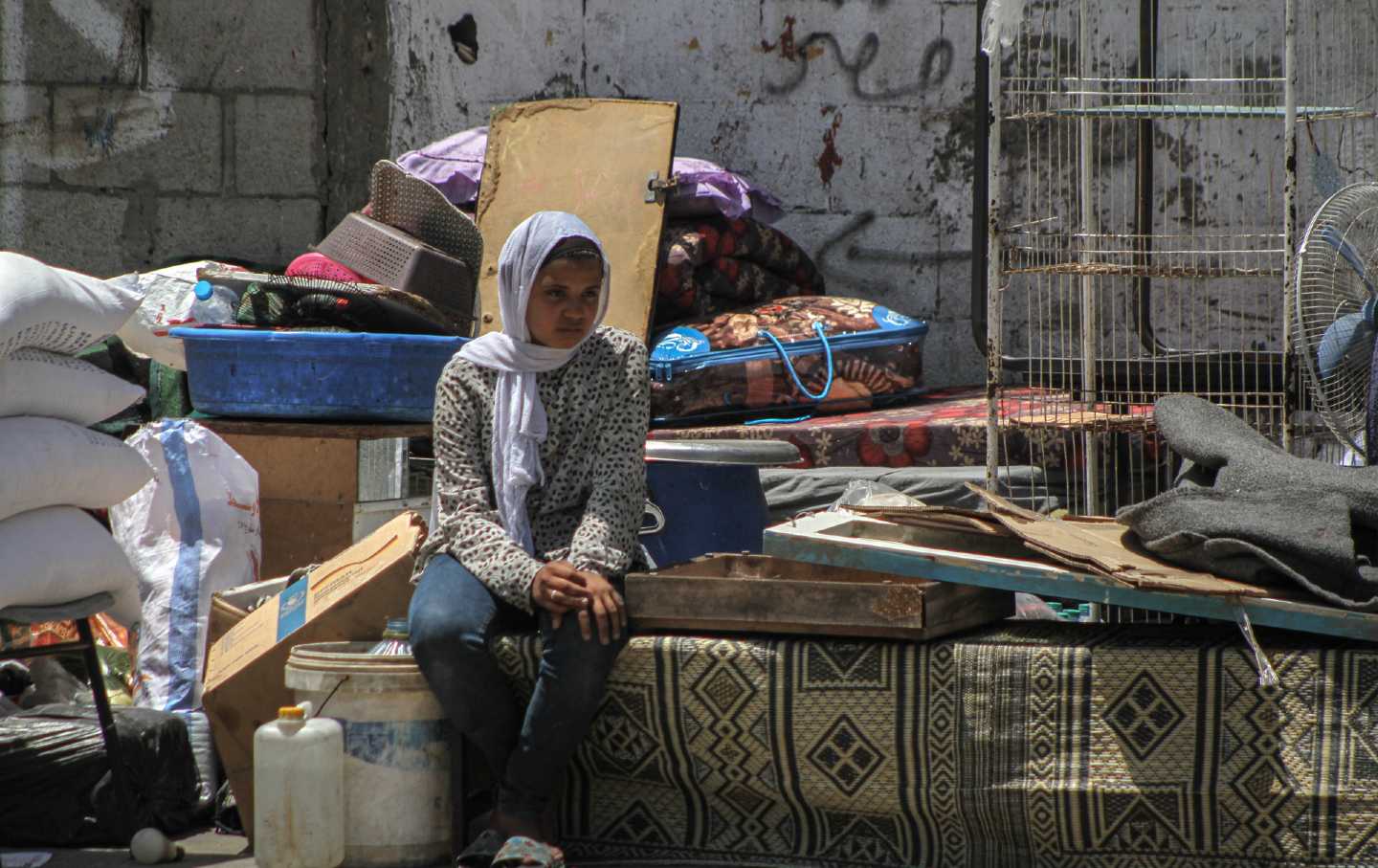
Palestinians flee Rafah as Israel intensifies its assault on the Gaza enclave, on Thursday, May 9, 2024.
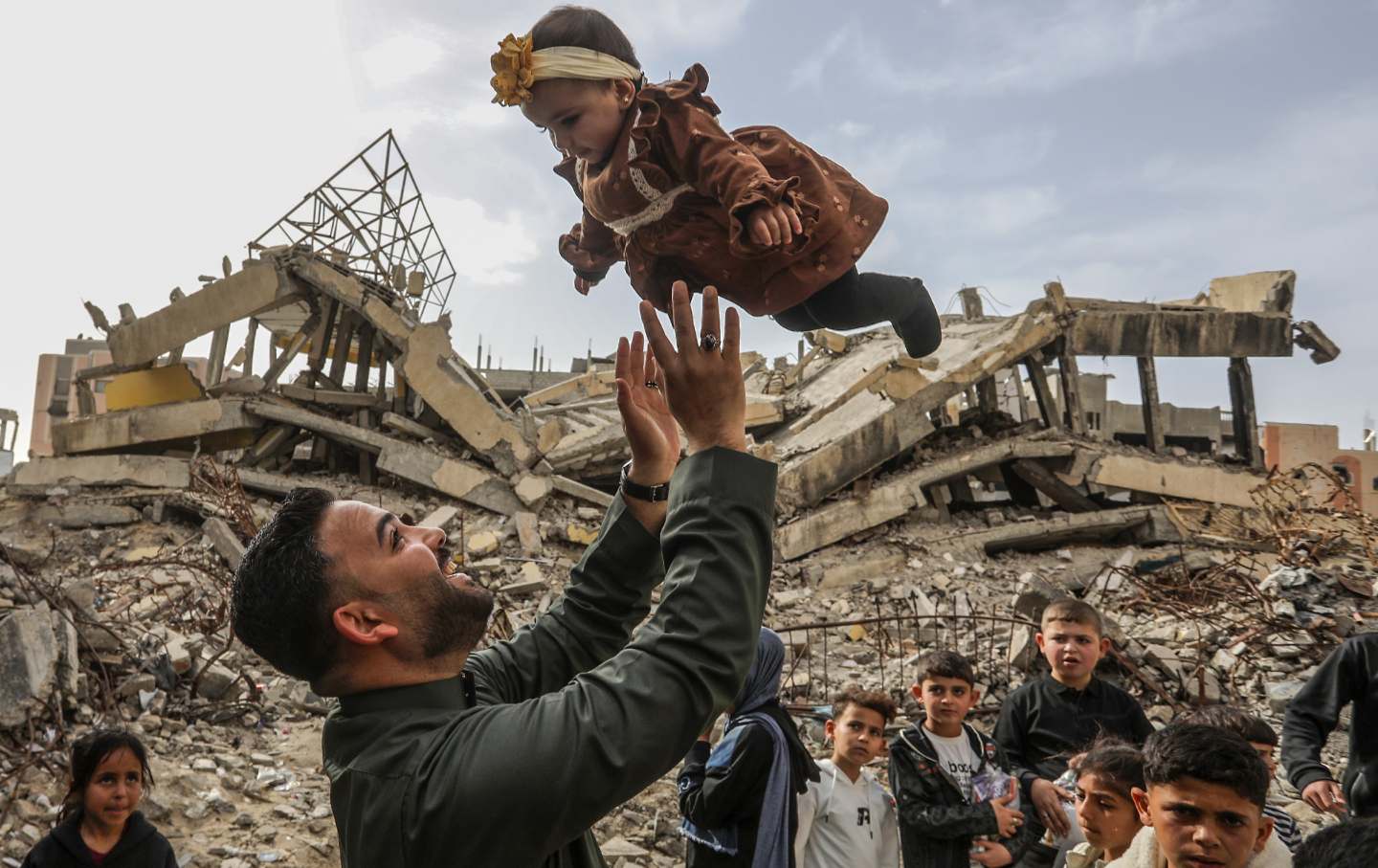
(Ahmad Salem / Bloomberg via Getty Images)I have been displaced 11 times since the start of Israel’s bloody campaign against Gaza. My husband, four kids, and I flee from one neighborhood in Gaza City to another, trying to stay ahead of the bombs, sheltering with relatives and friends. Each time we flee, fragments of my grandmother’s stories from 1948 come to mind.
My grandmother’s experiences during the Nakba, when the majority of Palestinians were expelled from their homeland during the establishment of the state of Israel, have taken root so deeply in my heart that I have often felt that her memories were my own. Of all her grandchildren, I was the closest. I even called her “Immi,” which means “my mother,” copying what my aunties called her, though her given name was, ironically, “Hejar,” derived from the word “Hejjra,” meaning “migration.” I drank in her stories about the Nakba. I never imagined that I would actually live the same terror and displacement that Immi did.
My home in the western part of Gaza City was first struck by Israeli bombs on October 9. Terrified, my family groped our way out through dust and gunpowder, forgetting to grab the emergency backpacks I had prepared. We returned the next morning, and found jagged holes from air strikes in the walls and ceilings. The windows and doors were blown out, and the kitchen entirely destroyed. Indeed, the entire street had been targeted. As we extracted the backpacks and important documents from the rubble, I remembered my grandmother describing mortar shells falling from the sky without warning in May 1948, and how she and my grandfather grabbed their children and fled for their lives, leaving all their valuables behind in their beautiful two-story home in Yaffa. How could Immi not carry her important belongings with her? I used to wonder. That judgment has entirely evaporated; in its place is my grandmother’s hard-earned wisdom that I cling to now.
My grandmother had moved to Yaffa some years earlier, after growing up in Gaza, where her father owned tracts of land planted with wheat and groves of olive trees. She had moved to the coastal city after marrying my grandfather, her cousin, who owned a tannery there. In 1948, the eldest of her (then) six children was 10 years old, and the youngest was one month. I say a prayer of gratitude each time my four children survive a near miss, remembering the panic that rose in Immi’s voice as she recounted nearly losing her little girl.
As the bombing in Yaffa grew closer, my grandparents hastily lifted their children onto a passing truck, climbing up behind them. My grandmother counted her children, realizing that 5-year-old Naema was missing. “Stop the truck!” she cried out desperately. They scrambled down, and my grandmother frantically stopped every passing truck, until finally she located Naema, who had been sobbing by the side of the road when another family found her and took her with them.
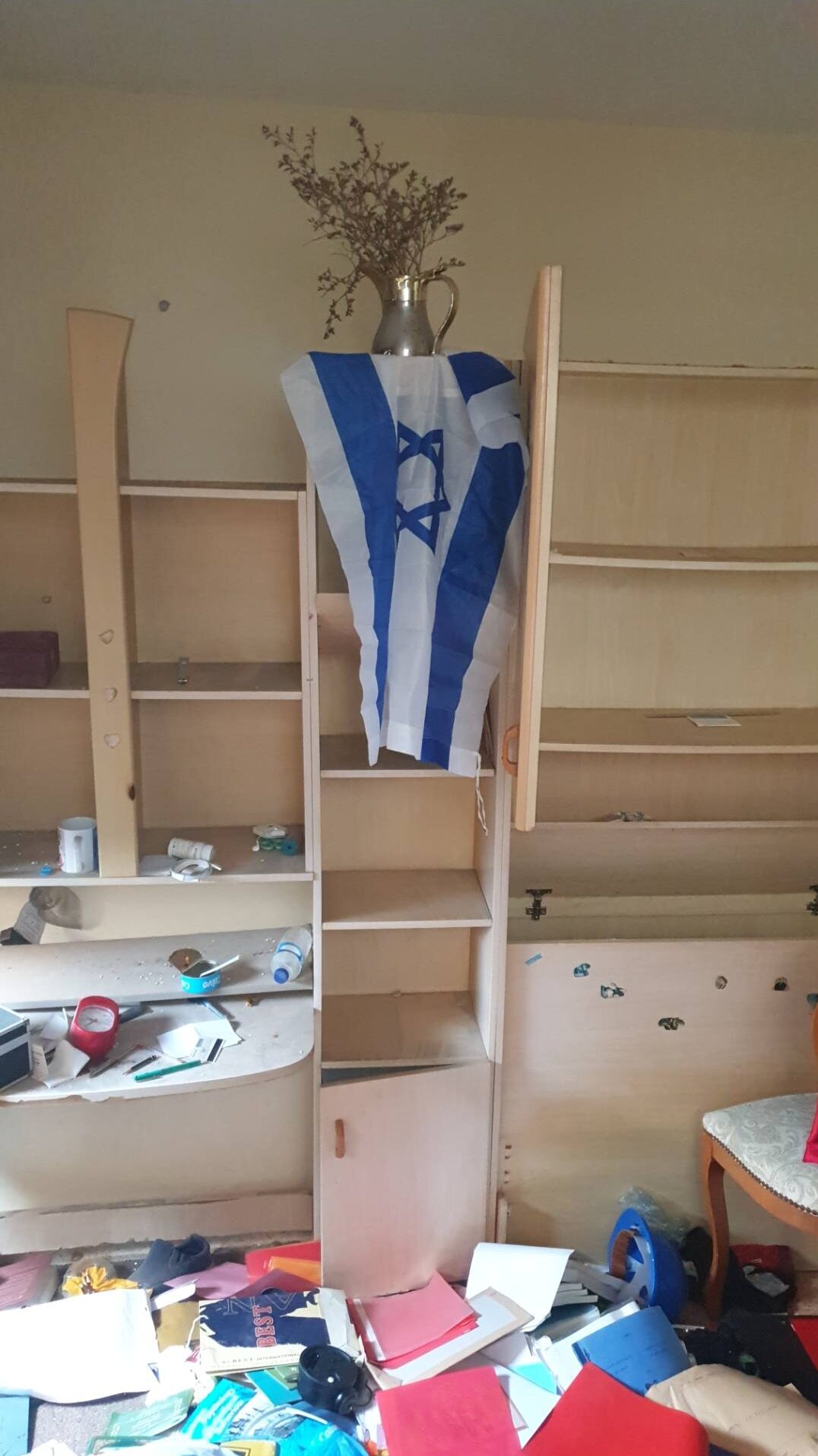
My grandparents ended up fleeing to Gaza. Luckily, they could stay in my great-grandfather’s home, as opposed to the tent cities springing up all over the suddenly crowded Strip. Even so, their entire world had been turned upside down. My grandmother lost her home, her land in Yaffa, her belongings, her comfortable life–yet she never gave up her hope of returning. She educated her children and grandchildren about reclaiming our land, nurturing our connection with our home. She made sure we knew the exact address of her home in Yaffa. Each time I return to my damaged home to retrieve more items, I think about how Immi’s heartbeat would quicken and eyes fill with tears as she told us about her lost home. I’m filled with anger when I encounter evidence that Israeli soldiers raided our home—they dumped our clothes and personal items onto the floor, and scrawled vulgar and violent Hebrew graffiti on our walls. But still, my home is within my reach. My grandmother, who died in 2016 at the age of 98, and gave birth to 13 children, three of whom died in infancy, could never return to Yaffa.
As I lie down to sleep, fully dressed in case I need to escape, I reflect on how it feels like a time machine has transported me back to my grandmother’s youth. I’m surrounded by massacres even more horrific than the infamous April 9, 1948, massacre in Deir Yassin, when over 100 Palestinian villagers were killed by Zionist paramilitary gangs, helping to trigger the mass flight of Palestinians. However, instead of the killings being committed by paramilitary gangs, they are at the hands of a powerful, organized army, with weapons and funding provided by the United States.
My grandmother spoke about being unable to access her family’s fertile lands, reduced to making onion soup to feed her hungry children. As I struggle to find food to feed my own kids (we don’t even have onions), I find myself talking to my grandmother in my mind. I tell her about everything I am living through, and how similar it is to her experiences in 1948. Even more, I let her know that her stories have given me the fortitude to endure the horrors of this genocide.
My grandmother was always critical that the international community didn’t do more to enable our return to our cities and villages. I thought she was unnecessarily pessimistic when she mistrusted “the peace process.” Now, seeing the international community still refuse to meaningfully intervene to protect us, I finally understand that my grandmother was merely realistic. The plight of the Palestinian people has been ongoing for 76 years, with no end in sight.
And yet. We continue to exist, to resist, to survive. Even if I could flee to safety outside of Gaza, I refuse to betray the sacrifices made by our youth and our ancestors. For my grandmother, and for my children, I will stay in my homeland. And I will do all that is in my power to survive so that, someday, I can tell my grandchildren my stories.
Support independent journalism that does not fall in line
Even before February 28, the reasons for Donald Trump’s imploding approval rating were abundantly clear: untrammeled corruption and personal enrichment to the tune of billions of dollars during an affordability crisis, a foreign policy guided only by his own derelict sense of morality, and the deployment of a murderous campaign of occupation, detention, and deportation on American streets.
Now an undeclared, unauthorized, unpopular, and unconstitutional war of aggression against Iran has spread like wildfire through the region and into Europe. A new “forever war”—with an ever-increasing likelihood of American troops on the ground—may very well be upon us.
As we’ve seen over and over, this administration uses lies, misdirection, and attempts to flood the zone to justify its abuses of power at home and abroad. Just as Trump, Marco Rubio, and Pete Hegseth offer erratic and contradictory rationales for the attacks on Iran, the administration is also spreading the lie that the upcoming midterm elections are under threat from noncitizens on voter rolls. When these lies go unchecked, they become the basis for further authoritarian encroachment and war.
In these dark times, independent journalism is uniquely able to uncover the falsehoods that threaten our republic—and civilians around the world—and shine a bright light on the truth.
The Nation’s experienced team of writers, editors, and fact-checkers understands the scale of what we’re up against and the urgency with which we have to act. That’s why we’re publishing critical reporting and analysis of the war on Iran, ICE violence at home, new forms of voter suppression emerging in the courts, and much more.
But this journalism is possible only with your support.
This March, The Nation needs to raise $50,000 to ensure that we have the resources for reporting and analysis that sets the record straight and empowers people of conscience to organize. Will you donate today?