
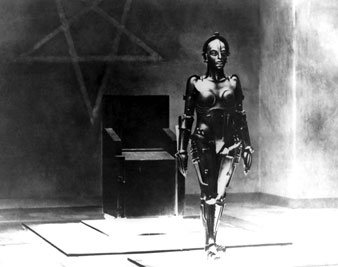
 Everett CollectionMetropolis, 1927.
Long before Orwell envisioned 1984, Fritz Lang depicted 2026 as a battleground between workers and capitalists beneath an Art Deco city.
Hollywood lives for money and sex. It borrows or buys its art. It is the Germans who are the perpetual adventurers in the cinema. They gave the camera its stripling mobility, its restless imagination. They played with lights in the studio and achieved innumerable subtleties in the use of black and white as a medium. Even in their scientific miniatures they have worked with a virtuoso camera. And it was the Germans who injected fantasy into the cinema.
Metropolis (Rialto Theater), for all its thesis and its subtitular dialectic compounded for American comprehension by the enlightened Charming Pollock, is much more akin to the romantic vagaries of Siegfried than to the realities of The Last Laugh. For Fritz Lang, who directed both Siegfried and Metropolis, is not a cinema radical. Like Murnau in Faust he thinks in terms of sheer visual beauty, composition, and group rhythms rather than of dynamics. He is still of the theater of Reinhardt in the fluency of his groups and the rhythmic progression of his pageant. Although Carl Freund, the camera man for The Last Laugh and Variety, has worked here in the same capacity, Metropolis lacks cinematic subtlety. It is only in the “shots” of machinery in motion and in the surge of the revolutionists that it is dynamic. The camera is too often immobile, the technique that of the stylized theater.
Yet here for the first time the chill mechanized world of the future, which only barely revealed itself in R. U. R., has been given reality. Here is the city, that tormented circus of buildings which touch the sky, of tunnels that disrupt the places under the earth. Through the air man has hurled his obstructions, his bridges and traffic ways. Yet only the machines seem real; gigantic purring gods grinding down life. Machines, machines, machines, sliding through the earth, challenging the cosmos, pounding out human resistance as they set the awful tempo of life.
There is no loveliness here, except in the gardens of the rich, high above the levels of the city, where space and light are not mortified for efficiency. Below the surface of the earth the workers and their children crawl through a timed eternity, strapped to the dynamos like so many numbered robots. There is no rest, no beauty, no life below the gardens of the higher levels Man is inanimate. Life is metronomic. It is only the machines that are alive. The machines and the careless children of “Brains.”
As Lang has directed it, Metropolis is more stylized fantasy than realism. Even in the torrentous revolt of the workers as they pour through the machine-rooms, alive, demoniacal, there is an air of unreality. This is not revolution as the Russians stage it. It has neither taste nor smell. Yet it is magnificent Even the most careless groupings are beautifully composed. Lang is too much the artist to deny the imagination.
H. U. H. was a satire, but Metropolis is utterly devoid of humor. Thea von Harbou, its author, wrote it originally as a novel and then adapted it to the screen. Only her concept of Metropolis itself is intellectual. The rest is sentimental symbolism. There is no individualization within the type. Her persons are puppets. There is the Capitalist, his Son, Mary the spiritual leader of the workers, et al. The Son is the eternal mediator who, with the help of the woman Mary, although only after a revolution intervenes, brings “brains” and “brawn” together for the final fade-out
Perhaps it is because of its original form that Metropolis lacks concision. One of the most interesting episodes of the entire film is that in which the inventor transmits the shape and likeness of Mary to the woman of his creation by encircling hands of electricity, yet it is only partially developed. The robotess, or creature of human invention, breeds revolution and is stoned by the mob, but the formula which gave her life is never mentioned again. The inventor is himself hurled from the cathedral roof by the blond and shining John, the hero; but what of the formula?
It is Metropolis itself, the city of domed basements and curving machine-rooms, of massed buildings that conceal the sky, of aeroplanes that ply their corner-to-corner traffic, of trains that seem to shoot into unmeasured and untracked space, that makes Fritz Lang’s film so significant.

