
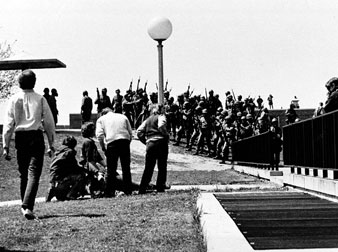
 AP ImagesA group of youths cluster around a wounded person, Monday, May 4, 1970.
The shootings by the National Guard at Kent State were a murder waiting to happen.
Article 11 of the Bill of Rights lays down the principle that a “well-regulated militia” is necessary to the security of a “free State.” The murders at Kent State University prove — not that proof was needed — that Ohio does not have a “well-regulated” militia. Since most, if not all, of the states are in the same case, it is of utmost importance that the National Guard, which serves as the militia of the individual states, should be thoroughly evaluated in the light of the tragedy at Kent State, the deteriorating countrywide political situation, and the further mass murders that may be engendered by the climate of violence being cultivated by Nixon, Agnew, Mitchell, Reagan and other politicians of similar views and character.
Arnold Sagalyn, who directed the study of police and military violence for the Kerner commission, says that “incidents” such as the one at Kent State “can happen again and again, given the nature of the National Guard, the nature of their weapons and their training.” The statements of the commander of the Ohio National Guard, Adjutant General Sylvester Del Corso, and the commanding officer at the scene of the murders, Brig. Gen. Robert Canterbury, leave little doubt that Mr. Sagalyn’s prediction is all too sound.
The murders occurred on May 4. Two days earlier, Del Corso had issued a statement that sniper fire would be met by gunfire from his men. After the massacre, Del Corso and his subordinates declared that sniper fire had triggered the fusillade. Unable to explain why the troops fired promiscuously into the crowd, he admitted that he had no evidence of sniping. The commander of the Ohio Highway Patrol Unit denied statements by Guard officers that his men, circling overhead in a helicopter, had seen a sniper on a roof.
So the buck was passed to Canterbury. He said that the argument as to the reality of a sniper was not important. “In any situation, whether in combat or anything else, the decision to use a weapon must be reserved to the individual.” He seems to be putting troops confronting civilians in the category with the armed householder who finds a burglar in his living room. But if the decision to shoot is left to the individual Guardsman, then we do not have a military body intent on maintaining public order but a mob armed with M-1 rifles opposing a mob armed with rocks and bottles. Sooner or later, the outcome will be on the pattern set at Kent State, where the pseudo-soldiers of the Ohio National Guard killed two young men and two young women, one of the men being second in his Reserve Officers Training Corps class, and none of the four being hippies, revolutionists or anything but law-abiding youngsters.
The news of the tragedy had hardly reached Washington when the President issued an avertive statement. A few days previously, he had referred to students who resorted to disorderly conduct in their protests against the lndo-Chinese war as “bums.” When 250,000 citizens, largely students, demonstrated in the most orderly fashion a few blocks from the White House last November, Mr. Nixon was watching a football game on TV. When some young people, not connected with the demonstration at the Washington Monument, went on a rampage afterwards, Attorney General Mitchell coupled the small disorderly demonstration with the big orderly one. After the Kent murders, the President deplored the deaths but, by clear implication, laid the blame on the students who had resorted to violence. There are many kinds of violence–Governor Reagan, who on April 8 had said that “if it takes a bloodbath” to end campus violence, “let’s get it over with, no more appeasement,” has hastened to assure critics that “bloodbath” was a figure of speech.
Mr. Nixon is laboring under a serious delusion if he thinks that his TV sermonizing and attitudinizing will enable him to prolong and enlarge the Vietnamese War indefinitely. He and his colleagues, and the right-wing state politicians, are consciously furthering the polarization of the country, in the hope that this will prove to their political advantage. They think they can remain in power by exploiting the ignorance and bellicosity of a section of the population. If they are right, they must expect to turn their regime into a native form of fascism. But there is at least an equal chance that the American people will recoil from that prospect. Opinion shifts by degrees, attitudes change imperceptibly, then, suddenly, under the impact of major events, masses of people change their broad assessments. A young man at Yale said, “A couple of weeks ago I crossed over…I got the feeling that the whole world was insane.” The indiscipline of the Guardsmen at Kent State, the stupidity and indifference of their officers, will provoke crossing over on a mass scale.

