
At an event in Iowa today, Jeb Bush was asked whether he believed the Voting Rights Act (VRA) should be reauthorized by the Congress following the gutting of one of its most important provisions by the Supreme Court in 2013.
Bush responded: “If it’s to reauthorize it to continue to provide regulations on top of states as though we’re living in 1960, because those were basically when many of those rules were put in place, I don’t believe we should do that. There’s been dramatic improvement in access to voting, exponentially better improvement, and I don’t think there’s a role for the federal government to play in most places.”
Bush is wrong on multiple counts.
First off, it’s a fallacy to assert that the VRA was important in 1965 but no longer needed. The Supreme Court rendered inoperative Section 5 of the VRA, which required states with a long history of voting discrimination to submit their voting changes to the federal government for approval. As I report in my book Give Us the Ballot, that provision blocked 3,000 discriminatory voting changes from taking effect from 1965 until 2013. It was critical not just in the 1960s but in the decades that followed as well.
This week, Alabama is in the news for passing a strict voter-ID law and then closing DMV offices across the state in majority-black counties—the very type of discriminatory voting change that would have been challenged under Section 5.
Moreover, depending on how you interpret Bush’s comments, he seems to be suggesting that the entire VRA—not just Section 5—is no longer needed, which goes far beyond what the Supreme Court ruled and would be a truly radical position. Section 2 of the VRA, which the Court left in place, has been used to challenge restrictive voting laws in states like North Carolina and Texas.
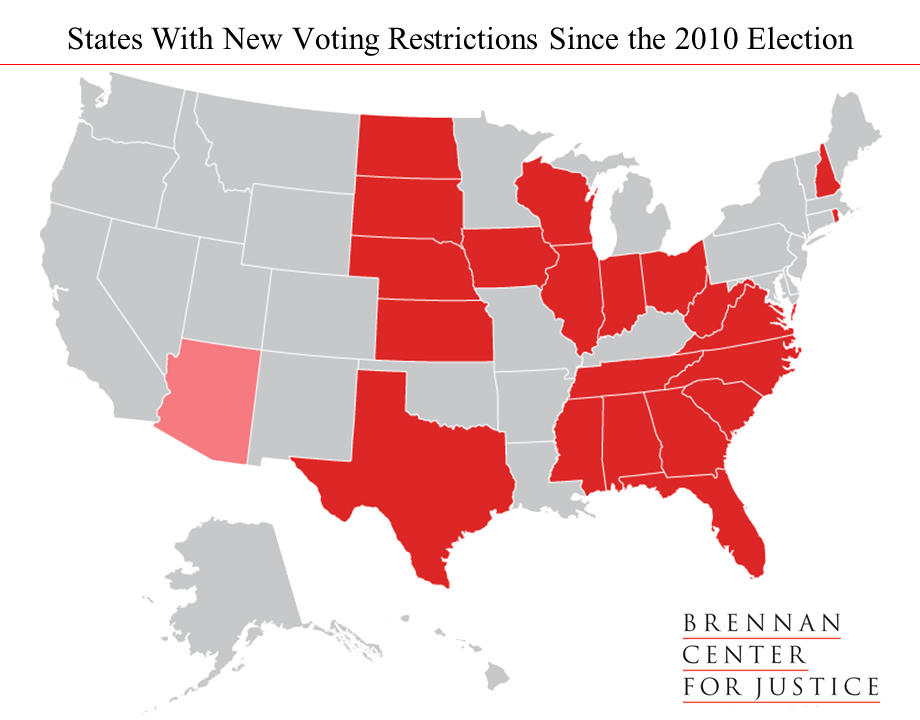
Secondly, while there have certainly been dramatic improvements in voting since 1965, there have also been widespread efforts to make it harder to vote in recent years. According to the Brennan Center for Justice, 468 new voting restrictions have been introduced in 49 states from 2011 to 2015, with 21 states putting in place new laws restricting access to the ballot.
In 2011, Bush’s home state of Florida passed a severe law shutting down voter-registration drives—which was later blocked in court—and cutting early-voting days, which led to seven-hour lines during the 2012 election.
Popular
"swipe left below to view more authors"Swipe →
Finally, it’s ironic that Bush, of all people, would say the VRA is no longer necessary, when it was under his watch, as governor in 2000, that Florida purged thousands of black voters from the rolls and likely violated the VRA, according to the US Commission on Civil Rights.
From my book excerpt in The Nation:
Before the election, Florida sent its county election supervisors a list of 58,000 alleged felons to purge from the voting rolls. Florida was one of eight states that prevented ex-felons from voting. The felon-disenfranchisement law dated back to 1868, when the state banned anyone with a felony conviction from voting unless the governor issued a pardon. The law targeted newly emancipated African-Americans, who during slavery were far more likely to be arrested than whites, including for such offenses as looking at a white woman. This racially discriminatory policy was still on the books in 2000. Blacks made up only 11 percent of registered voters in the state, but 44 percent of those on the purge list, which turned out to be littered with errors.
The NAACP sued Florida after the election for violating the Voting Rights Act (VRA). As a result of the settlement, the company that the Florida legislature entrusted with the purge—the Boca Raton–based Database Technologies (DBT)—ran the names on its 2000 purge list using stricter criteria. The exercise turned up 12,000 voters who shouldn’t have been labeled felons. That was 22 times [George] Bush’s 537-vote margin of victory.
In January and February 2001, the Civil Rights Commission listened to 30 hours of testimony from more than 100 witnesses during three field hearings in Tallahassee and Miami—including [Jeb] Bush, Harris, the state attorney general, and numerous county election supervisors. The commission’s final report found evidence of “widespread voter disenfranchisement”—which likely violated the VRA—and concluded that an “overall lack of leadership in protecting voting rights was largely responsible for the broad array of problems in Florida during the 2000 election.”
In 2006, Jeb’s brother, George W. Bush, signed the 2006 reauthorization of the VRA, which passed the Congress by a vote of 390-33 in the House and 98-0 in the Senate. President Bush recently traveled to Selma with President Obama to observe the 50th anniversary of Bloody Sunday in Selma. It’s a shame Jeb didn’t make the trip—he might have learned something.
It’s sad, but not surprising, that the same guy who said African-Americans just wanted “free stuff” from the government is now claiming that the VRA, the country’s most important civil-rights law, is no longer necessary.

