
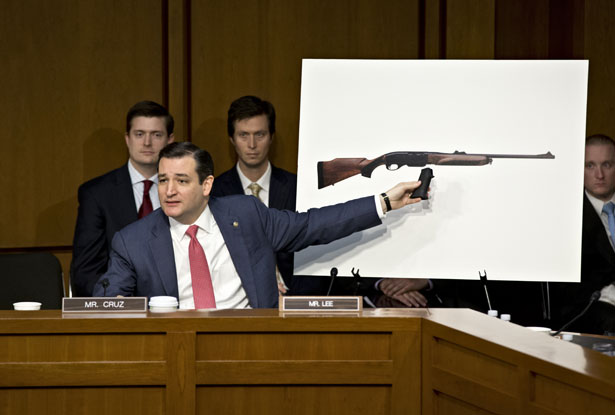
Senator Ted Cruz during the Senate Judiciary Committee hearing on what lawmakers should do to curb gun violence on January 30, 2013, on Capitol Hill in Washington. (AP Photo/J. Scott Applewhite)
“He’s a Canadian.”
So says Toronto lawyer Stephen Green, the past chairman of the Canadian Bar Association’s Citizenship and Immigration Section, of Texas Senator Ted Cruz.
Cruz, the in-a-very-big-hurry Republican who started making noises about running for president before the ink on his Senate stationery had dried, was born in Canada.
He has a Canadian birth certificate.
He spent his formative years in Canada.
But he says it never occurred to him that he was a Canadian until The Dallas Morning News reported that the senator is indeed a true son of America’s neighbor to the north.
“If a child was born in the territory, he is Canadian, period,” France Houle, a law professor at the University of Montreal, told the Texas paper. “He can ask for a passport. He can vote.”
Indeed, since the requirements to gain election to the Canadian House of Commons hold that the candidate be a citizen and of voting age, and since prime ministers are invariably parliamentarians, Cruz could be excused for imagining himself not just as a potential US presidential prospect but a potential prime minister of Canada. (Former Canadian Prime Minister John Turner was born in Britain and arrived in Canada at the age of 3.)
Cruz is not just Canadian. He is also American. His mother was a US citizen outside the country at the time of his birth, and that makes her son a dual citizen.
So the Tea Party favorite should be able to run for president—a prospect that unsettles Republican strategists but rather delights Democrats.
Popular
"swipe left below to view more authors"Swipe →
Just to assure that there are no questions about his loyalties, however, Cruz says he’ll renounce his Canadian citizenship. As he puts it, “I believe I should be only an American.”
That’s cool.
The whole “Canadian Ted” thing is tiresome.
In fact, the whole discussion about candidate citizenship and birth certificates and the Americanism of potential presidents is tiresome.
It should be put to rest.
The US Constitution should be amended to remove the section that reads, “No person except a natural born citizen, or a citizen of the United States, at the time of the adoption of this Constitution, shall be eligible to the office of President.”
Anyone who is a citizen and who meets the other requirements for seeking and holding the presidency should be able to lead the country. The “natural-born citizen” language does not merely limit the ability of otherwise qualified candidates to seek the presidency or vice-presidency—former Michigan Governor Jennifer Granholm, who was born in Canada, or former Vermont Governor Madeleine Kunin, who was born in Switzerland. It also limits the ability of voters to choose from candidates who would be credible contenders except for an accident of birth.
A decade ago, when there was a brief enthusiasm among Republicans for a presidential run by Arnold Schwarzenegger, the Austrian-born movie star who had recently been elected governor of California, one of the leading Republican members of the Senate Judiciary Committee, Utah’s Orrin Hatch, proposed “The Equal Opportunity to Govern Amendment.”
The measure would have repealed the “natural-born citizen” clause and allowed anyone who has been a US citizen for twenty years to seek the presidency or vice-presidency. The language Hatch wanted to add to the Constitution declared, “A person who is a citizen of the United States, who has been for 20 years a citizen of the United States, and who is otherwise eligible to the Office of President, is not ineligible to that Office by reason of not being a native born citizen of the United States.”
Hatch’s amendment did not get very far after its introduction in 2003. A Judiciary Committee hearing was held in 2004, but the full Senate never took up the proposal. It should now—not for the sake of Ted Cruz or any other candidate but for the sake of the American experiment in democracy.
Despite the fact that seven of the thirty-nine men who signed the US Constitution in 1787 did not meet the “natural-born citizen” standard, there was just enough fear at the time that a foreign-born monarch would take charge of the newly formed United States to cause the clause to be added.
The line’s inclusion was at odds with the Enlightenment vision of the best of the founders (including British-born Thomas Paine) and, as constitutional scholar Akhil Reed Amar noted at the 2004 Judiciary Committee hearing, the rest of the Constitution “repudiated this [English] tradition across the board, opening the House, Senate, Cabinet and federal judiciary to naturalized and native alike.”
It is time to get over the fears of 226 years ago and embrace the Enlightenment vision, recognizing that Amar was right when he told the Judiciary Committee that “modern Americans can best honor the Founders’ generally egalitarian vision by repealing the specific natural-born rule that has outlived its original purpose.”
John Nichols and Bob McChesney are the authors of Dollarocracy: How the Money and Media Election Complex is Destroying America (Nation Books), which outlines an agenda of constitutional reforms to extend American democracy.
Why did Chris Christie back down on gun control?

