

Federal agents detain someone near 19th and Portland Avenue S. in Minneapolis, Minnesota, on Thursday, January, 29, 2026.
(Richard Tsong-Taatarii / The Minnesota Star Tribune via Getty Images)With the final votes being counted in the 2026 midterms, electoral contests have given way to the usual and infinitely more annoying postelection debate over what the results mean. Did the Democrats triumph purely because of anger at the high price of gas? Was it because Black voters rose up against the Trump administration’s efforts to disenfranchise them? Was it a nationwide repudiation of MAGA on economic and cultural fronts? Do the people want another FDR?
These discussions, fun as they are for commentators (I know, glass houses), rest on the shaky premise that an election in an ultra-diverse, vast country of over 340 million people electing politicians at every level of government can speak with anything like a unified voice. But the rush to form a consensus that voters are driven above all by one singular factor also tends to paper over a host of other significant factors. For instance, most of the postelection analysis so far seems to have largely glided past one of the most directly visible examples of Donald Trump’s authoritarian excesses: the broad crackdown on immigration, speech, and political organizing helmed by ICE. This is despite the fact that revulsion at the crackdown can probably help explain not only the complete reversal of Republicans’ 2024 gains among Latinos but also broader Democratic turnout across the board.
It would be a mistake not to see the ICE invasion of Minneapolis, and the killings of Alex Pretti and Renée Good, as an inflection point in the country’s political thinking—not only in terms of the attack on immigration itself but also as such an open and militarized display of the administration’s authoritarian designs that it could no longer be ignored. Conversely, the resistance to ICE also proved that the administration was not invincible and was vulnerable to bleeding public support—and led to the biggest revival of the movement to abolish ICE since Trump’s first term.
Trump himself was questioned on this by Ross Douthat, Bari Weiss’s latest smooth-brained acquisition at the shell of 60 Minutes, where he said he might have been “too tough” on immigration enforcement. This unsurprisingly appeared to be a manifestation of Trump’s reflex to just agree with whomever he’s in front of, as almost immediately afterward he named Stephen Miller, the architect of this barbaric effort, the new White House chief of staff—a move not unlike replacing the control rods in a nuclear reactor with just more plutonium to see what happens.
The thing about Trump is that he is intrinsically, fundamentally a racist and has been for his whole life—an attitude learned from his developer father, who was infamously named alongside Donald in a federal civil rights case for refusing to rent to Black New Yorkers. He is, however, a different type of racist than Miller. Trump is the prototypical white Queens uncle racist, the sort who latently believes that Black people are less intellectually capable and Mexicans are simple, good workers who are exploitable and expendable, but is ultimately happy to transact with anyone as long as they serve his direct material interests. Miller, on the other hand, is a blood-and-soil racist, a man whose every impulse and action is warped through the prism of his deep, ideological bigotry.
In making Miller the chief of staff, Trump is ensuring that the latter approach wins out, if only because a matchup between relative indifference and zealotry will almost always result in a victory for the zealot. Trump can spend the next two years keeping the grift spigot going and enriching himself while letting Miller et al. mind the store. He’s in such a hermetic information bubble that he almost certainly does not and could not grasp the volume of disgust at Miller’s crackdown, particularly since the media narrative is already downplaying its importance to this enormous electoral loss.
No matter what, it will be hard to dislodge Miller. Trump, over a decade in public life, has proved mainly that he is committed to certain overarching tenets—his enrichment, his vanity, petty grievance and retribution, social hierarchy—but otherwise completely erratic in decision-making and personnel decisions. Apart from his family, other people do not seem entirely real to him, so he can command absolute loyalty from wretched underlings but is always prepared to toss them by the wayside the moment he thinks it’s advantageous. He has already dumped several people involved with his unpopular immigration actions, including former DHS secretary and noted puppy slaughterer Kristi Noem and fun-size Nazi Greg Bovino, the one-time Border Patrol commander responsible for the aggressive occupations in cities like Chicago and Minneapolis.
Miller, though, has been a remarkably consistent presence by Trump’s side since his first campaign, far outlasting Miller’s own former boss Jeff Sessions, who spent about a year and a half as attorney general (a long tenure in Trumpworld, as it would turn out). He seems to have entered that rarefied inner circle status just below family (the Tiffany tier, if you will).
For his part, Miller, who, if nothing else, is a tactical operator, must realize that the time he has to see through his vision of a paramilitary-enforced white America is dwindling. There will be significant pressure for Democrats to at the very least launch inquiries into ICE’s conduct. There are rumors about growing support for Maryland Senator Chris Van Hollen as Senate majority leader. If his name rings a bell, it might be because Van Hollen made headlines for traveling to El Salvador to demand to see his constituent Kilmar Ábrego García at the notorious CECOT gulag at a time when no one had seen him—or indeed the other dozens of men unlawfully sent there—alive since their rendition. A majority leader Van Hollen is not likely to forget about ICE.
Whatever guardrails still exist, Miller is liable to try to remove them completely and let the authoritarian train run unimpeded until Congress and the courts actually throw some obstacles on the tracks. He has at least the financial ability to do so, given the MAGA Congress’s mammoth appropriation for immigration enforcement just earlier this year. Yet we’re already seeing centrist pundits and party apparatchiks performing a sleight of hand, saying that the new majority must prioritize “kitchen-table” issues rather than accountability work—a prospect that will only get more ridiculous if and when ICE and its corollaries do not moderate, and perhaps just get more sadistic. As with the other questions of accountability, corruption, and weaponization of government, it should be easy to make the case not just that they are just as needed as economic justice but are inextricably tied together with it.
I don’t think that the millions of voters that handed Democrats historic victories will need much convincing that the $70 billion handed to ICE and CBP—as the Iran War was in its fourth month and after the killings of Good and Pretti—could be better used elsewhere, or that the administration’s current enforcement posture has torpedoed industries from agriculture to construction to biotech, imposing long-term costs on the American economy writ large. Not that the argument has to or should be purely an economic one; there was true, tangible, national rejection of the administration’s targeting of longtime residents and contempt for constitutional principles and basic decency. Articles in the vein of “I supported Trump’s deportation efforts, and then my wife was detained” have become so common as to basically be a trope now.
Dragging DHS officials from the secretary down before congressional committees; having a Church Committee–style dedicated investigative team uncovering the extent, mechanics, and executors of DHS abuses; referring some to criminal prosecution or civil penalties, including the prospect of impeachment; and both clawing back DHS funding and putting some stricter limits on the spending that still exists (while broaching the conversation of full abolition) are not only moral and constitutional imperatives but at this point likely political slam dunks.
The post-2024 pundit consensus that the slim Trump victory had definitively indicated a popular appetite for mass and indiscriminate deportation and the unrestrained surveillance and enforcement apparatus to support it has been proved pretty conclusively wrong. Even those voters that ostensibly did support it were backing a version of it that existed mainly in their own imaginations. As the election showed, many of them have come to detest or at the very least disavow the operations in practice.
Miller, like all dogmatists, will stop only when he’s stopped. As they settle into power, the new Democratic majorities must understand this as part of their mandate.
More from The Nation


Democrats Should Not Give an Inch to the Lame-Duck Congress Democrats Should Not Give an Inch to the Lame-Duck Congress
In this week’s Elie v. U.S., our justice correspondent makes the case for Democrats to block Trump’s attempt at judiciary-stuffing. Plus, boycott Harry Potter!

Chris Van Hollen’s Leadership Bid Is Starting Strong Chris Van Hollen’s Leadership Bid Is Starting Strong
The senator netted key endorsements from progressives, activists, and unions in his quest to oust Chuck Schumer. But he still faces an uphill climb.

Trump and Vance Are Using War to Enrich Their Cronies Trump and Vance Are Using War to Enrich Their Cronies
A new report shows how the pair is robbing Venezuela blind on behalf of one of their donors.

A Kingdom of Animals Enslaved A Kingdom of Animals Enslaved
An industry built on torture.
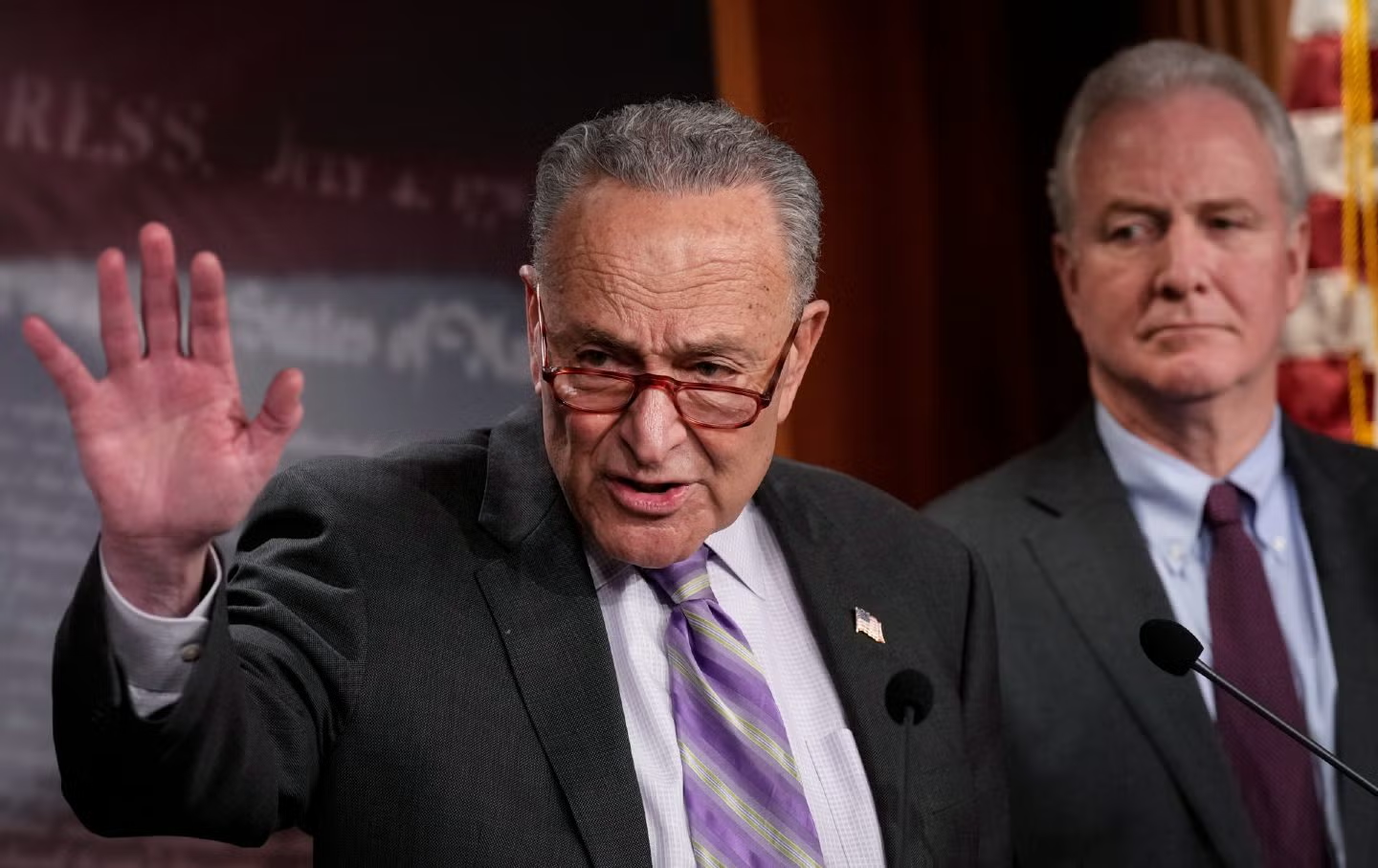
Who Will Lead the New Congress? Van Hollen vs. Schumer Who Will Lead the New Congress? Van Hollen vs. Schumer
Can the bluenami clean its own house?

