
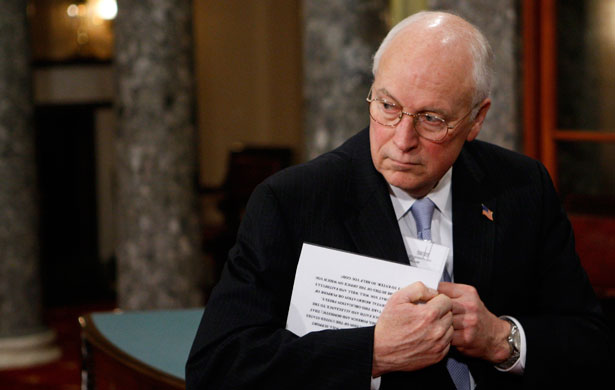
Former Vice President Dick Cheney lurks in the Old Senate Chamber on Capitol Hill. (AP Photo/Charles Dharapak)
After the Republicans gained control of the US Senate in the 2002 election, giving them across-the-board dominance of the legislative and executive branches of the federal government, the key players in the administration of President George W. Bush gathered to discuss fiscal policy.
Vice President Dick Cheney wanted to cut taxes for the rich.
Treasury Secretary Paul O’Neill was skeptical. According to his recounting of the incident in Ron Suskind’s brilliant book, The Price of Loyalty, O’Neill expressed concern that a trillion dollars worth of tax cuts had already been enacted. O’Neill was no liberal. He liked tax cuts. But with the country rebuilding from the economic slowdown after the 9/11 attacks, and with a war being fought in Afghanistan and another on the horizon in Iraq, O’Neill noted that the budget deficit was increasing. And he argued against Cheney’s position, suggesting that another tax cut was unnecessary and unwise.
“You know, Paul, Reagan proved that deficits don’t matter,” said the vice president. “We won the mid-term elections, this is our due.”
O’Neill was, according to Suskind, left speechless.
But Cheney wasn’t done. He and the Bush-Cheney administration that he served as CEO piled up deficits and debts. Indeed, as The New York Times has well noted, “Under Mr. Bush, tax cuts and war spending were the biggest policy drivers of the swing from projected surpluses to deficits from 2002 to 2009. Budget estimates that didn’t foresee the recessions in 2001 and in 2008 and 2009 also contributed to deficits. Mr. Obama’s policies, taken out to 2017, add to deficits, but not by nearly as much.”
Now, a decade later, Cheney’s party is arguing that deficits matter. A lot. House Republicans are so fretful that they are willing to steer the country toward chaos by refusing the compromises that would avert across-the-board sequester cuts. Other Republicans uncomfortable with sequestration are pushing an austerity agenda that’s better organized than the sequester, but potentially even more painful.
So was Cheney right in 2002? Or is he right, now, when he cheers on Republican attacks on Obama’s spending and says, “I worship the ground Paul Ryan walks on”?
Popular
"swipe left below to view more authors"Swipe →
The fact is that deficits are relevant.
So are debts.
Nations must treat them seriously.
But nations do not have to fear deficits, any more than Dick Cheney did on that day in the fall of 2002. And in that sense Cheney was right: deficits don’t matter if they are employed for a purpose. Cheney’s purpose—cutting taxes for the rich—was dubious. But stimulating the economy, expanding access to healthcare, funding state and local governments and protecting seniors on Social Security… these are good, and necessary, purposes.
Spending has value, especially when it is needed. As Bob Borosage of the Campaign for America’s Future reminds us: “The U.S. has witnessed slow growth since coming out of the Great Recession in 2009. The result has been a deficit that has come down from over 10 percent of gross domestic product to a projected 5.3 percent of GDP this year (slightly higher if Congress is sensible enough to repeal the sequester) and a projected 2.4 percent in 2015 (if congressional austerity bombs don’t blow up the weak recovery).”
For Cheney’s political heirs to claim now that the United States is in crisis, or at a “tipping point,” is absurd. For them to refuse to govern until they get their way, throwing one tantrum after another, is irresponsible. For them to see value in sequester cuts that impose real pain on real people is not just crude, it’s economically senseless—and dangerous to the long-term prospects for economic renewal and growth.
President Obama needs to push back against the deficit fabulists. He does not have to echo Cheney’s glib “deficits don’t matter” talk. But he should explain, as economist Dean Baker does, that the ranting and raving about deficits and debts by groups such as Pete Peterson’s Fix the Debt campaign and its co-chairs, Erskine Bowles and Alan Simpson, is “the great distraction.”
America should be focused on the economic challenges that have slowed our economy, and that have caused our government to run up deficits and debts. We need to be focused on putting people to work and growing the economy, not playing sequester games that result in real job losses and create an equally real threat of recession.
When the Fix the Debt crew gather, as Baker has noted, “many of the people most responsible for the current downturn come together to tell us why we should be worried about the deficit at a time when 25 million people are unemployed, underemployed or have given up looking for work altogether and millions face the prospect of losing their homes.”
Our concern as a country should be with shaping the policies and making the investments that find work for the jobless and create the robust economic growth that creates surpluses. That’s far more vital than the focus on fiscal issues and the deficits that Dick Cheney explained—back when he was in power—“don’t matter.”
What is Fix the Debt? And who’s behind it? Watch John Nichols’s take.

