
American Democracy, RIP
The bulwarks of self-government have given way under multiple MAGA putsches. Instead of pledging to protect our democracy, Democrats need a plan to restore it
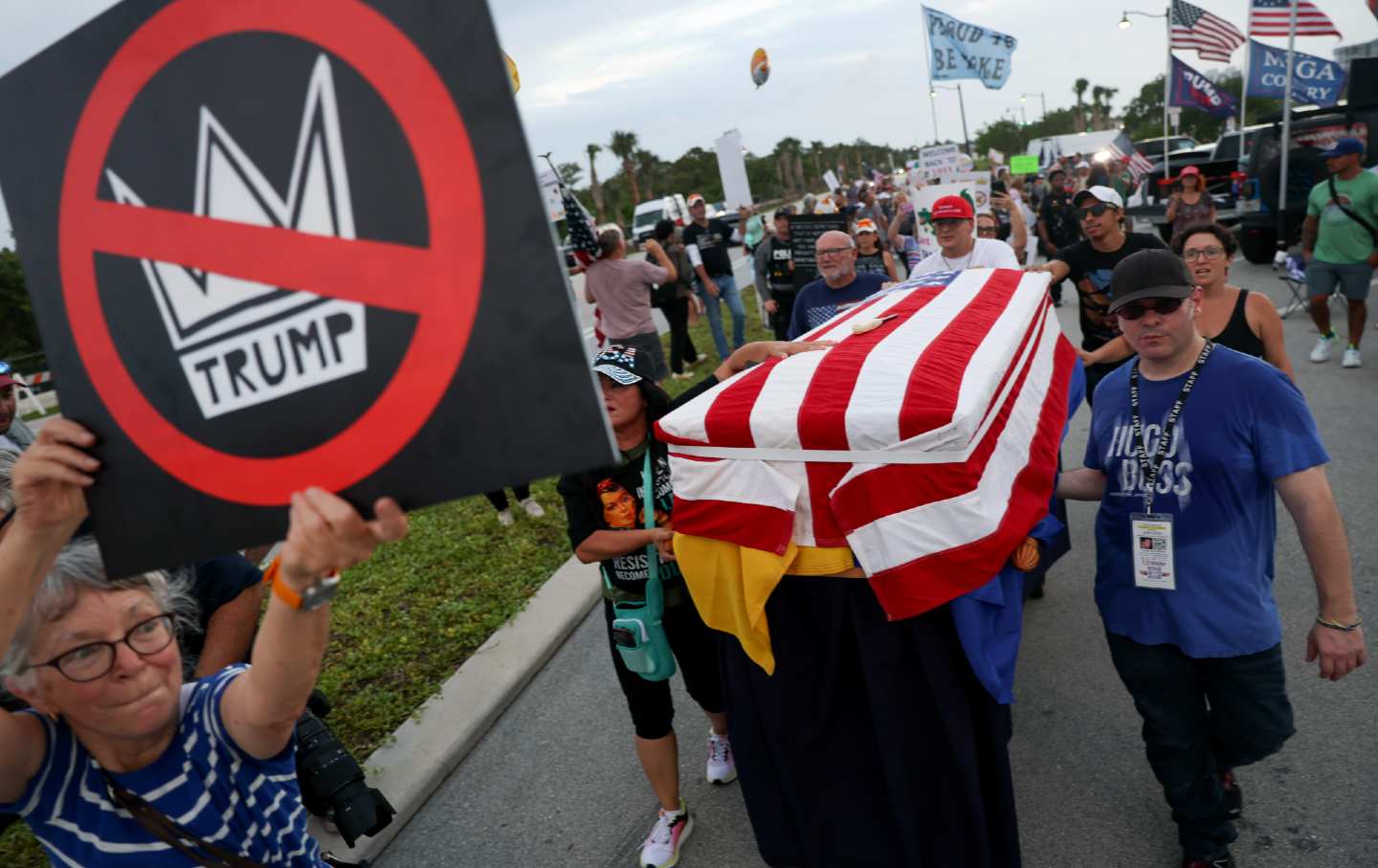
Protesters carry a coffin symbolizing the death of democracy near Donald Trump’s Mar-a-Lago home.
(Joe Raedle / Getty Images)For close to a decade now, leading Democrats have told voters that they have to vote blue to save democracy from Donald Trump and his allies. Following the assassination of a Minnesota Democratic lawmaker and her husband by a far-right extremist in June, for example, House minority leader Hakeem Jeffries (D-NY) went on television and said that the task ahead was to “defend our democracy, uplift and cherish the Constitution and create a better America moving forward.” The message voters keep getting is that Trump is a terrible president and a threat to democracy but that things will basically be fine if you vote for Democrats in 2026.
But Jeffries is wrong. American democracy is gone—not under siege, not threatened, but vanquished, with a generous assist from a 2024 electorate that endorsed (wittingly or otherwise) the institution-wrecking that is on display every day in Washington. And if Democrats can get themselves back into power using the only remnant of democracy that’s still barely on life support—national elections conducted by state authorities not yet in the bag for Trump—they need to understand that their task is not to defend an imperiled democracy but to prevent the GOP from further consolidating the autocracy that its craven politicians, reactionary intellectuals, complicit judges, and guileless voters have imagined for more than two decades and have finally put into practice over the last seven months.
The scale of America’s democratic collapse over the past six months has been obscured by the relentless pace of the second Trump administration’s policy outrages and the fact that even today many people aren’t paying particularly close attention. The crisis is also easy to overlook because the 2024 election was free and fair in the context of US democracy’s well-known limitations. But virtually everything that has transpired since November represents a sustained assault on the institutions that those elections are fought over—and every time one of them is dismantled, hobbled or set aside, it makes the task of future policymakers even harder.
The pace of horrific events has been so manic since January that it’s easy to lose sight of the big picture. President Donald Trump has succeeded in destroying the nonpartisan civil service that carries out policy in the executive branch. He has usurped the power to spend tax dollars from Congress, convincing a hard-right Supreme Court supermajority that this is fully constitutional, often in the face of unambiguous laws to the contrary. National Guard units from multiple former Confederate states are currently conducting an open-ended occupation of the nation’s capital that doubles as a trial run for subjugating other cities.
The president targets law firms, universities, publications, media corporations, and even individuals who have wronged him, while federal law enforcement is conducting a farcical probe of the leading fundraising arm of the Democratic Party. And agents from his FBI have searched the home of John Bolton—one of the many GOP critics of MAGA autocracy who served in his first White House—on flimsy-at-best allegations of improperly possessing classified documents.
The ultimate goal here is to cut off at the knees any criticism, pushback, or opposition to GOP suzerainty, destroy the institutions that undergird a free society, and demoralize the growing opposition by attaching risks of physical or financial harm to the expression of dissent. Meanwhile, Trump’s subservient allies in red states dutifully prepare to more aggressively gerrymander their district lines mid-decade so that Mike Johnson’s majority in the House can survive the backlash to this madness that they all know is coming.
Democracy can’t work if one of the major political forces in a society is implacably opposed to it. And people who study it know that there is more to the theory and practice of democracy than holding elections every few years. That is precisely why organizations like Freedom House construct elaborate models with a vast array of variables to evaluate the performance of a democracy. And on these metrics, it is clear that what the United States has experienced in the past six months is a full-scale democratic collapse.
In 2024, the country scored 84 out of 100 points on the organization’s composite democracy index. This score already reflected a significant erosion from our 2016 score of 90 and placed the United States below countries that Americans probably think of as somewhat troubled, including Italy, Argentina, and Greece. Freedom House hasn’t yet released an updated post-Trump restoration report yet, but a review of the fundamental variables makes it clear that we are set to experience a double-digit drop.
For example, the organization awards four points to countries based on whether “safeguards against official corruption” are “strong and effective.” With President Trump launching multiple scammy crypto-currencies, offering official pardons to more or less anyone who dons a MAGA hat, and using the White House as an unabashed vehicle for his own enrichment, we can safely assume that the US score on this metric will drop from three in four to (at best) one in four. Given that Trump is now appointing kooks to sous-vide official economic data because he didn’t like the most recent jobs report, bullying and blackmailing universities that refuse to crack down on free expression about Israel-Palestine, and deploying ICE agents and federal troops to detain and rendition immigrants at will, a similar decline can be expected for four-point questions like “Is there academic freedom?,” “Is there protection from the illegitimate use of physical force and freedom from war and insurgencies?,” and “Does the government operate with openness and transparency?”
I have no special insight into how the organization will evaluate these developments, but if I had to guess, I would imagine that the United States has already experienced, just since November, a roughly 20-point decline into what Freedom House calls the “Partly Free” category, which includes countries like India, Mexico, Hungary, and Bangladesh. This dramatic plunge places the United States in the realm of what political scientists call “competitive authoritarianism.” This is a relatively new model of non-democratic governance; the scholars who coined the term, Lucan Way and Steven Levitsky, defined it recently in The Journal of Democracy as a country where the “coexistence of meaningful democratic institutions and serious incumbent abuse yields electoral competition that is real but unfair.” Their 2010 book, Competitive Authoritarianism: Hybrid Regimes After the Cold War, identified nearly three dozen countries that fit into the category, and some of them indeed got more democratic over the course of the decade.
But these were mostly poor or middle-income countries navigating the transition from authoritarianism to democracy; they experienced competitive authoritarianism as a kind of way station. None had made the journey that the United States is on. In fact, it is not at all clear that there is a single example of a country dropping from near the pinnacle of democratic governance—a consolidated, healthy democracy where citizens enjoy a high standard of living and long-standing civil and political rights, and where institutions of democratic governance have operated successfully and unproblematically for decades—into sclerotic, corrupt, competitive authoritarianism and then returning to a place of full, mostly untroubled democratic rule.
What makes the GOP’s authoritarian takeover of the country especially pernicious and hard to reverse is that most Republicans have not yet, and may never, come to terms with the reality of America’s democratic collapse. This is exactly what maintaining the facade of democracy atop its smoldering corpse is meant to accomplish: It seeks to convince millions of people that there actually is no autocracy to fight and dismantle. This makes it difficult, if not impossible, to create the kind of society-wide unity and resolve needed to dislodge entrenched authoritarian rulers.
The next Democratic government, therefore, will be faced with a daunting task. Restoring democracy will mean using the kinds of emergency powers and illiberal maneuvers that Trump’s GOP used to put us in this nightmare situation. The alternative—trying to restore pre-Trump norms by example, and governing as if these are more or less normal times—has not only failed in the United States in the very recent past but also in countries like Poland, which are still struggling to escape from the trap of competitive authoritarianism.
“The fundamental problem of post-illiberalism,” wrote scholars Ben and Bill Stanley about Poland’s struggles in a July 2025 article, is that “there is no easy or obvious course of action for a reforming government to take, even with a strong democratic mandate for change.” Staying strictly within the boundaries of pre-rupture norms and laws risks alienating supporters and failing to implement critical changes to the constitutional order. Meanwhile, using illiberal tactics may lead to their full institutionalization, and allow the original aggressors against democracy to cosplay as the victims.
Popular
“swipe left below to view more authors”Swipe →The task, then, for any future Democratic-led government will not be to “uplift and cherish” the US Constitution. It will mean using every available tool—including the unaccountable, imperial power the Supreme Court has granted American presidents—to ensure that if MAGA Republicans ever get back into power, they are confronted with laws, courts, and institutions that can properly contain the party’s authoritarian ambitions. If Democrats are to construct and maintain the coalition needed to pursue bold reforms and stay in power long enough to see them through, they must break with the long-standing rhetorical posture about how saving democracy starts and ends with electing them into office.
Voters need, instead, to be braced for a frustrating reality: that our democracy has in fact collapsed. Putting Democrats back into power is merely the opening salvo in a battle to restore democracy—one that even in a best-case scenario will last for decades.
More from The Nation
Can the Dictionary Keep Up? Can the Dictionary Keep Up?
In Stefan Fatsis’s capacious, and at times score-settling, personal history of the reference book, he reveals what the dictionary can still tell us about language in modern life

The Endless Hypocrisy of Bari Weiss The Endless Hypocrisy of Bari Weiss
She claims to be a free speech champion. But as her actions at CBS News keep showing, she seems to think free speech should run only in a rightward direction.
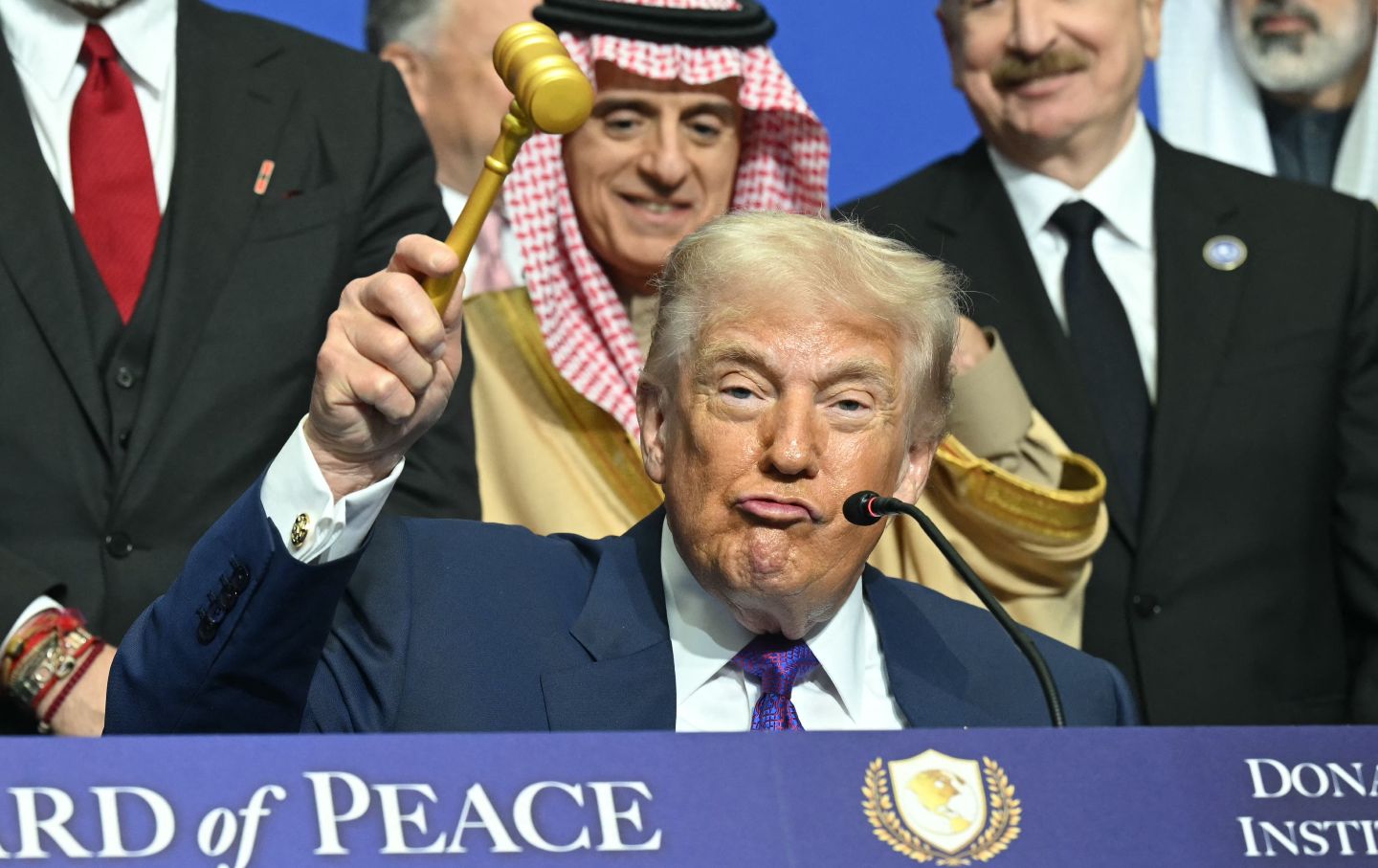
An Unlawful War An Unlawful War
The precedent being set by the US in launching this war of aggression against Iran will long live in infamy.
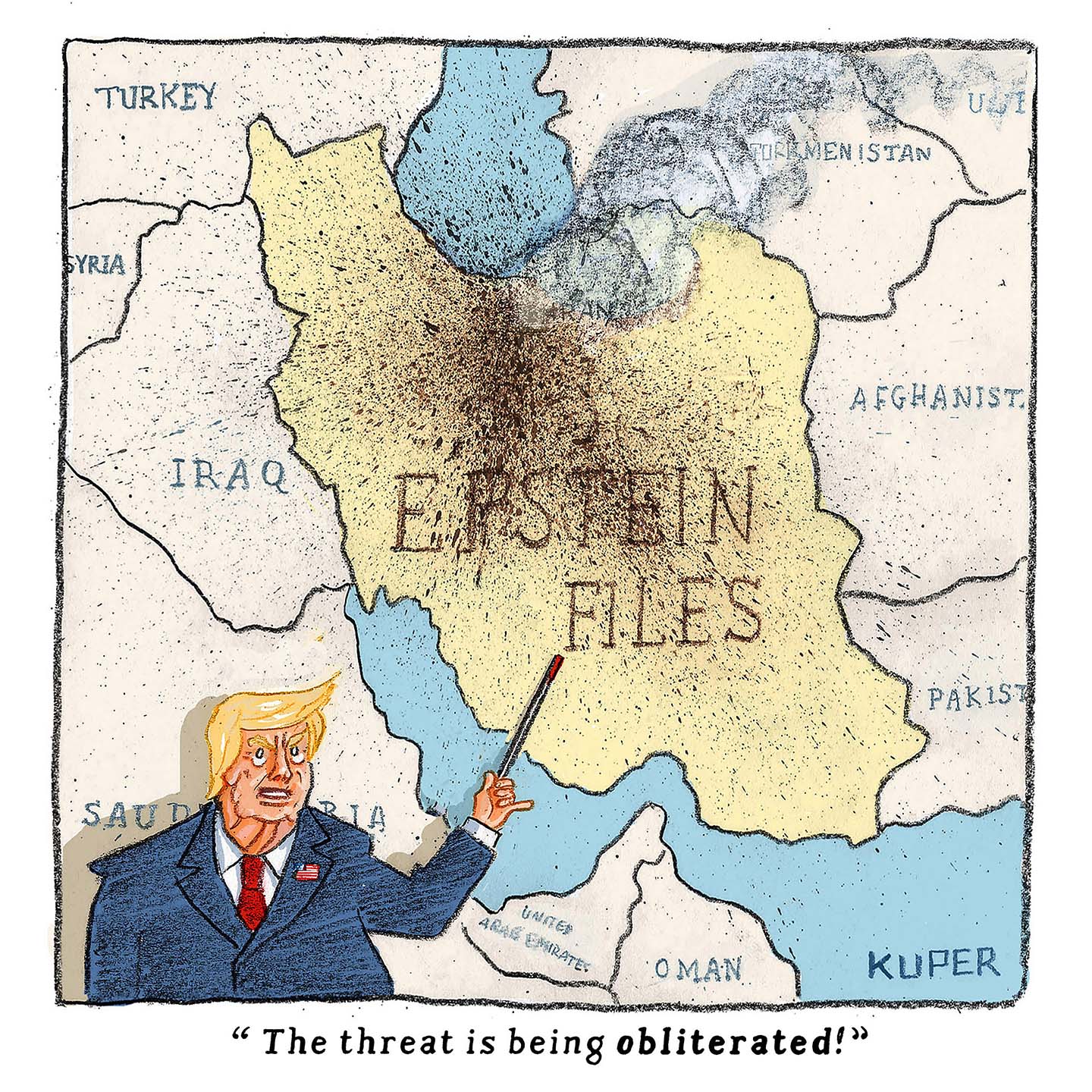
Trump’s Reason for War in Iran? Trump’s Reason for War in Iran?
Obliterating the Epstein files at any cost.
The Corporate Media Is Head Over Heels for the Iran War The Corporate Media Is Head Over Heels for the Iran War
Donald Trump’s attack may be surreal, unjustified, and illegal. But that’s not stopping the press from turning the propaganda dial way up.

Why We Misunderstand the Chinese Internet Why We Misunderstand the Chinese Internet
Journalist Yi-Ling Liu’s The Wall Dancers traces how the Internet affected daily life in China, showing how similar this corner of the Web is to the one experienced in the West.

