
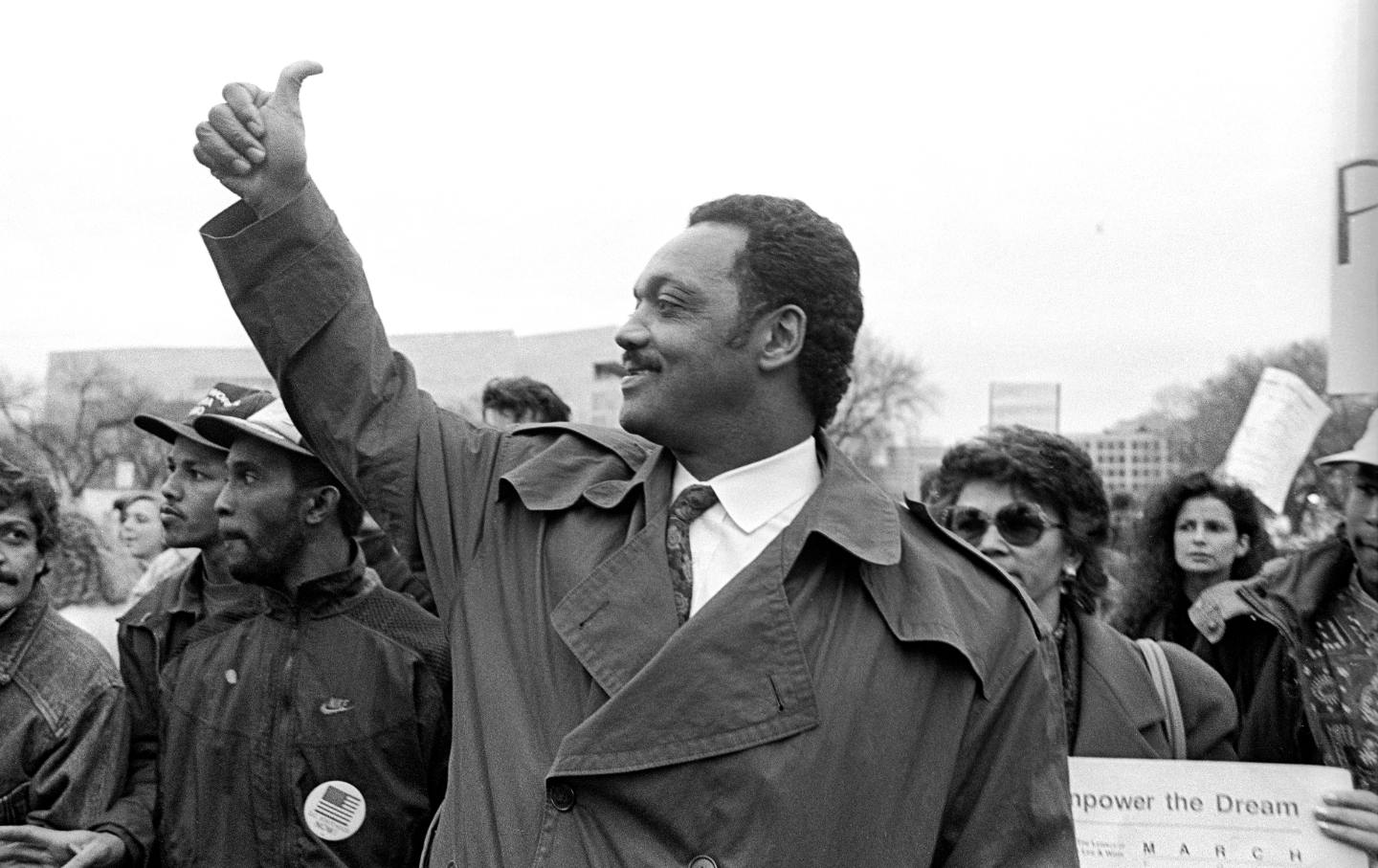
Jesse Jackson at a rally against the Gulf War in Washington, DC, on January 18, 1991.
(Ricky Flores / Getty Images)The Rev. Jesse Jackson Jr., the iconic champion of racial, economic, and social justice whose work as a young aide to the Rev. Martin Luther King Jr. began a public life that would eventually see him mount a pair of transformative presidential bids, died Tuesday morning at age 84.
Jackson’s legacy is so rich, and extends across so many generations and struggles, that it cannot be contained in one reflection. He was, as the Rev. Al Sharpton said Tuesday, “a movement unto himself.”
Over seven decades in the public arena, Jackson emerged as one of the most multifaceted figures in American history: a legendary civil rights leader, a knowing and caring defender of the disenfranchised, a vital advocate for voting rights and voter mobilization, a savvy media critic who recognized the importance of challenging narratives that promoted discrimination and division, an essential ally of labor unions, a reformer of the Democratic Party, a friend to struggling family farmers and urban workers alike, and a counselor to presidents and prime ministers. He was, as well, a man of deep faith, who expressed that faith in his ardent advocacy for peace.
That dedication to peace was central to both his 1984 and 1988 presidential bids, a fact that is too frequently neglected in cursory reflections on those seismic Rainbow Coalition campaigns.
Political historians recognize Minnesota Senator Eugene McCarthy and New York Senator Robert F. Kennedy as the great anti–Vietnam War candidates of the 1968 presidential campaign. George McGovern, the Democratic presidential nominee in 1972, is often recalled as the most ardent foe of a US military intervention to be nominated by a major American political party since Democrats ran William Jennings Bryan in 1900. Former Vermont governor Howard Dean and former Ohio representative Dennis Kucinich are remembered for seeking the Democratic presidential nod in 2004 as sharp critics of the Iraq War. Barack Obama’s prescient opposition to the Bush-Cheney administration’s war of choice, which he voiced as early as 2002, did much to advance his successful bid for the presidency in 2008. And Vermont Senator Bernie Sanders, whose 2020 presidential bid Jackson supported, reframed foreign policy debates by explicitly rejecting the elite consensus about the US role in the Middle East and so many other parts of the world.
Jackson’s two 1980s campaigns deserve a key place in this proud history—both because they were uniquely dynamic and because they had a profound and lasting impact on progressive thinking about foreign policy. That’s one of the many reasons, when veterans of the Jackson campaigns got together, we often reflected on this too-frequently-neglected aspect of his political legacy. His was a powerful and transformative message that resonates to this day.
The campaigns are often recalled for their groundbreaking advocacy on behalf of economic, social, and racial justice at home, but Jackson also outlined what was then a fresh foreign policy vision, rooted in what has come to be known as progressive internationalism. He advanced a comprehensive—and morally coherent—argument for shifting American foreign policy away from military interventionism, nuclear brinksmanship, and Cold War posturing and toward diplomacy, cooperation, and dramatically reduced Pentagon spending.
Jackson understood precisely what was at stake, and he declared in a voice so resonant that it inspired a new generation of activists, “Peace is worth the risk!”
And he was taking a risk. It is important to recall how—as Ronald Reagan was ramping up the Cold War around the world and pouring US resources into heated conflicts in El Salvador and on the border of Nicaragua—Jackson boldly broke not just with the Republican president but also with many Democrats to make opposition to war a focal point of his bid.
After it was revealed that the Central Intelligence Agency had mined three harbors in Central America, as part of an effort to destabilize the country’s left-wing government, Jackson declared in April 1984 that “the undeclared war against the people of Nicaragua…must be stopped.” In addition to criticizing the Reagan administration and the CIA, Jackson took issue with Walter Mondale and Gary Hart, the front-runners for the Democratic nomination that year, for failing to clearly deliver a message that the US must “stop our funding of terror in Nicaragua and El Salvador now and to withdraw all our troops from Central America.”
“It is not enough for Walter Mondale to call mining the harbors a clumsy and ill-conceived act,” argued Jackson. “It is not enough to imply that the main problem was not informing Congress adequately. Our foreign policy in Central America is wrong. We are standing on the wrong side of history. We are engaged in killing people, and starving people who are trying to work out their own destiny.”
Jackson’s 1984 Rainbow Coalition campaign shocked pundits by winning primaries and caucuses in key states, and by collecting roughly 20 percent of the Democratic primary vote. Jackson also made a historic trip to Central America and the Caribbean, where he met with regional leaders—including Cuban President Fidel Castro—and warned, “The signs of war are rising. We see the military buildup throughout the region. We see the United States taking sides instead of helping to reconcile the conflict. We cannot allow another Vietnam.”
The bitter legacy of the Vietnam War, which Jackson had opposed as a young aide to Dr. King, weighed heavily on his mind during the 1984 campaign. At the Democratic National Convention in San Francisco, Jackson delivered a renowned, electrifying speech, in which he recalled,
Twenty years ago, our young people were dying in a war for which they could not even vote. Twenty years later, young America has the power to stop a war in Central America and the responsibility to vote in great numbers. Young America must be politically active in 1984. The choice is war or peace.
Jackson’s focus in 1984 and in 1988 extended beyond concerns about the “dirty wars” in Central America. He campaigned as an outspoken advocate for nuclear disarmament, embracing the “nuclear freeze” movement to halt the testing, production, and deployment of nuclear weapons by the United States and the Soviet Union. He called for a rethinking of US military and economic alliances in order to advance democracy and human rights, argued for an end to US aid to the violent apartheid regime in South Africa, and proposed a new approach to Middle East relations that respected the rights of both Israelis and Palestinians.
As a 42-year-old first-time candidate in the fall of 1983, Jackson met with Arab Americans, urged the US to use diplomacy so that the Middle East would no longer be a ”flashpoint for both hot and cold war,” and said that any path to peace had to include a ”homeland and a state for Palestine.”
”It is a tragedy to see the lack of talk and dialogue in the Middle East, but it is even worse not to see it here,” said Jackson. ”The first step for peace in the Middle East is for black Americans, Arab-Americans and Jewish-Americans to start talking here.”
A young James Zogby, then the director of the Arab-American Antidiscrimination Committee, cheered Jackson’s inclusion of Palestinian rights in his campaign platform. ”He challenged us on 50 issues and not just one,” said Zogby, who would go on to place Jackson’s name in nomination at the 1984 Democratic National Convention. ”He respected us as Arab-Americans and didn’t pander to us. This is the first time ever that a presidential candidate has come before an Arab-American audience, and we don’t feel disenfranchised anymore.”
Popular
“swipe left below to view more authors”Swipe →At the end of that year, Jackson traveled to the Middle East and visited the Jaramana refugee camp in Syria, where on New Year’s Day in 1984, he told a group of Palestinian children, “Keep your dreams high. Don’t let anyone break your spirit. You’ll be free one day.” It was on that same journey that he secured the release of US Navy airman Lt. Robert Goodman, whose plane had been shot down over Lebanon and who had been captured and held by Syrian forces.
Jackson remained actively engaged with Middle East peace issues through the rest of his life. Among the memorials posted on Tuesday was one from former British Labour Party leader Jeremy Corbyn, who wrote, “It was an honor to march alongside him against the Iraq War in 2003. May his legacy inspire us to strive for a world of dignity and peace for all.” More than two decades later, one of an ailing Jackson’s last great initiatives was an emergency conference—held at the headquarters of the Rainbow-Push Coalition in Chicago in early 2024—to demand a ceasefire in Gaza.
Jackson’s faith in diplomacy and negotiation was part of a broader commitment to creating the circumstances for peace to thrive. Just like his mentor King, the Nobel Peace Prize recipient who linked his nonviolent civil rights activism in the US to the global anti-war movement—and who took his own huge risk for peace by standing against the Vietnam War—Jackson recognized the political courage that was required to advance that commitment.
As a presidential candidate, he showed that courage by talking about cutting as much as 25 percent from the Pentagon budget. In response to critics who claimed his ideas were too radical, Jackson told New Hampshire primary voters in February of 1984, “We are so strong militarily that we can afford to take measures such as these in the pursuit of peace.… We must fight for peace and give peace a chance.”
After the 1988 campaign, in which he was endorsed by The Nation, won more than a dozen statewide primary and caucus contests, and secured 6.9 million votes, Jackson pulled all the threads together in an epic address to that year’s Democratic National Convention in Atlanta. He spoke movingly of tackling poverty and inequality within the United States, but he was just as compelling in his discussion of foreign policy, which included a stirring call for disarmament that is as relevant today as it was 35 years ago.
Jackson told the cheering delegates:
The nuclear war build-up is irrational. Strong leadership cannot desire to look tough and let that stand in the way of the pursuit of peace. Leadership must reverse the arms race. At least we should pledge no first use. Why? Because first use begets first retaliation. And that’s mutual annihilation. That’s not a rational way out.
No use at all. Let’s think it out and not fight it out because it’s an unwinnable fight. Why hold a card that you can never drop? Let’s give peace a chance.
More from The Nation
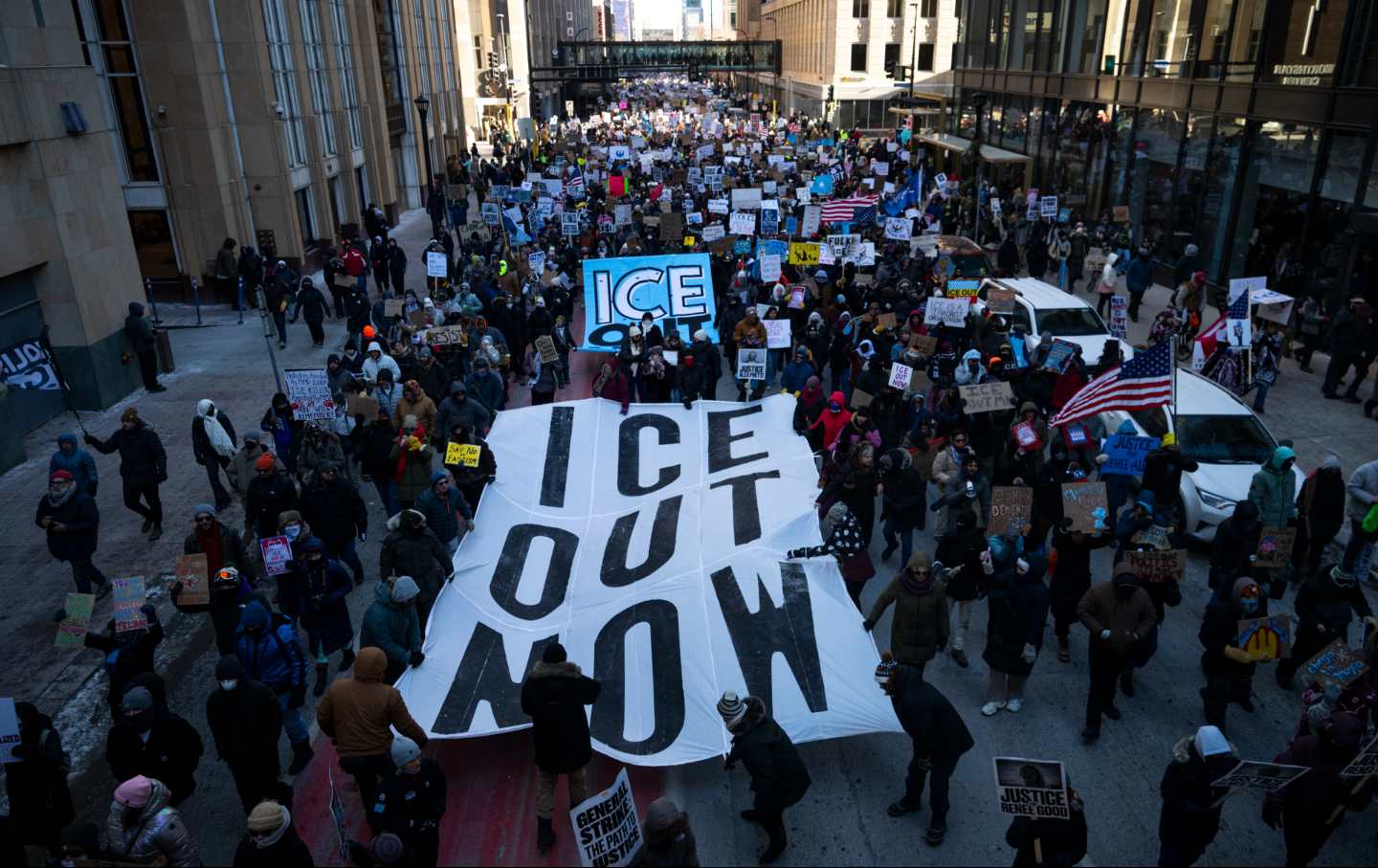
ICE Melts in the Minneapolis Winter ICE Melts in the Minneapolis Winter
Now it’s time to abolish the agency and impeach Kristi Noem.
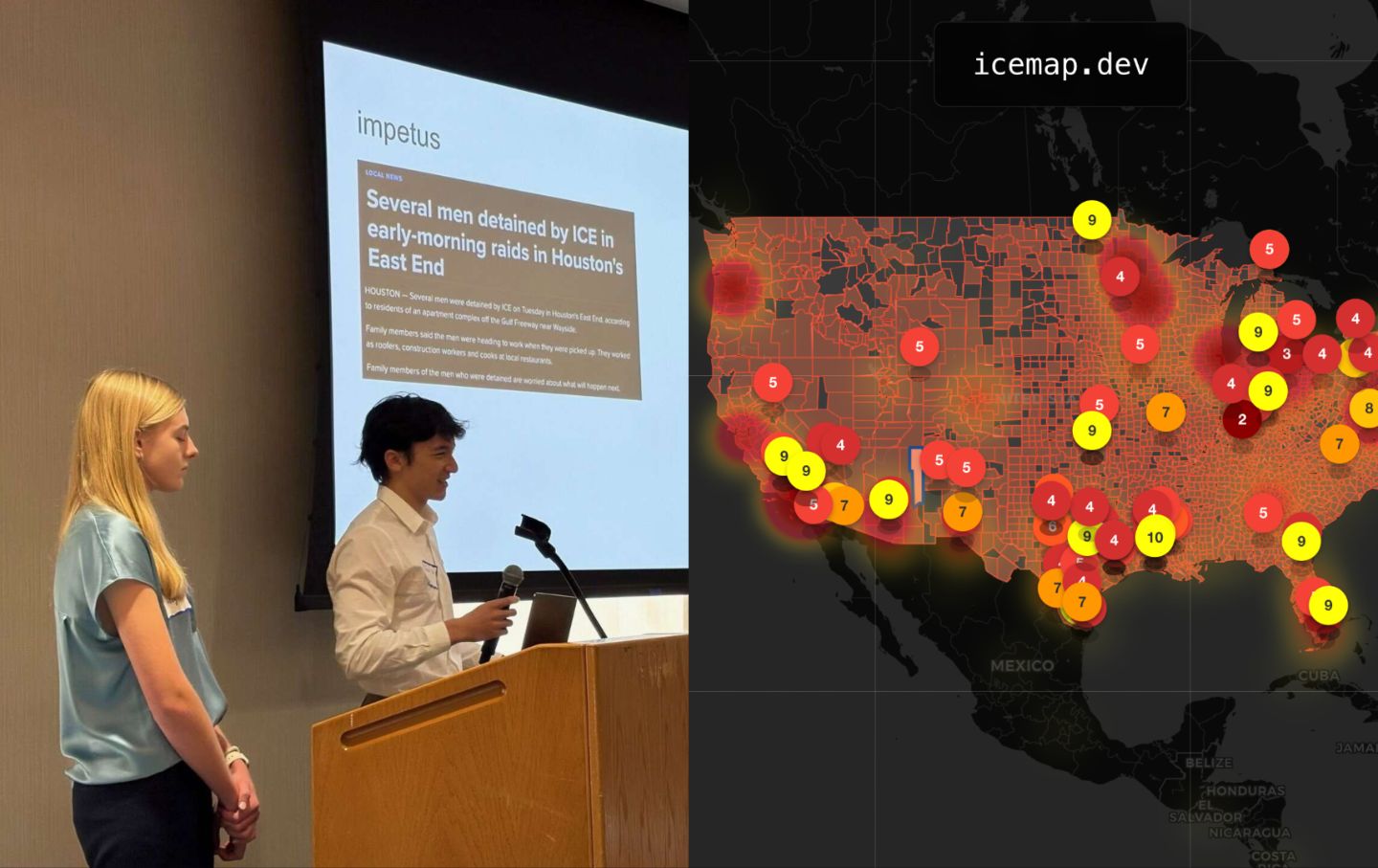
How 2 University Freshman Are Tracking ICE Enforcement Actions Across the Country How 2 University Freshman Are Tracking ICE Enforcement Actions Across the Country
With ICE Map, Rice University students Jack Vu and Abby Manuel hope to help communities understand where immigration enforcement activity is happening and how it unfolds in real t...
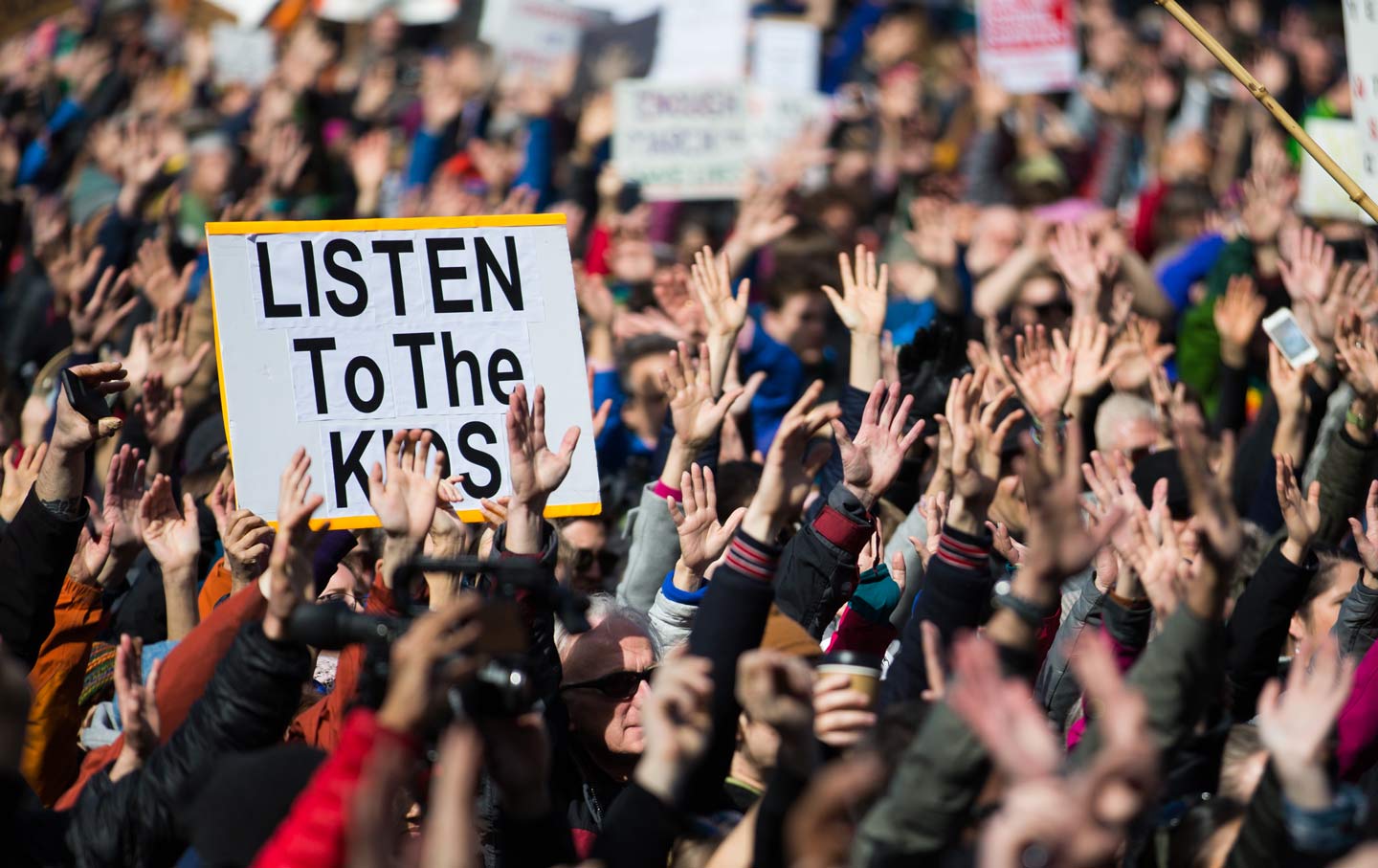
Meet the Young Organizers Survival Corps Meet the Young Organizers Survival Corps
Young organizers from around the country gathered at Haley Farm to study past social movements and train in the tactics of nonviolent resistance and grassroots organizing.
I Fled the US to Escape the Security State. Instead, It Followed Me. I Fled the US to Escape the Security State. Instead, It Followed Me.
My recent detention at Heathrow shows that the architecture of state repression knows no borders.
Surveilled on Your Own Campus Surveilled on Your Own Campus
Universities across the country have used extraordinary measures to target student activists following more than two years of pro-Palestinian protests.
Citizen Journalists Are Minneapolis’s Unsung Heroes Citizen Journalists Are Minneapolis’s Unsung Heroes
Without their videos of ICE shootings, we wouldn’t know what is really happening.

