
Meet the Immigrant Workers Who Launched the First Major Meatpacking Strike in Decades
Amid the Trump administration’s assault on immigrant workers, thousands at the country’s largest meat processor organized across nationalities to launch a historic work stoppage.
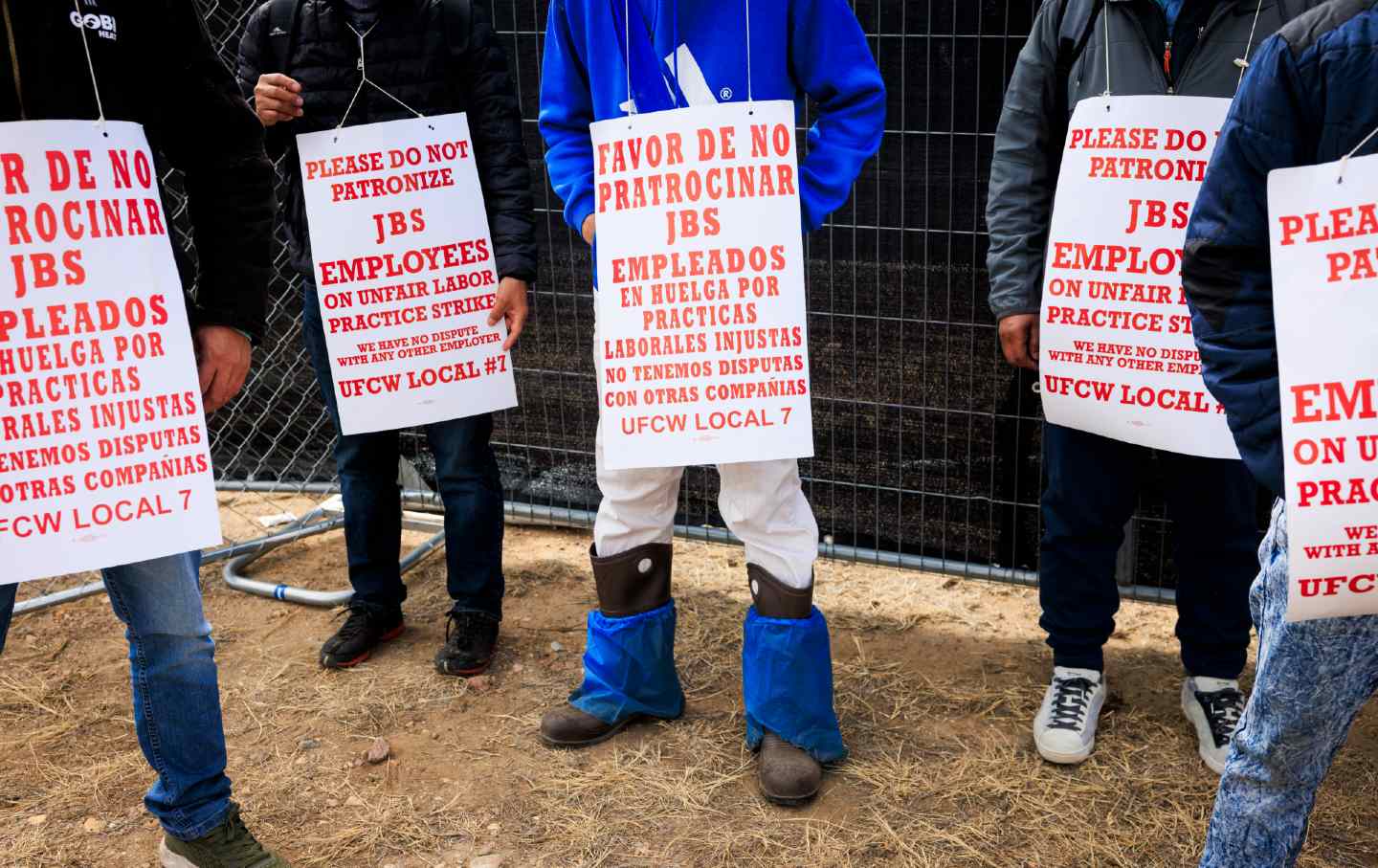
Workers picket outside of the JBS meatpacking plant on March 16, 2026, in Greeley, Colorado.
(Michael Ciaglo / Getty Images)Olga Barrios has been working at the beef-processing plant in Greeley, Colorado, long enough to remember the morning in 2006 when ICE agents stormed in and arrested 260 of her coworkers. She watched as they were rounded up, restrained with cellophane wrap and chains, and marched out of the facility. Recounting that time to me, she grew emotional as she described how a local church took in children whose parents had been detained. To this day, “it’s in the back of my mind,” she said. “The company, instead of protecting the workers, was actually turning them in.”
The owner of the Greeley plant at the time, Swift, was the target of six simultaneous ICE raids across the United States in “Operation Wagon Train,” the largest single worksite immigration enforcement action in US history. Some 1,300 workers were detained in all, depleting Swift’s overall workforce by 10 percent. The company struggled to recover, and a year later it was acquired by JBS, a Brazilian company and the world’s largest meat producer.
Since the raid, JBS has rebuilt its workforce by partnering with refugee resettlement agencies to recruit migrants with work authorization. As of 2020, an estimated 80–90 percent of workers at the Greeley plant were foreign born. Workers speak over 50 languages on the disassembly line as they slice, debone, trim, and grind up to 6,000 carcasses a day. Kim Cordova, the president of United Food and Commercial Workers (UFCW) Local 7, which represents workers at the plant, said JBS’s reliance on immigrant labor is strategic. “They’re really good about bringing in folks from different countries that don’t know their rights yet or are here seeking asylum,” she said. JBS knows that precarity and fear means “they can run those chain speeds fast.”
But on March 16, Barrios and her 3,800 coworkers reached a breaking point, walking off the job to launch the first-ever strike at the Greeley plant and the first major strike in the US meatpacking industry in four decades. Members have been working under an expired contract since last July, and have struggled to come to an agreement with JBS on issues including pay and adequate safety equipment. According to the union, JBS has offered wage increases of less than 2 percent per year on average, lower than the rate of inflation. The strike is scheduled to end today after stretching into a third week as the union said JBS refused to come to the table.
Meatpacking is among the most dangerous industries in the United States, with workers standing shoulder-to-shoulder using industrial tools and sharp knives to make thousands of repetitive cuts in a shift. Workers don personal protective equipment including hard hats (with colors indicating their level of seniority), safety goggles, boots, metal-mesh gloves, arm-guards, aprons, and more. But when that gear is inevitably damaged or worn down, JBS garnishes the cost of replacement directly from workers’ checks, which can cost up to $1,100. The plant’s average wage is just $26 an hour.
Amid the Trump administration’s assault on immigrant workers, JBS employees organized across nationalities and languages to launch a historic work stoppage. Many workers in meatpacking plants have Temporary Protected Status, which Trump has eliminated for millions from countries including Haiti, Venezuela, and Afghanistan. Last June, the administration paused ICE raids in agriculture and meatpacking after pressure from the industry, but reversed course just days later. In July, ICE raided a Glenn Valley Foods meat processing plant in Omaha, Nebraska, detaining more than 50 employees, and leaving the plant without most of its workforce. And ICE’s terror campaign across the country puts workers at risk, regardless of their immigration status. “It doesn’t matter whether you’re born in this country or not,” said Cordova. “We’ve had US citizens killed by ICE.”
Even in this hostile political climate, workers in Greeley are fighting back, Cordova said, “Because you can die at that plant.” In 2021, OSHA cited JBS after a worker fell into a vat containing chemicals used to process animal hides and died. That same year, a worker was pulled into a conveyor belt and had to have his arm amputated. “Our union gave us an opportunity to speak up for ourselves and that’s what we’re doing,” said Nathaniel Mann, who has worked at JBS for one year. “Pay us for our work. People are losing their hands. People are losing their lives.”
You may not have heard of JBS, but you likely have seen their products sold under brand names like Blue Ribbon Beef and Certified Angus Beef sold at Costco, Kroger, and Stop & Shop and supplied to McDonald’s, Burger King, and more. JBS is the largest player in the highly concentrated US meatpacking industry, 85 percent of which was dominated by just four companies in 2019. The flagship Greeley plant alone accounts for 5 percent of the country’s beef-processing capacity.
JBS is the largest employer in surrounding Weld County, and has built a workforce of migrants from Mexico, Somalia, Myanmar, and more. By 2007, Greeley’s foreign-born population had swelled to 12,000, constituting more than 12 percent of the total population and a 60 percent increase from 2000. Other companies emulated JBS’s model and as of 2020 more than 45 percent of all meatpacking workers were foreign-born.
JBS relies on a stream of migrant labor constantly replenished by high turnover in its grueling slaughterhouses. According to Local 7, a new hire class of up to 60 workers go through training at the plant every week. “The company would benefit if they took better care of the ones that are there, have been there long, and know the job,” said Barrios.
To meet its labor demand, JBS has allegedly turned to increasingly unscrupulous hiring methods. The company currently faces a class-action lawsuit by over 1,000 Haitian workers who say they were recruited to Greeley via TikTok with the promise of jobs and housing nearby. Instead, they were packed into squalid motel rooms with up to 11 other people, and thrown into hazardous disassembly work without training in their native language.
“We strongly disagree with the claims made in the recently filed lawsuit,” said a JBS spokesperson. “Our employees choose to work with us, understand the terms of their employment, and are free to leave at any time.”
JBS’s market size allows it to set industry standards for pay and conditions, especially for newly arrived immigrant workers who lack other options for entry-level jobs that don’t require English proficiency. From Greeley, an Amazon warehouse that could provide similar work is over an hour away. “JBS is doing whatever they want because they don’t have competition,” said Bienvenue Hovozounkou, a union steward who has worked at JBS since he moved to the United States from Benin in 2019. JBS paid $55 million to settle a 2024 lawsuit alleging that it colluded with other big meatpackers to suppress wages across the industry.
JBS is trying to pressure workers at Greeley to accept the same terms it negotiated with 14 other plants last year. “We presented a strong, fair offer consistent with the historic national contract reached in 2025 in partnership with UFCW International – an agreement that has already delivered higher wages, a secure pension, and long-term financial stability for team members at our other major facilities,” said the JBS spokesperson. But Local 7 says that contract doesn’t account for the higher living expenses in Colorado (compared to other worksites in places like Nebraska and Texas). If workers in Greeley win more, it could open the door for tens of thousands of workers at other plants to demand the same when their contracts expire.
Mann works on the cleaning team, sweeping away discarded innards and cuts of meat that fall to the floor and spraying the conveyors and work surfaces clean of blood. He wears a wetsuit to protect him from the 180-degree water in the pressurized hose he uses. During a recent shift, he heard screaming behind him and turned around to see that the hose’s back end had exploded, spraying scalding water on everyone on the line (who aren’t given protective suits). He watched it burn through a woman’s boot down to her shoe. Two days later, management hadn’t properly patched the hose, and it exploded again.
This time Mann saw it happening and jumped on top of the hose as if to block the impact of a bomb, covering the geyser with his suited body. He felt the scorching water seeping through the seams of his suit until another coworker realized what was happening and turned the water off. Mann’s story isn’t uncommon. JBS has been fined by OSHA for failing to provide proper protective equipment to workers handling the hot water lines and exposing them to severe skin and eye injuries from hazardous chemical cleaners.
A lack of proper equipment can turn a dangerous job into a deadly one. The union says JBS keeps a low inventory of personal protective equipment, which is often given to workers damaged or in the wrong size. Workers use dull, thinned down knives to cut through hide, muscle, and bone. When they ask for a replacement, workers say JBS garnishes the cost directly out of their paychecks, ranging from around $100 for gloves to over $1,000 for mesh gowns. “Our policy is—and has long been—that team members are only responsible for paying for personal protective equipment if the equipment is lost or maliciously damaged,” said the JBS spokesperson.
Even if they avoid the most gruesome accidents, workers often suffer from repetitive motion injuries. Nesly Pierre, one of the plaintiffs in the class action suit by Haitian workers, was assigned to “slaughter intestines” on the kill floor, which required him to stick two fingers into the belly of a cow carcass and pull the intestine out with his fingers. After a few days, his fingers locked in a clawing position and his hand swelled so big that he couldn’t close it.
The pace of work is set by an overhead chain that launches carcasses toward workers who rush to carve them using heavy saws, knives, and power tools. As of 2024, JBS’s crewing guide had a maximum speed of 390 “heads” per hour. But Hovozounkou monitors chain speeds as a union steward, and has seen them reach 420 in the last year. The USDA is currently considering a proposal to allow for even faster chain speeds in pork and chicken processing plants, which JBS has publicly applauded.
Popular
“swipe left below to view more authors”Swipe →A week before the strike began, workers say JBS management brought them into rooms in groups and told them the company couldn’t guarantee that they’d keep their jobs if they went on strike. “Because we hadn’t seen [a strike] before, there was definitely fear and a lot of questioning as to what are going to be the consequences of all this,” said Barrios. But, she added, “We all agreed that this is going to have to happen for…ourselves and also for the future and the betterment of the community.”
The specter of Trump’s immigration crackdowns functions as a means of control to scare workers out of taking action. “The company is doubling down on their threats and intimidation to try to force people to come to work in really bad working environments,” said Cordova. Images from Greeley have captured a striking defiance against the Trump administration’s campaign of fear. On the lively picket line, workers danced and sang in Spanish, French, Haitian Creole, Burmese, Somali, Rohingya, and more. “For many of the workers, this is the first time they’ve ever got to experience democracy, is having the right to vote on their contract,” said Cordova. “A strike represents democracy.”
By striking, workers are hitting back not just at JBS management but also the Trump administration’s embrace of the company. Pilgrim’s Pride, a chicken-processing subsidiary of JBS, was the single largest donor to Trump’s inauguration fund, giving $5 million. Just months later, the SEC approved JBS’s listing on the New York Stock Exchange over the protests of lawmakers and activists based on the company’s history of bribing Brazilian officials, deforestation in the Amazon, and child-labor violations, including at the Greeley plant, where investigators found that migrant children as young as 13 were working overnight shifts.
Hovozounkou sees JBS’s donations to Trump as an insult to workers. “They have money to support someone else who is not even working for them,” he said. “We are the ones who are suffering, making money for them, putting our lives in danger.” Workers believe JBS will ultimately come to the table because it can’t generate its record profits without them. “Without the employees, there is no company,” said Hovozounkou. “We want JBS to listen, to hear from our voice what we want and then give it to us.”
More from The Nation
How Gaza Broke Big Tech’s Campus Pipeline How Gaza Broke Big Tech’s Campus Pipeline
Big Tech’s complicity in Israel’s genocide in Gaza has pushed STEM students to organize for a more ethical tech industry.
Bernie Sanders: “This War Must End Immediately!” Bernie Sanders: “This War Must End Immediately!”
The senator delivered a powerful message on Iran at the No Kings Rally in Minnesota.
No Kings! No Wars! No Kings! No Wars!
The founders of the United States feared monarchically inclined presidents who could wage wars of whim.
What We Must Learn From the Revelations About Cesar Chavez What We Must Learn From the Revelations About Cesar Chavez
The sexual predations of the late labor leader follow a depressingly familiar pattern in left organizing circles.
Dolores Huerta: “My Silence Ends Here” Dolores Huerta: “My Silence Ends Here”
The labor movement icon speaks out after revealing that she was sexually assaulted by Cesar Chavez.

