We Need to Turn Our Outrage Way Up
This is no time to sit idly by. People’s lives are at stake. We have to put our bodies on the line.
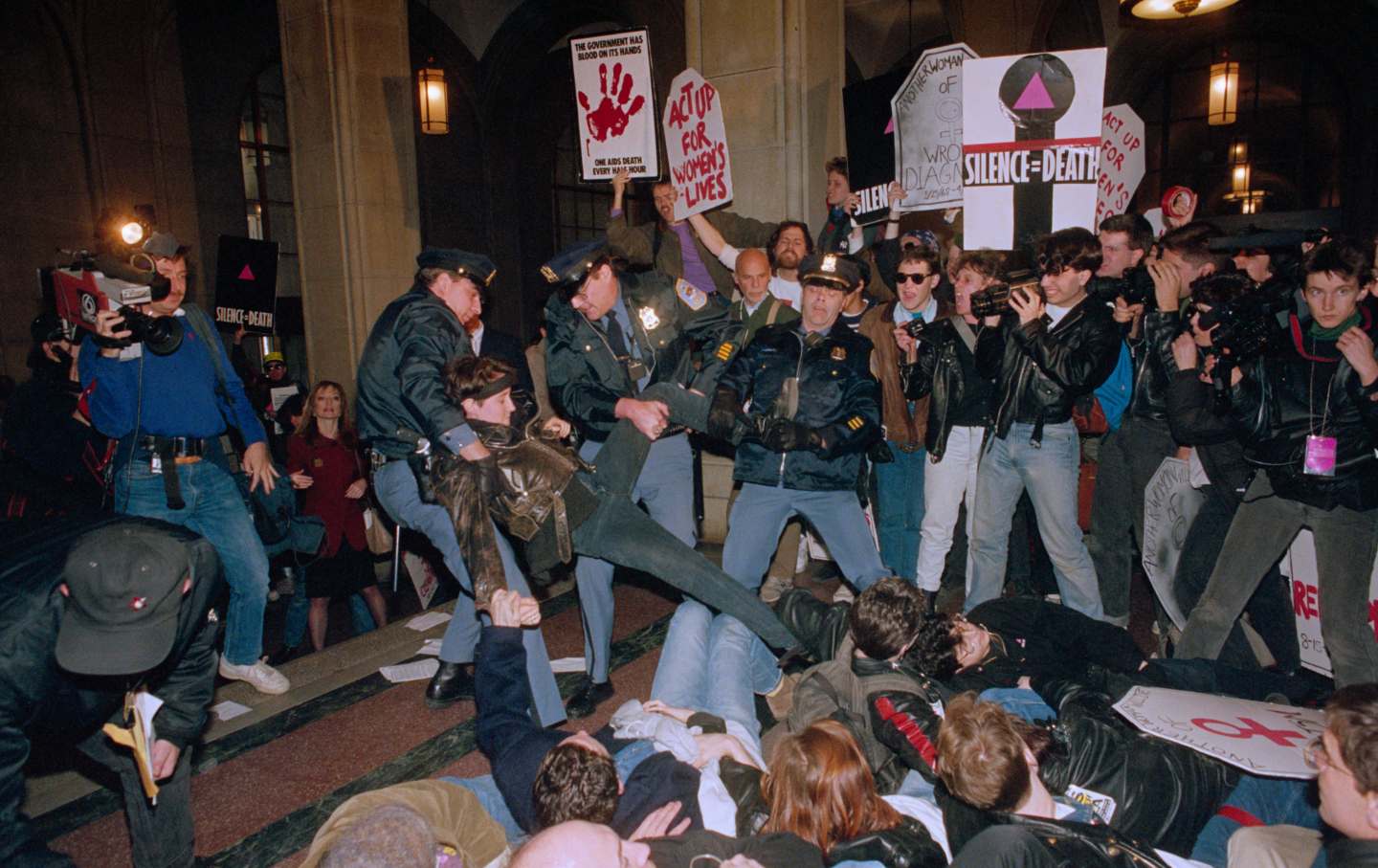
Police officers remove members of ACT UP who have staged a sit-in inside the hallway of the New York State Capitol in Albany in 1990.
(Bettmann via Getty Images)Back in the 1980s, I was a young gay man struggling to come to terms with my sexuality. By 1986, I had dropped out of college and moved to London. I ended up working in a factory as a clerk, and, far away from home. I was reveling in exploring all that gay London had to offer. One evening, I went to the Royal Court Theater to see a production by a gay playwright named Larry Kramer called The Normal Heart.
Little did I know that a few years later I would join ACT UP, meet Larry, and count him as a friend and comrade over the rest of his life.
I am thinking of Larry and The Normal Heart lately because of the tale it tells. Largely, well, almost entirely autobiographical, it’s about the early days of the AIDS epidemic in New York City, the establishment of Gay Men’s Health Crisis, which was set up to serve the needs of those living with the disease, and Larry’s growing estrangement from his peers as he excoriates them for their genteel timidity in the face of this new plague. In a pivotal scene, just before Ned Weeks, Larry’s alter ego and the play’s main character, is booted off the board of the organization he helped found, he screams at Bruce Niles, the organization’s president: “It’s happened before. It’s all happened before. History is worth shit. I swear to God I now understand… Is this how so many people just walked into gas chambers?”
I remember the audible gasp in the theater at that line, with its ugly insinuation that Jews and other exterminated by the Nazis didn’t fight hard enough to avoid their fate. Ned Weeks continued a few minutes later: “Until we organize ourselves block by neighborhood by city by state into a united visible community that fights back, we’re doomed. That’s how I want to be defined: as one of the men who fought the war.”
I am thinking of Larry now because he was right: It wasn’t until gay men and their allies organized in ACT UP—the AIDS Coalition to Unleash Power—that our community broke through. We couldn’t be ignored any longer. We scared the leaders of federal agencies, challenged politicians on their doorsteps, took on media giants who ignored the epidemic. And we changed the world.
We’re now faced with a new existential threat in our midst, and I wish Larry was here to call us out. I can’t tell you the number of conversations I’ve been in with leaders of different groups, where they rattle on about crafting better messages, reaching out to Republicans on the Hill, drafting white papers, getting op-eds in local papers—the standard run-of-the-mill to-do list of getting things accomplished in Washington, or in New York City, or in state capitals around the country. The worst part comes when someone inevitably suggests that the best thing to do is lie low and wait the current moment out—or to yield to Republicans just a little bit.
But this isn’t just the strategy of health advocates or university leaders. It’s the MO of the Democratic Party—with James Carville’s clueless op-ed in The New York Times telling people to play dead and let the GOP implode, or Dems in Congress suggesting that their colleagues wear pink to express their disapproval during the State of the Union, or Elissa Slotkin waxing sentimental about Ronald Reagan. (Dear Elissa: I remember the man too—he didn’t mention the pandemic until late into his term and after over 10,000 people had died of AIDS in this country.)
My message to everyone who thinks they can just hide away right now is simple: People are going to die. Imminently. We don’t have time to waste playing games.
The cuts to USAID alone are imperiling millions of lives around the globe. The proposed cuts to Medicaid in the House budget resolution, Robert F. Kennedy Jr.’s reign of error at the Department of Health and Human Services (his shenanigans with vaccine advisory committees are already risking next year’s flu vaccine), and the constant fuckery from the White House (including the ongoing dismantling of the CDC) could cause a death toll that would make the AIDS epidemic in the US look mild by comparison.
And yet, where is the outrage? I know people feel it. It’s part of every conversation I’ve had for weeks with colleagues, friends, students, and others. Yes, I know the circles I run in are expected to be angry, but constituents at GOP town halls far away from New Haven and Boston are up in arms as well.
But people who run the big institutions and groups get indignant when you suggest this is an existential moment. They say that they will not be shamed for not speaking out or doing more, that we all have different roles to play. Sure, I get it. But then I don’t.
If these were ordinary times, the usual tactics and strategies would be useful. Hell, I’ve spent time in DC lobbying for AIDS legislation. I’ve written policy papers, crafted press releases to get the message out.
Popular
“swipe left below to view more authors”Swipe →But it is indeed time for more. Those of us with privilege—and it’s most of the people in the meetings I’ve been part of—have the most responsibility here. We have less to lose than many others. So, as we always must do in existential moments, it’s time to put our bodies on the line and lead.
And yes, there have been demonstrations and civil disobedience happening, but it’s been on a small scale. Only with support from major organizations and civil society actors can this kind of action reverberate nationally. It’s all-hands-on-deck time. From unions, to religious groups, to those of us in higher education, to civil rights organizations, we need a mass mobilization—a united democratic front—to push back before it’s too late. Too many lives are at stake to rest in this bizarre moment of frozen agitation.
“That’s how I want to be defined: as one of the men who fought the war,” said Ned Weeks in The Normal Heart. I have little use for war metaphors, but how is it that we want to be remembered? The worst thing I can think of is being remembered as doing too little, holding back, and playing it safe as the world burned.