As AI Breathes Down Our Necks, It’s Time for a Luddite Renaissance
Nineteenth-century textile workers longed to stay human in a machine age. So do we.
Vermont Senator Bernie Sanders became the first federal legislator to seriously challenge the lurch by Big Tech oligarchs into the uncharted territories of artificial intelligence when he issued a call in December for a “moratorium on the construction of data centers that are powering the unregulated sprint to develop and deploy AI.” His reasoned argument—that a moratorium is necessary “to slow it down” and “give democracy a chance to catch up”—echoes the sentiments of a growing number of Americans who have come to see AI less as a promise than a threat. Yet Sanders was hit with immediate, and strikingly vitriolic, pushback from the tribunes of the billionaire class.
Dismissing the concerns that he raised—and despite the fact that many of the defining figures in the development of AI have expressed similar sentiments—Fox News’s Stuart Varney rushed to label Sanders as “economically illiterate,” while other corporate-friendly conservatives tagged him as “the nation’s foremost avatar of reactionary socialism,” accused him of engaging in “AI doomerism” and “NIMBY-type” reasoning, and concluded that he might just be peddling “the most poisonously stupid idea of the year.” Then they hurled the ultimate insult that contemporary elites can muster when the American people and their elected representatives start to question tech-bro definitions of “progress.” Sanders, they announced, was “a Luddite.”
In an editorial headlined “Bernie Sanders’s Worst Idea Yet.” The Washington Post fumed that “a national ban on new AI data centers would make the Luddites look good.” This was not the first time that the label had been attached to him. A few months earlier, after Sanders and Democratic staffers on the Senate Health, Education, Labor, and Pensions Committee had issued a report warning that AI could eliminate 100 million US jobs, the notion was savaged by an American Enterprise Institute commentator as an example of “Luddite legerdemain.”
Never mind that Anthropic CEO Dario Amodei had already speculated, in May of 2025, that the rise of AI could eliminate half of all white-collar entry-level jobs and lead to unemployment rates as high as 20 percent, and would explain that “AI isn’t a substitute for specific human jobs but rather a general labor substitute for humans.” Or that Bill Gates had predicted in March of 2025 that humans “won’t be needed for most things.” Social-media critics ripped Sanders on mega-billionaire Elon Musk’s X platform, declaring that “socialists are the new Luddites” and claiming that Sanders was bent on “cornering the Luddite vote.”
With so much vitriol coming his way, it was perhaps understandable that the senator would announce, “I am not a Luddite.”
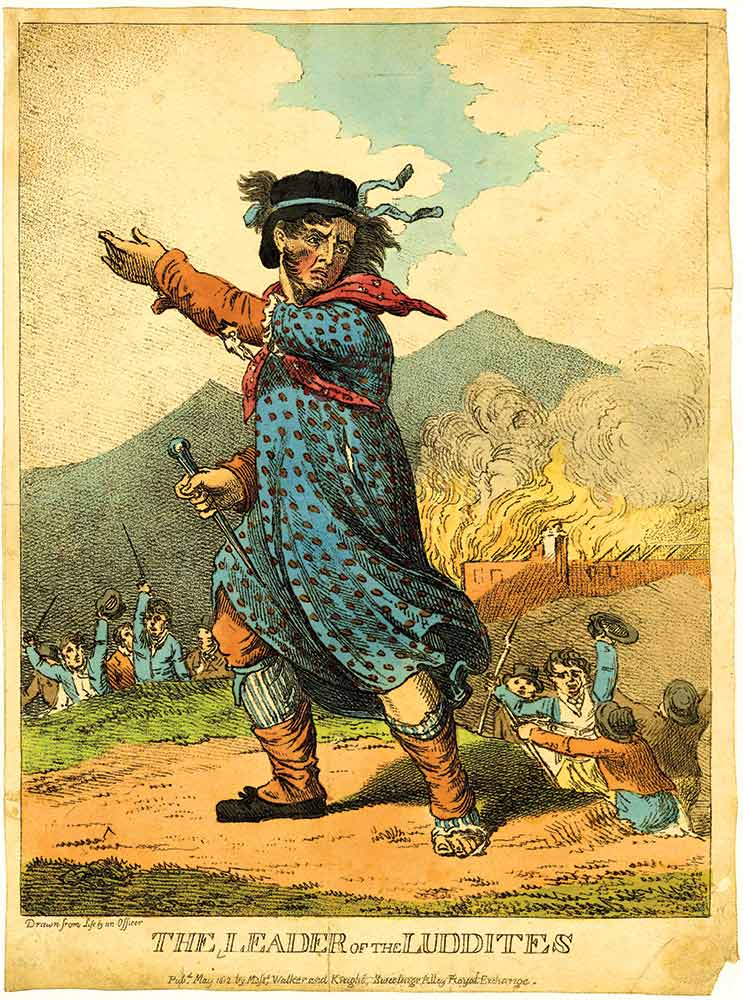
But there’s no shame in being a Luddite—or, to be more precise, in being an heir to the Luddite tradition of refusing to accept the adoption of new technologies simply because capitalists decide to impose them on workers.

Elite opinion writers may still dismiss the Luddites as unthinking reactionaries who sought to wreck the machinery of the dawning Industrial Revolution. But many of the most tech-savvy observers of the dawning AI era are expressing admiration for the 19th-century weavers and mechanics of northern England, who fought to prevent the dislocation and wage cuts that the factory-owning oligarchs of their day called “progress.” On campuses across the country, New Luddite and Neo-Luddite clubs have been formed by students who have grown up with smartphones and are justifiably concerned about what’s coming their way. After the Writers Guild of America waged a prescient struggle in 2023 to prevent media conglomerates from using AI technologies to capture their creativity and then toss them into the dustbin of history—a fight that anticipated The Hollywood Reporter’s blunt declaration in 2024 that “generative artificial intelligence is killing jobs in Hollywood, with little relief on the horizon,” and the more recent reports linking AI consolidation and cost cutting to tens of thousands of layoffs in the media and entertainment industry—the actor and documentary filmmaker Alex Winter wrote, “The term Luddite is often used incorrectly to describe an exhausted and embittered populace that wants technology to go away. But the actual Luddites were highly engaged with technology and skilled at using it in their work in the textile industry. They weren’t an anti-tech movement but a pro-labor movement, fighting to prevent the exploitation and devaluation of their work by rapacious company overlords. If you want to know how to fix the problems we face from AI and other technology, become genuinely and deeply involved. Become a Luddite.” The artist and activist Molly Crabapple, who in 2023 helped organize an open letter urging publishers to restrict their use of AI-generated illustrations, adopted a similar view, explaining: “That stereotypical definition of a luddite as some stupid worker who smashes machines because they’re dumb? That was concocted by bosses.” The year before, the writer Cory Doctorow argued, “The Luddites did what every science fiction writer does: they took a technology and imagined all the different ways it could be used—who it could be used for and whom it could be used against. They demanded the creation of a parallel universe in which the left fork was taken, rather than the right. That is many things, but it is not technophobic. Using ‘Luddite’ as a synonym for technophobe is an historically insupportable libel.”
Today’s Luddite renaissance comes as little surprise, given the anxiety over AI. But this is not the first time that people have looked to the leather-aproned croppers who resisted the power looms of another era. Going back to the 1950s, activists have looked to the Luddites’ example in times when new technologies—from nuclear weapons to the Internet—have upended our lives. The bosses have done their best to portray the Luddites as ignorant and self-serving laborers who clung to a dying past—and much of the media still does. But that mischaracterization was always an example of the “enormous condescension of posterity” that the great historians of the English working class E.P. and Dorothy Thompson, who were partners in life and in scholarship, long ago upended. In the middle of the last century, the Thompsons shined a new light on the Luddite uprisings that swept Nottinghamshire, Lancashire, and the West Riding of Yorkshire from 1811 to 1816. As the Industrial Revolution gathered steam, textile workers who had used their own machines—working in their homes and in small shops—to clothe England and the world were suddenly confronted with a future in which they would be crowded into a new kind of workplace: the factory. Inside the new textile mills, they, and frequently their children, would toil long hours for reduced pay on the mechanized shearing machines and automated power looms that were their era’s technological wonders. The Luddites were no fools; they correctly anticipated the future that William King described in 1829 in his newspaper The Co-operator: “If then the machine which I work produces as much as a thousand men, I ought to enjoy the produce of a thousand men. But no such thing. I am working a machine which I know will starve me.”

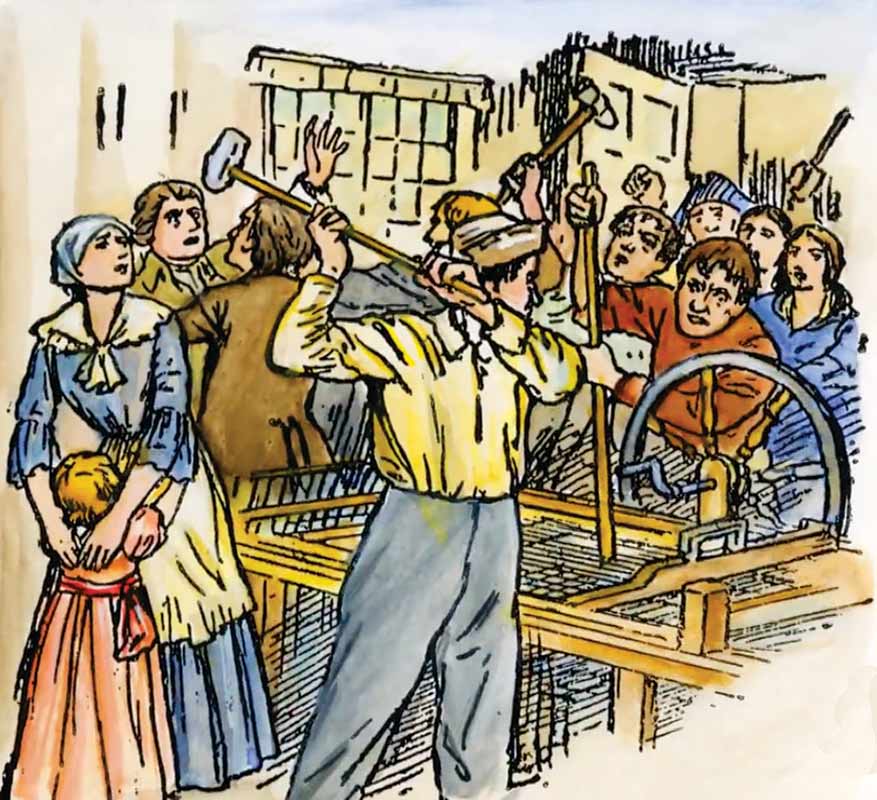
The weavers and mechanics who gathered by moonlight atop the West Pennine Moors near Bolton and in the upstairs rooms of the Shears Inn at Liversedge in the West Riding of Yorkshire were unwilling to cede their futures to the oligarchs of a nascent Industrial Revolution. Amid an economic depression that had already slashed their wages and impoverished their families, they were determined to fight against the denial of their rights—and their humanity—by industrialists who adopted new technologies without the slightest care for the disruption of society. Their uprising followed mass protests and petition campaigns demanding that the government and employers provide living wages and protections for the workers who were being exploited in what William Blake aptly described as “dark Satanic Mills.” After their petitions were rejected, the Luddites gathered by the thousands and marched on the mills to break the new machines, smashing them in riotous agitations that terrified industrialists and parliamentarians.
Those sledgehammer blows against the Industrial Revolution earned the Luddites a place in history. But their struggle was always about more than a simplistic rejection of the new. Rather, it was a movement of engaged and informed skilled workers who opposed an economic and social transformation that promised to enrich the wealthiest men of their time while dispossessing an entire class of handloom weavers and their families. They organized demonstrations and petitioned government officials for increased wages, an end to child-labor abuses, and the right to form “combinations” (unions) of workers. Their anti-oligarchical energy and penchant for direct action led one of their champions, a young Lord Byron, to compare the Luddites to “the Liberty lads o’er the sea”—the revolutionary Americans who had overturned British colonialism—and to argue that British workers “will die fighting, or live free,” under the banner of “down with all kings but King Ludd!”
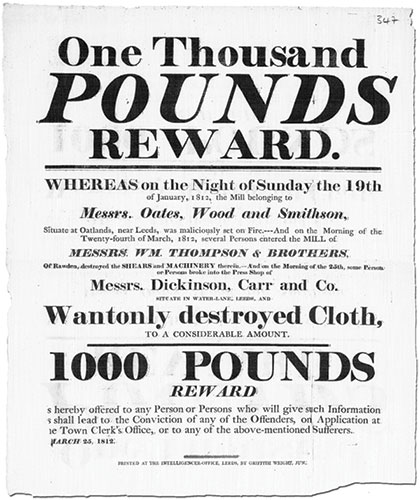
There was, it should be added, no such person: The first Luddites concocted the story of a young textile maker named Ned Ludd who, when ordered to speed up his work and sacrifice its quality by a boss, instead smashed the mechanical knitting machines to which he was assigned. As the tactic spread during the Luddites’ five years of industrial unrest, they adopted the name along with elaborate disguises and a strategy of stealthy nighttime raids. They did so to cloak the identities of the leaders and members of a labor movement that faced brutal repression, including laws that were enacted to punish their activism with the death penalty or forced expulsion to Australian prison colonies; an elaborate spy network that offered rewards to bounty hunters; and an ever-expanding military presence that would eventually see 12,000 troops stationed in the textile towns of northern England. Like the earlier Sons of Liberty in what would become the United States, the Luddites organized secretly and targeted the economic interests of their overlords. As the Americans had dumped the British East India Company’s tea into Boston Harbor, the Luddites broke the gig mills and shearing frames in factories from Marsden to Lancashire. What the historian Eric Hobsbawm called “collective bargaining by riot” was not an example of a working-class movement that “did not know what it was doing, but merely reacted, blindly and gropingly, to the pressure of misery.” On the contrary, Hobsbawm explained, it was a response to the imposition of a new technology that workers rightly foresaw would make their lives worse by sacrificing them to cross a certain “threshold of profit.”
The Luddites’ decision to destroy machines was much debated and decried in their time, though it arguably has scant relevance to our own. As Richard Conniff observed some years ago in his seminal Smithsonian essay “What the Luddites Really Fought Against,” “Our uneasy protests against technology almost inevitably take technological form. We worry about whether violent computer games are warping our children, then decry them by tweet, text or Facebook post. We try to simplify our lives by shopping at the local farmers market—then haul our organic arugula home in a Prius. College students take out their earbuds to discuss how technology dominates their lives. But when a class ends, Loyola University of Chicago professor Steven E. Jones notes, their cellphones all come to life, screens glowing in front of their faces, ‘and they migrate across the lawns like giant schools of cyborg jellyfish.’”
If destroying the machine itself is not in our future, what can we learn from the Luddites that is relevant for today? Start with the notion that the Luddite resistance to “progress for the sake of progress” was defined by a longing to remain human in a machine age. That premise makes them a touchstone for 21st-century bank clerks and delivery drivers, actors and architects, autoworkers and nurses, who all fret about whether they’ll have a place in an AI-generated future. “We should be Luddites,” Brian Merchant, a tech journalist, columnist, critic, and the author of the 2023 book Blood in the Machine: The Origins of the Rebellion Against Big Tech, argued in an article in Time. “The Luddites were making a powerful complaint. If we reclaim what they were actually trying to say, we can apply the lessons of their story to today, and prevent a lot of misery.”
The great value of the Luddites for the purposes of our contemporary discourse is that they mounted an informed resistance to a warped definition of progress that threatened not just their livelihoods but their humanity. That is the same recognition that today animates tech-savvy advocates for placing guardrails on AI. Gavin Mueller, a scholar of digital media and culture who teaches at the University of Amsterdam and has written extensively about the Luddites, is right to remind us that “behind AI skepticism is a larger question. What kind of future do we want to have?”
We are all under pressure to accept the inevitability of an AI-generated future. This year’s Super Bowl advertising was a parade of paeans to artificial intelligence. The billboards that light up Times Square in New York City offer larger-than-life, brighter-than-the-sun, 24/7 promotions for this new technology: AI companions will give you “someone who listens, responds, and supports you.” Global leaders are “scaling with AI.” Employers will soon “Stop Hiring Humans” because “The Era of AI Employees Is Here.”
Yet Americans aren’t buying it.
A December 2025 YouGov poll found that 77 percent of Americans view AI as a possible threat to humanity; a YouGov/Economist survey from February found that 74 percent of respondents think AI will hurt the economy, and 63 percent think it will eliminate jobs. A poll by Bentley-Gallup found that an overwhelming majority of Americans (79 percent) have no faith in private companies to use AI responsibly.
That’s a lot of people that The Washington Post’seditorial page would disparage as “Luddites.” Or maybe, if we’re willing to put aside the Post and consider the actual history of the Industrial Revolution, that’s a lot of reason for hope that if we embrace our skepticism, we might build a mass movement to get this technological revolution right.
The story of the Luddites offers an intellectual antidote to the anxiety of an age when our experience of the digital and social-media revolutions has given us reason to doubt the promise that every new technology will make our lives better. There is now broad acceptance that the disinformation streaming from our screens has coarsened our politics and “mainstreamed” racism and xenophobia. As studies tell us that social-media addictions threaten our mental health, and as schools ban smartphones in a desperate attempt to regain the attention of our children, millions of Americans have come to the realization—through bitter experience—that new technologies should be greeted with skepticism and regulation. Instead of bending to the dictates of Silicon Valley’s trillionaires-in-waiting, an emerging consensus suggests that we just might want to consider the wisdom of slowing down the headlong rush toward an AI-dominated future with dramatically fewer jobs, more surveillance, and a military-industrial complex that cranks out autonomous killing machines.
For the Luddites’ story to be useful, however, it is necessary to toss aside the stereotypes that were on display in the reaction to Sanders’s advocacy for a perfectly reasonable slowdown in data-center construction. There’s a compelling argument to be made that to be a modern Luddite is to be on the right side of history—even if history has not been particularly kind to the Luddites. “History is written by the winners,” George Orwell reminded us, and rarely has there been a more successful smearing of a movement than the one that targeted the Luddites, who were decried in their day by the British authorities as “evil minded persons…assembled together in riotous manner” who had created a “Spirit of Disorder.”
The Luddites did create their share of disorder with those midnight raids on the dark satanic mills. But what matters for our own day is the disorder that the Luddites were opposing, which Lord Byron encapsulated when he declared, “We must not allow mankind to be sacrificed to improvements in Mechanism.”
More from The Nation
The Cost of Making Cesar Chavez the Face of a Movement The Cost of Making Cesar Chavez the Face of a Movement
The harrowing revelations about Chavez expose how much Latino history in the United States has been made to rest on one man.

Meet the Immigrant Workers Who Launched the First Major Meatpacking Strike in Decades Meet the Immigrant Workers Who Launched the First Major Meatpacking Strike in Decades
Amid the Trump administration’s assault on immigrant workers, thousands at the country’s largest meat processor organized across nationalities to launch a historic work stoppage.

How Gaza Broke Big Tech’s Campus Pipeline How Gaza Broke Big Tech’s Campus Pipeline
Big Tech’s complicity in Israel’s genocide in Gaza has pushed STEM students to organize for a more ethical tech industry.

Bernie Sanders: “This War Must End Immediately!” Bernie Sanders: “This War Must End Immediately!”
The senator delivered a powerful message on Iran at the No Kings Rally in Minnesota.

No Kings! No Wars! No Kings! No Wars!
The founders of the United States feared monarchically inclined presidents who could wage wars of whim.