
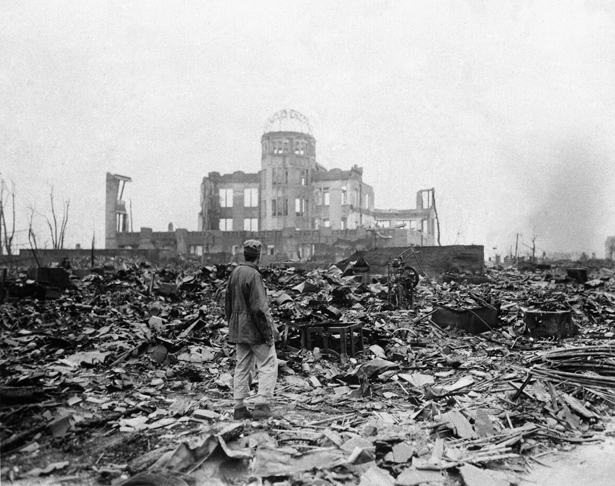
An allied correspondent stands in Hiroshima Sept. 8, 1945, a month after the first atomic bomb ever used in warfare was dropped by the US. (AP Photo/Stanley Troutman)
This story originally appeared at Truthdig. Robert Scheer is the author of The Great American Stickup: How Reagan Republicans and Clinton Democrats Enriched Wall Street While Mugging Main Street (Nation Books).
August 6 marks sixty-eight years since the United States committed what is arguably the single gravest act of terrorism that the world has ever known. Terrorism means the deliberate targeting of innocent civilians, and targeted they were, with the cutely named “Little Boy” atomic bomb dropped on Hiroshima at a location and time of day when, as the Strategic Bombing Survey commissioned by President Harry Truman conceded, “nearly all the school children … were at work in the open,” a perfect opportunity for mass incineration.
“That fateful summer, 8:15,” the mayor of Hiroshima recalled at a memorial service in 2007, “the roar of a B-29 breaks the morning calm. A parachute opens in the blue sky. Then suddenly, a flash, an enormous blast—silence—hell on earth. The eyes of young girls watching the parachute were melted. Their faces became giant charred blisters. The skin of people seeking help dangled from their fingernails.… Others died when their eyeballs and internal organs burst from their bodies. Hiroshima was a hell where those who somehow survived envied the dead. Within the year, 140,000 had died.”
It was followed three days later by the “Fat Man” bomb leveling Nagasaki, with a comparable disastrous impact on a largely civilian population that had no effective control over the decisions of the emperor who initiated the war. Nagasaki was a last-minute substitute for Kyoto, which Secretary of War Henry L. Stimson ordered spared because he had fond memories of his honeymoon in that city a couple of decades earlier. The devastation of those two cities was so gruesome that our government banned the showing of film footage depicting the carnage we had caused.
We have never been very good at challenging our nation’s own reprehensible behavior, but if we don’t take proper measure of the immense extermination wrought by two small and primitive nuclear weapons as compared with today’s arsenals, we lose the point as to why they must be banned. We are the country that designed and exploded these weapons that are inherently implements of terrorism in that, as the nuking of Japan amply demonstrated, they cannot distinguish between civilian and combatant.
For those who believe that honorable ends absolve a nation of evil means, there is the argument that the bombings shortened the war, although the preponderance of more recent evidence would hold that the Soviet entrance into the war against Japan two days after Hiroshima was a more decisive factor.
But the basic assumption of universal opposition to terrorism is a rejection of the notion that even noble ends justify ignoble means, and a consistent opposition to the proliferation, let alone use of nuclear weapons, must insist that they are inherently anti-civilian and therefore immoral.
Why, then, on this anniversary, do we not acknowledge our responsibility as the nation that first created these weapons, has been the only country to use them, and is still in possession of the biggest repository of such weapons of mass destruction on earth? Is it not unwise, as well as wrong, for August 6 to pass, as it generally does, without any widespread discussion of our culpability for the vast death in Hiroshima and Nagasaki?
Indeed, in Santa Monica, California, home of one of the rare reminders of the catastrophe we unleashed, a sculpture of a mushroom cloud, designed by three-time Pulitzer Prize–winner Paul Conrad, is slated for destruction by a city council that claims it does not have funding for needed repairs.
That sculpture, called “Chain Reaction,” was given to the city in 1991 thanks to the beneficence of Joan Kroc, the widow of the founder of McDonald’s, who used her fortune to advance the cause of public enlightenment. It is a grim warning that the best educated can commit the most heinous of crimes, and its placement opposite the RAND Corp., a faux intellectual outpost of the military-industrial complex, adds historic significance to a landmark designated municipal work of art that is now threatened with extinction.
Conrad, world famous as the editorial cartoonist for The Denver Post and the Los Angeles Times for four decades, was himself a veteran of the war in the Pacific, one of those whose life the bomb was ostensibly designed to save. Conrad joined the Army in 1942 and participated in the invasions of Guam and Okinawa, where he was stationed at the time of the Hiroshima bombing.
His sentiment about that horrific event is inscribed on his powerful sculpture: “This is a statement of peace. May it never become an epitaph.”
Conrad’s critically important sculpture might soon be gone. As a nation, we excel at obliterating reminders of our own failings.
Will the media finally raise the key questions about US nuclear legacy?

