
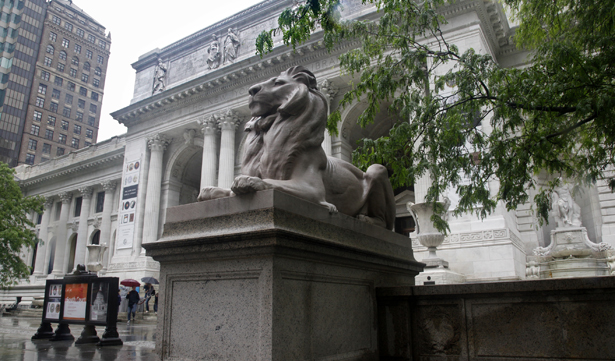
The main entrance to the New York Public Library in New York. (AP Photo/Bebeto Matthews)
Are public research libraries repositories of knowledge or real estate parcels to be auctioned off to the highest bidder? Sometime during Paul LeClerc’s eighteen-year tenure as its president, the New York Public Library formulated the Central Library Plan (CLP), under which two of the system’s major assets, the Mid-Manhattan Library and the Science, Industry and Business Library, would be sold and their holdings incorporated into the landmark Beaux-Arts research library at Forty-second Street. LeClerc retired last summer, but the CLP endures, and the library’s new president, Anthony Marx, is determined to implement it. Conceived in absolute secrecy, the CLP has a price tag of $350 million and will transform, in a destructive way, one of the world’s great public libraries.
As Scott Sherman first reported in these pages (“Upheaval at the New York Public Library,” November 30, 2011), the CLP would compromise the scholarly mission of the NYPL in numerous ways, including banishing nearly 3 million books to a storage facility in Princeton, New Jersey, from which it could take up to five days for requested items to be delivered to Forty-second Street. It would also disfigure an architectural treasure by demolishing the seven levels of century-old stacks beneath the Rose Reading Room to make way for a high-tech circulating library—a proposal that prompted historian David Nasaw to say, at a recent New School forum, “We’re being told that the only way to save the library is to rip out its innards.” The many parts of the NYPL with innards in need of repair—the overburdened and underfunded eighty-seven branch libraries—may not receive a cent under the plan. It appears that the CLP would also starve two other research libraries: the Performing Arts Library—once an oasis and now a “dump,” according to a recent New York Times essay by Edmund Morris—and the Schomburg Center for Research in Black Culture, which needs an infusion of funds to sustain its historic mission in Harlem.
Sherman’s investigative reporting struck a nerve, generating extensive coverage in the Times (whose editorial board offered halfhearted support for the CLP on May 8), plus articles in the Wall Street Journal, the Daily News, the New York Post and other publications. On A Prairie Home Companion, Garrison Keillor brought his caustic satire to bear by musing that the Forty-second Street stacks will be demolished to make way for high-priced condos. Tom Stoppard, Salman Rushdie, Annie Proulx, Art Spiegelman, Amitav Ghosh, David Byrne and Colum McCann are among the 1,500 people who have signed a protest letter.
Finding itself on the defensive, the New York Public Library has unleashed its lions. Writing in The New York Review of Books, Robert Darnton, an NYPL Trustee, argued that the CLP is a necessary response to fiscal pressures in general and declining financial support from the city in particular. (The Review’s editor, Robert Silvers, is an NYPL Trustee too.) Marx has stated that “by combining three facilities into one, we expect to have up to $15 million more to spend annually”—an assertion that has lately become the chief rationale for the CLP. (The original rationale, as LeClerc declared in an internal publication in 2008, was to build “the largest comprehensive library open to the public in human history”; last summer, NYPL officials told Sherman the objective was to “democratize” the Forty-second Street Library.) But NYPL’s chief operating officer told Charles Petersen of n+1 magazine that the extra revenue could amount to as little as $7 million per year. And there are no guarantees it will be that much. A great deal of public discussion—not to mention robust intervention by city and state elected officials—should occur before the New York Public Library undertakes a $350 million renovation plan that produces $7 million or less a year in additional revenue. But Marx is keen to dash to the finish line: he admitted in a May 16 letter to scholars critical of the CLP that the next mayor and City Council may not support it.
The CLP is a castle in the sky, to which the city will be contributing $150 million. The New York Public Library should abandon it in favor of a more modest proposal, and one hatched in consultation with the public. The sale of one library, instead of two, could raise up to $100 million, and Marx—a scholar who has built his career on the ideals of racial and economic justice—should hasten to allocate that money where it’s needed most: the branch libraries, many of which desperately require more computers, books and DVDs as well as capital improvements. The money promised by the city for the CLP could be usefully redirected to the tumbledown Mid-Manhattan Library. The Forty-second Street landmark, designed by Carrère & Hastings, should be left unspoiled, in all its grandeur.
 TAKE ACTION: Save the New York Public Library
