
 Reuters Photos
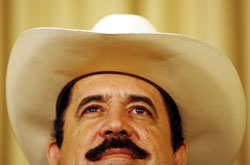
Honduras’ ousted President Manuel Zelaya.
The US announcement of an aid cutoff to Honduras is a “direct blow” against the strategy of the coup regime in Honduras, deposed President Manuel Zelaya declared in an interview with The Nation today.
After an afternoon meeting between Zelaya and Secretary of State Hillary Clinton, the US government announced the termination of hundreds of millions of dollars in assistance to Honduras and declared its refusal “for the moment” to support the Honduran elections scheduled for November. Zelaya said the “most significant” outcome of the meeting was the State Department’s declaration that the elections will not be recognized, which “puts the United States in line with Latin America, because it was not said before.”
Zelaya announced that he is “prepared to return” to Honduras “independently of any US plans” and to “protect the population.” The US declaration was a “great step forward” that puts intense pressure on the Micheletti regime in Honduras to commit to the peace proposals of former president Oscar Arias of Costa Rica.
The aid termination will include $215 million in five-year Millennium Challenge grants, Zelaya said, in addition to $16 million in military aid already cut. Secretary Clinton chairs the Millennium Challenge Corporation, which meets this coming week.
Asked if the American aid could be restored before the elections scheduled for November, Zelaya indicated that it could be, “when democracy is restored and President Zelaya returns.”
The Nation will post Tom Hayden’s full interview with President Zelaya on September 4.

