
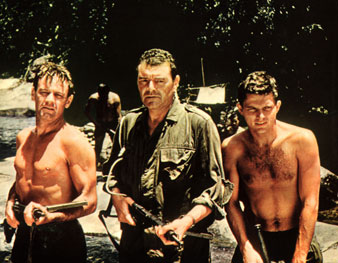
 Everett CollectionWilliam Holden, Jack Hawkins, Geoffrey Horne, 1957.
A brutal tale that, ironically, sent thousands of moviegoers on their way whistling a happy tune.
One of the dubious habits a reviewer can fall into is that of tearing hell out of a picture which thoroughly entertained him while he was watching it. This is mean-spirited but not as hypocritical as it may seem. A good movie team can teach mass psychology to an Indian fakir, and the reviewer is not much less gullible than the rest of the audience. Unlike the rest of the audience, however, he has to think about the show after he has gone home. That’s when he may discover that he has been led a merry chase and, red with indignation, begin to pound his typewriter. I don’t see how this can be avoided, but I resolve that hereafter when a picture has amused or excited me I shall say so before carving it up.
The Bridge on the River Kwai amused and excited me. Its enormous jungle setting, its spectacular feats, its deadpan heroism offer irresistible and, I should think, almost universal entertainment. And yet, on second thought, it is a very odd story.
Take, for a start, the personality of the villain. The Japanese commandant of a prison camp deep in Burma (Sessue Hayakawa) is described by the older inhabitants as a sadistic and homicidal brute, and they can point to a considerable graveyard to back their opinion. Yet when Major Alec Guinness shows up and decides to make a stand on the letter of the Hague Convention the terrible Hayakawa turns as sheepish as a high school valedictorian. I got a kick out of watching Guinness sass the beast of Burma, but it strikes me now as a good deal less than plausible.
Then there is the bridge itself. The Japanese are using prisoners to construct it and the men sabotage the job, as they certainly should. But Major Guinness feels that gold-bricking is bad for morale and, once he has beaten the commandant on the principle that British officers cannot be ordered to perform manual labor, he organizes his expert staff and throws up an elegant twin-cantilever span in record time. Only the battalion medical officer asks whether the major’s enthusiasm for discipline is leading him into uncomfortable collaboration with the enemy, and he is cut down by the famous Guinness sniff. Even when the cripples are bullied out of hospital to make the job go faster, no one notices that poor old Guinness has slipped his pulley, and when the job is finished officers and men celebrate with an evening of jollification. It’s a rum business.
Meanwhile, three saboteurs led by Jack Hawkins are beating their way through leach-infested swamps toward that fancy piece of engineering on the Kwai. This intrepid trio is supported by a baggage train of a dozen or so Burmese maidens recruited in a remote jungle village. Not knowing Burma, I was astonished by the delicate beauty of these girl porters. Not only are they lovely of face and figure but they wear a uniform of well-cut sarong and lampshade bonnet with Parisian dash and contempt for the cosmetic hazards of a tropical rain forest. Having been for some time deprived of male company by the Japanese manpower draft, they are soon on excellent terms with their employers. The lingering, yearning caresses with which they apply camouflage grease-paint to their heroes’ flanks is a tropical daydream of very high voltage. It takes good men to fight under these conditions and my hat is off to Hawkins’ commandos. Also to David Lean, a director who serves the very best hokum.

