
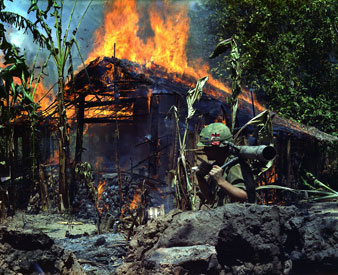
 Everett CollectionMy Tho, a Viet Cong base camp.
This article appeared in the November 20, 1967 edition of The Nation.
A soldier’s button says “We Shall Overkill.” In Vietnam, it speaks the truth.
I was speaking to a Vietcong who had been captured by the Americans and who said he would fight for us now.
"Why?"
"Because you too strong."
"You mean the Americans are winning?"
"Now, yes."
"If tomorrow the Vietcong were winning would you again fight for the Vietcong’!"
"Yes."
I thought there had been a misunderstanding of my question so I told the interpreter to ask it again. "Yes," and all the American soldiers laughed but it was a dry, humorless laugh.
There were six 105 howitzers on our hill, used mostly for interdiction and harassment, but now they were being used on seven guerrilla partisans at a range of about 4 miles in the folds of the mountain across the small sea of rice paddies.
"Are they enemy definites," I said, "or could they be peasants?"
"Who gives a fuck?" the American corporal said. "All the zipperheads was told to stay out of the hills."
I asked the American captain how he knew the Vietcong turncoat was not a double agent.
"We watch him closely," the captain said. The Vietcong turncoats were called Kit Carson Scouts, the captain told me. He also said they go through a very extensive screening program and are well paid. "Well motivated," the captain said. "He put us wise to those seven we’re firing at now. We got a recon patrol out there giving us their position. Were not doing any good. We been firing at them all morning." And then he said, "I’m going to call in air for napalm."
"Napalm?"
I told the interpreter to tell the VC that the captain was calling in napalm on his buddies. What did be think?
The VC wanted to know if it was necessary.
"As sure as shit," the corporal said.
The VC understood this English and said, "Fuck me."
"You’re well paid," the captain said.
The howitzers were silent while we waited for the air strike of napalm. It was all very silent. We watched the VC Kit Carson Scout. He weighed 91 pounds, was 26 years old, had served with the VC three years, with the Americans three months, had SPEEDY written on his camouflaged jacket, was called Our Pet Monkey by the Americans. Speedy was about to vomit.
Speedy said in Vietnamese that he wanted to go down in the bunker. He pointed down.
The captain pointed up.
The white gunnery sergeant, who wore a button which said "The Spirit of 67" (it was given away by the thousands by some traveling movie star for morale or something), nodded his head in agreement, and the black corporal on the sandbags sitting above the VC who wore a button he had brought from the States and which everyone thought extremely humorous–it said "We Shall Overkill" nodded too, and Speedy turned green.
"Air is slow," the captain said.
The Spirit of 67 agreed and We Shall Overkill agreed.
Everyone agreed that the napalm was slow. Everyone agreed excepting the Pet Monkey
"A beautiful day," I said stupidly.
"Where’s Air?" the captain said watching where I watched.
"Where’s the action?" the Spirit of 67 said.
"It’s coming," We Shall Overkill said. "I’m coming and his head is bended low," he said, pointing to Our Pet Monkey.
"When?"
"Now."
Three Phantom jets flashed over and three silver canisters flashed out, three fire bombs flashed up, and the day was all afire.
The white sergeant said to the black corporal, "Burn, Baby, burn," and the black corporal looked down and studied his jungle boots and Our Pet Monkey threw up all over the Spirit of 67, and the captain said, "Perfect. That was perfect." We Shall Overkill leaned back so far I thought he would come off the sandbag parapet and said, "Shit, man, shit," and then he said down to Our Pet Monkey, the Kit Carson Scout, "Behave yourself, man. Behave yourself. We are being visited by a gentleman of the press."

