We’re Ready to Love Hot Democrats Again
Politician-related thirst levels are reaching heights not seen in decades. Why is America’s longing for lusty legislators spiking so much?
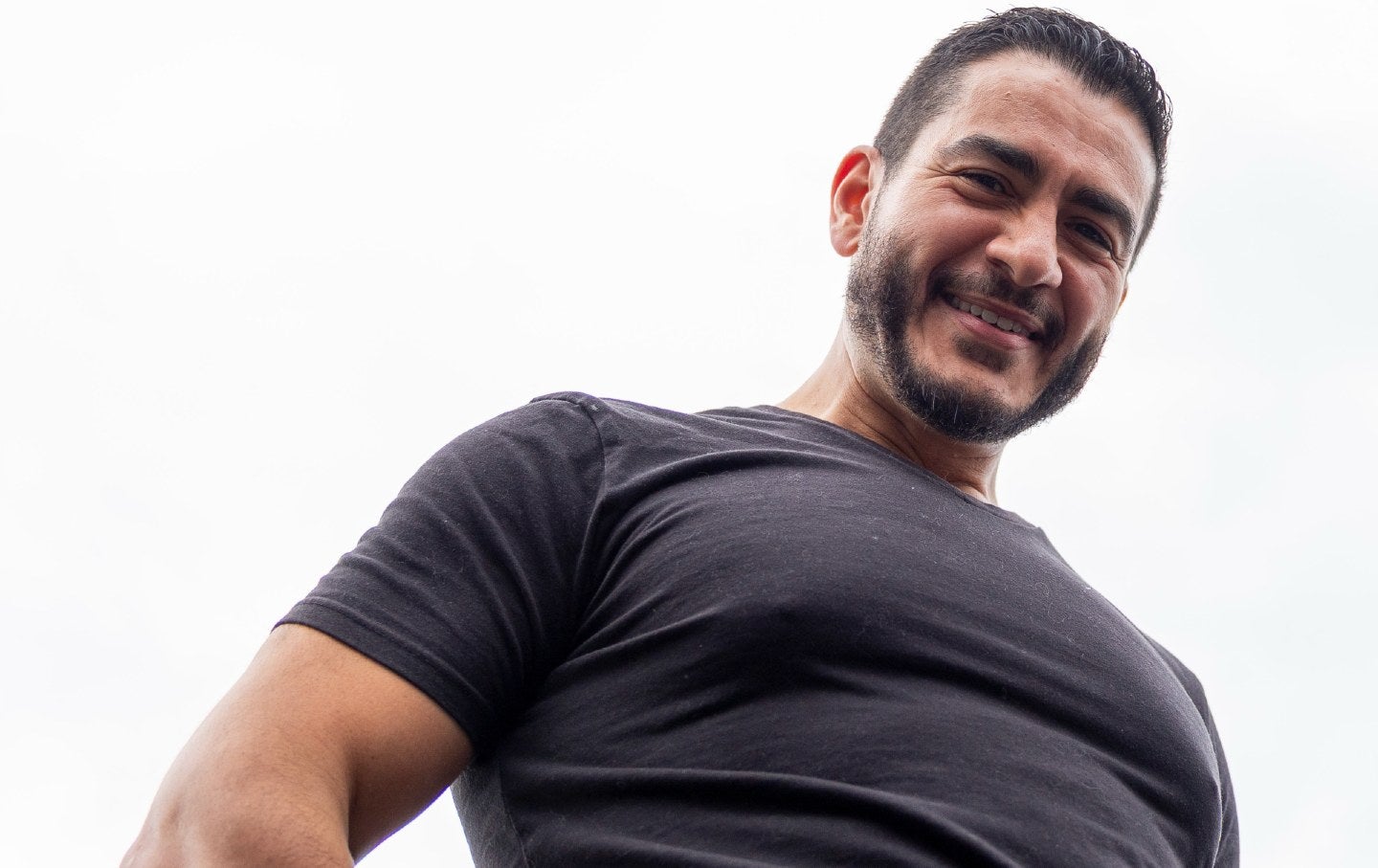
Abdul El-Sayed speaks to the press after a radio appearance on Dr. Horace Sheffield’s GOTV Community Rally on August 1, 2026, in Detroit, Michigan.
(Finn Gomez / Getty Images)In the sixth season of Sex and the City, public relations expert Samantha Jones instructed her soon-to-be-movie-star beau Jerry “Smith” Jerrod in the art of cultivating a fandom. The secret to widespread popularity, it turned out, was getting people to ogle you. “First come the gays, then the girls, then the industry,” she quipped.
Replace “industry” with “electorate,” and you have a maxim that somewhat explains the post-Bluenami Internet fanfare over the yet-to-be-sworn in 120th Congress and its crop of incoming (and returning) Hot Democrats.
Ever since the first “CNN projects!” on Blue Wave Night, an AI rendering of once-popular teen-heartthrob rag Tiger Beat has been going viral. The mock-up has a few variations, but all of them feature Abdul El-Sayed smoldering, James Talarico smiling, and Jon Ossoff smizing. They sport denim jackets and exude a comforting aura. Some incoming politicians who didn’t make the cut, such as US representatives-elect Manny Rutinel and Sam Forstag, have still been lusted over. The message is clear: We, the American electorate, have creamed our jeans.
These faces represent a sharp contrast to the legislative body they will be entering—or, in Ossoff’s case, reentering. The 119th Senate has an average age of 64, meaning the typical senator was born at the tail end of the boomer generation; the average House member is a relatively youthful, though still firmly Gen X, 57.
Beyond all being millennials—sorry, Gen X!—each of these newly minted Hot Dems possess a handsomeness that has seemed to cause a collective regression to doe-eyed teenagedom. Group chats I’m in—full of other gay men—feature unpublishable texts about Ossoff’s and El-Sayed’s butts, both of which have garnered quite a bit of online attention. Even TMZ seems to have caught the Bluenami Boy Crazies, asking Ossoff whether he has #BDE—short for “big-dick energy”—prompting him to laugh and respond, “Come on, my brother.” One viral tweet re-upping the video adorned the clip with the hashtag #needdat.
To those for whom politics is their business, none were surprised that the candidates’ handsomeness had taken center stage in the postelection discourse.
“They used to say, ‘I want to vote for a guy I could have a beer with, but that’s a very boomer notion,’ Ryan Adams, a progressive political consultant, told The Nation. “The millennial notion is ‘I want to vote for a guy I can thirst after.”
While everyone loves a handsome face, it’s clear that the fervor for these hot candidates has stretched beyond normal bounds of thirst, especially in the political arena. We’ve had plenty of models for hot politicians—Barack Obama and John F. Kennedy come to mind, of course—but never so many all at once and with such an Internet-ready response to their good looks.
Part of the reason the candidates’ looks seem to be front and center in the aftermath of this election cycle is purely that, given the last 10 years of our political landscape, the American citizens are ready for some eye candy in office again.
“After going through the Biden and Trump administrations with these two old guys who are shuffling along, losing their place and rambling, voters are looking for energy and competence,” says Steve Grand, a veteran Republican media consultant. But, more than good looks, Grand says, the 2026 Bluenami was a “backlash to the last two presidents.” Thirst-driven accounts saturating the Internet with pictures of El-Sayed’s butt while rock climbing are certainly calling attention to his plump assets, but also, such an image is the visual antithesis of the past decade of electoral politics.
Compare El-Sayed’s rock climbing to visuals of Biden or Trump, who “can barely get up the stairs on Air Force One,” Grand says. “That’s a real visual contrast for the voter.”
Certainly El-Sayed or Ossoff are a contrast to Trump and Biden, but are the American people so shallow as to just vote for a hot person?
“People still want to vote for you on policy,” Grand says. “Hotness is kind of a plus at the end.”
Gallup polling in the lead-up to the election proved that a usual suspects list of issues worried voters as they headed to the ballot box: the economy, healthcare, the worsening situation in Iran, gas prices, and income inequality. No pollster would’ve asked whether hotness played a role, but it’s hard to imagine it didn’t.
“Democracy revolves around human beings and what human beings want,” says Mitchell Jackson, a communication strategist and the founder of DCC Communications. “Human biology revolves around that. It’s just an animalistic thing.”
While hotness appeals to our most basic instincts, it has also, for millennia, been seen as a stand-in for all the attractive qualities one wants in a statesman: competence, leadership, acumen. Greek philosopher Aristotle laid out the beginnings of these beliefs—later called physiognomy—in his treatise Prior Analytics.
“It seems to me that soul and body affect each other sympathetically,” he wrote, per one 2020 translation. “A changed state of the soul changes also the appearance of the body; and again, a changed appearance of the body changes the state of the soul.”
In the second century CE, Roman sophist Polemon praised Emperor Hadrian by complimenting his eyes, which Polemon described as “clear and shining are good, unless other signs corrupt them. Of this type surely are the eyes of the Emperor Hadrian…gleaming, moist, keen, large, full of light.”
Researchers in 1972 coined this phenomenon the “what is beautiful is good” stereotype, which has also been called the “halo effect,” a cognitive bias wherein one positive trait, such as handsomeness, spurs people to assume other positive qualities, such as kindness or intelligence. Research has also shown that when it comes to leadership, countenance counts, and people prefer to vote for candidates they consider good-looking. Another 1999 study even showed that digitally altered versions of famous politicians could make them read differently—more honest, more cunning, less warm—to everyday Americans.
“We tend to impute to attractive people a level of competence that we don’t necessarily impute to people who are less attractive,” says Monika McDermott, a professor of political science at Fordham University. “That’s human nature.”
Of course, not every hot politician gets the keys to the Oval Office—sorry, John Edwards—and less-attractive politicians can prosper. No one is digitizing Sherrod Brown onto a Tiger Beat cover, but he still bested Jon Husted, whose rear end was the subject of many a Trump rally.
Even the agreed-upon pick for Best President of All Time was no looker. Abraham Lincoln may have predated mass media, but news of his face reached the people via newspapers. The Houston Telegraph called Lincoln the “leanest, lankiest, most ungainly mass of legs, arms and hatchet face ever strung upon a single frame. He has most unwarrantably abused the privilege which all politicians have of being ugly.” British journalist Edward Dicey poked fun at Lincoln’s “coconut-shaped” head and his pockmarked face—”furrowed, wrinkled, and indented, as though it had been scarred by vitriol.” Even his nose and ears, “which have been taken by mistake from a head of twice the size,” weren’t safe.
Logically, the question then becomes: If looks matter so much to the average American voter, then how did we get the current president in office? Though many Trump sycophants, including recent convert Nicki Minaj, have called Trump handsome, the rest of us have eyes. Despite being known to scrutinize women’s looks, he has also been ridiculed for his wispy hair, his signature ocher complexion, his sedentary paunch, and his “neck vagina.” Surely an electorate obsessed with artifice wouldn’t elect such a creature.
“It’s not just about hot,” says Jackson. “Donald Trump is not hot, but he has a look.” He added, “He has a look the same way that a drag queen has a look.”
Trump’s own form of bloviating masculinity downplayed physical fitness; he even believes that each person has a finite amount of energy that exercise can drain.
Trump himself has, of course, complimented many men on their good looks, including Zohran Mamdani, whose 2025 ascent to New York City Hall primed us all for more Hot Dems.
“I do think it was kicked off by Mamdani,” McDermott says. “And I do think it’s continuing in the fact that people are just saying, ‘Hey, look at these people—they look so different from who we’re used to.”
Our current Hot Politician era probably started in 1960, when John F. Kennedy bested champion debater Richard Nixon in the first televised presidential debate. You already know the lore: To those who listened on the radio, Nixon was the victor, but TV viewers favored the dashing Kennedy over the sweaty, awkward Nixon.
“Between the bleak gray walls and the bright floodlights of the television studio, [Nixon’s] gray suit and heavily powdered jowls looked flabby and pallid beside Kennedy’s dark suit and healthy tan,” biographer Theodore Sorenson wrote about the September 1960 debate.
Nearly 70 years later, hotness still matters.
“Attractiveness is not the end-all, be-all,” McDermott said. But “in a tight race it can make a difference.”
Of course, the right candidate has to come at the right time. And the left was ready. “Oh my God, I want a hot president,” wine mom par excellence and I’ve Had It host Jennifer Welch said in an interview in March. A week later, The Bulwark published an article claiming that Democrats were using hotness as an electoral strategy.
“Democrats remembered that people like hot people,” Jackson says.
Both Grand and McDermott agreed that the embrace of the incoming senatorial class is a generational issue and that people are ready to see fresh-faced people in government. Such a call, of course, brings us back to Obama, not only because of his looks but also the role his ascendancy played in the rise of 2010s-era millennial optimism.
Obama’s 2008 election victory has become the quintessential moment associated with Gen Y’s particular brand of hope, change, and unity, and his looks were a key part of his electability. (Readers of a certain age will remember when, in June 2007, a still-in-its-infancy YouTube became the site of a level-five nuclear hot-drogen bomb: “Crush on Obama,” the earworm that solidified him as the youthful, and handsome, alternative to the fumbling, unsexy lame duck George W. Bush and eventual Republican candidate John McCain.)
But if Obama emphasized that it helps to be hot, his presidency also showed another obvious truth—that good looks don’t necessarily make you a great leader. His presidency began with notes of hope and change, but his ties to plutocracy ended up launching the Occupy Wall Street movement and paving the way for Trump. His tenure has only soured further in the collective rearview mirror.
That souring is proof that while hotness can put on temporary blinders, it doesn’t last forever. People fall out of love with hot politicians all the time: Justin Trudeau’s popularity eventually plummeted and even Mamdani has encountered some stumbling blocks in transition from candidate to mustachioed mayor. Visual appeal can be an initial boon, but the novelty wears off; just as politicians campaign in poetry and govern in prose, the handsomeness of a person seeking office often feels less novel once the American people have begun to sign their checks.
“Attractiveness only matters on the margins,” McDermott says. “It’s unlikely to blind voters to issues that opponents and the media raise.”
If voting is like dating—we want a candidate who meets a laundry list of requirements, such as smart, handsome, and empathetic—then this 2026 class represents our first time trusting candidates after being spurned by our crush on 44.
“There was this feeling of letdown,” says Emily Keegin, a photo editor and creative director, who pointed to a “despondency” among millennials who put their faith in Obama. “There was like, ‘Can we ever love again?’”
Ossoff, Talarico, and El-Sayed might represent a Democratic voting body with a healed heart, ready to get back on the market with a new guy.
If Obama was the last time that love entered the equation, a new math has emerged since his time as a candidate. While Obama’s campaign is widely recognized as the first to effectively use the Internet to its advantage, the Bluenami occurred at a time when the Internet is now just a fact of political life. Not only must candidates adapt to it—they must fight for eyeball time in the attention economy, in which concentration is a currency.
That is a new opportunity and a new reality for handsome candidates.
Popular
“swipe left below to view more authors”Swipe →“JFK would have never admitted he was trying to sell sex. Obama and his campaign would have never admitted that they were trading on his handsomeness,” says Rachael Kay Albers, a brand strategist. She says that while campaign strategists may not admit it, they are stoking the fires of thirst. “In order to participate in the conversation, you have to find your angle.”
Complicating this, of course, is that the same news outlets that cover these candidates are also prey to the realities of the doomscrolling citizenry.
“This is also profitable for publishers, to turn Mamdani or El-Sayed into thirst traps,” she said. “To play into that, because it’s getting people clicking.”
Albers, as well as many others who spoke about these hot Democrats, underscored that hotness is never a primary concern for voters. Albers added that hotness is often only focused on after a candidate has “proven their competence in other ways.”
These hot new Dems are not just an alternative to an electorate primed to embrace a new generation; they are also entering an arena in which people are tired of the MAGA manosphere. (Even the manosphere is tired of its association with MAGA and a certain brand of masculinity; it turned away from Trump in the last election.) With the culture souring on the red-pilled podcasting Pepe the Frog walking memes, it’s searching for a healthier masculinity, a void that these Dems seem to have filled.
“There’s a craving for youthful vitality and a hope that, for the future, we’re gonna do things different,” Albers said. “They are the foil to the old guard, Pete Hegseth, the manosphere.”
If you haven’t noticed yet, almost everyone who has benefited from this discussion of hotness has been male; there hasn’t been the equivalent meme for the youthful Gina Hinojosa, for instance. Part of that is certainly that it is less socially acceptable to objectify professional women than it is to ogle Ossoff’s butt. Current cultural gender dynamics in the United States, and especially in electoral politics, also make it much more complicated when it comes to discussions of the hotness of women running for office.
Research on attractiveness in female candidates is a mixed bag: While Sarah Palin’s past as a pageant queen helped drum up interest, research seems to say that her beauty worked against her and ultimately cost the ticket votes. And while we do ascribe good qualities to people who are attractive, some research has shown that objectification makes women be perceived as less competent and human. Conversely, one Dartmouth study found that pretty female candidates do experience an electoral boon.
The question of whether hotness matters when it comes to women will be put to the test if New York Representative Alexandria Ocasio-Cortez does run for the presidency in 2028, as some progressive fundraisers already want her to do.
“When I say that she could win if she ran for president, people go, ‘No, the electorate’s too sexist. They’ll never vote for a woman,’” Adams said, of course referring to the fact that two female Democrats have already lost when vying for the presidency. “And I say, ‘No, they will vote for a hot woman.’”
Ocasio-Cortez, who Jackson says is doing “what works” when it comes to her social-media routine and how she speaks to voters, has already found that playing up her glamour is no easy road for her. Her appearance at the 2021 Met Gala with a “Tax the Rich” dress spurred several news cycles’ worth of coverage, outstripping attention paid to many other frocks.
If hotness continues to be a strategy for Democrats, then it’s not one that can come to bear too soon. In politics we’ve experienced what Vogue editor Andre Leon Talley once called a “famine of beauty.” To an electorate with its mouths open and its jowls drooling, this crop of Democrats is a welcome sight. While looking at Ossoff or El-Sayed’s butt might be titillating, it’s also a very different visual from watching Republican Senator Mitch McConnell sitting on the Senate floor, Weekend at Bernie’s–style, barely speaking and not contributing in any way to find solutions to the many problems currently besieging America.
“Republicans are wheeling out Mitch McConnell and he can’t even walk or talk. What does that say to voters?” Adams said. “You don’t deserve a living body. You deserve however we tell this corpse to vote.”
More from The Nation
Indigenous Roots, American History Indigenous Roots, American History
November is Native American Heritage Month, a reminder to honor Indigenous histories, cultures, and contributions, not just this month but throughout the year.
Henry Kissinger’s Reputational Management Henry Kissinger’s Reputational Management
Barbara J. Keys’s new book, “Super K,” reveals Kissinger’s ceaseless efforts to burnish his bloody legacy.
The Right Has Stopped Pretending to Care About Meritocracy and Is Openly Embracing Racism The Right Has Stopped Pretending to Care About Meritocracy and Is Openly Embracing Racism
Apparently grit and diligence are only virtues when they’re being portrayed as something Black people lack. Once Indian Americans demonstrate them, they’re suspect.
Trump’s Goons Are Melting Down Trump’s Goons Are Melting Down
In this week’s Elie v. U.S., our justice correspondent digs into the freakout over the coming congressional investigations. Plus: the freakout over court reform.