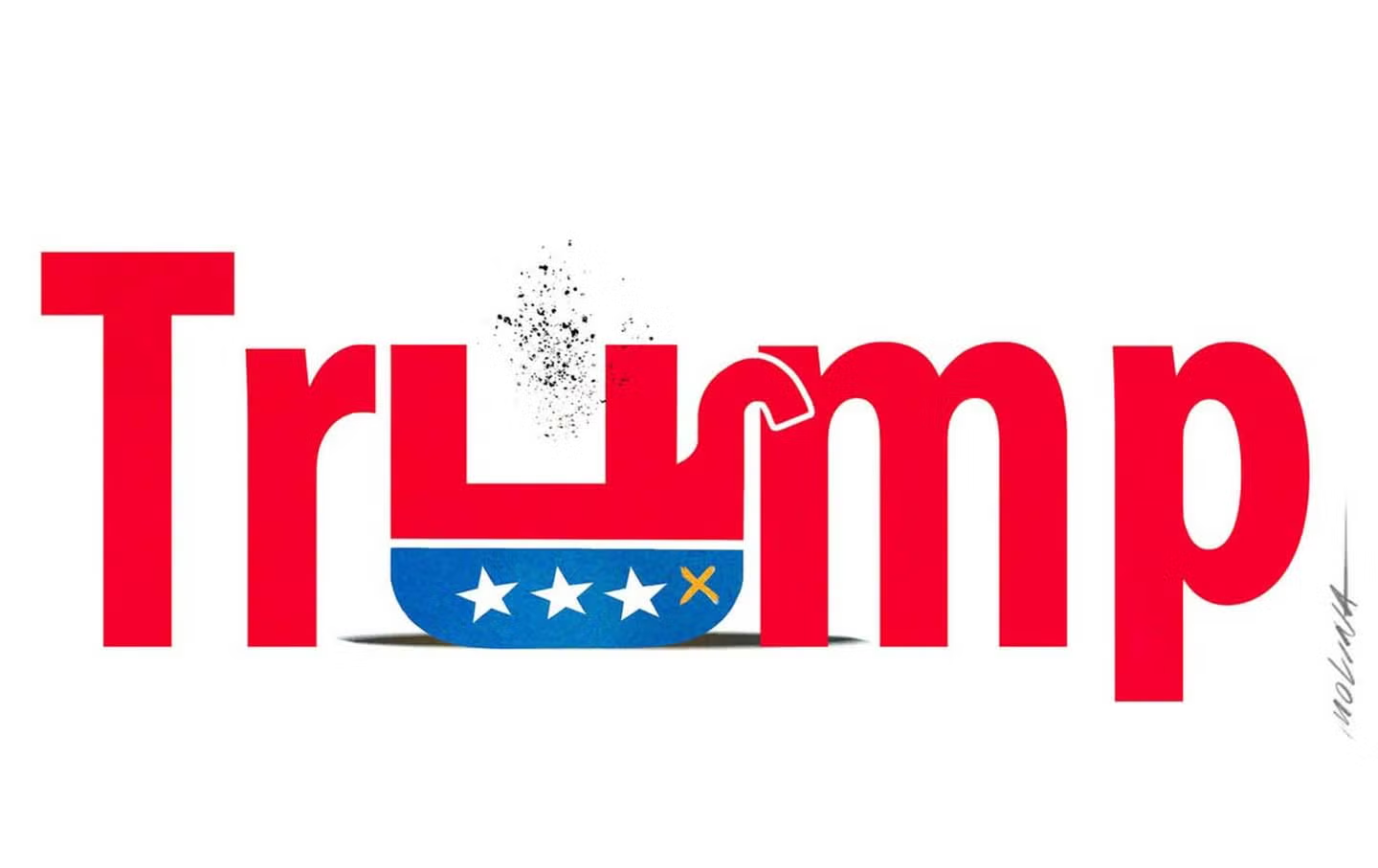
Wise investors know that having a diverse portfolio is good in politics, not just the stock market. That’s why plutocrats have traditionally donated lavishly to both Republicans and Democrats—it’s a way of ensuring that they always have politicians in their pockets no matter which way the electoral wind may blow. But over the last two years, some of the wealthiest figures in Silicon Valley, led by trillionaire Elon Musk, have broken this once-cardinal rule by becoming strident partisans of Donald Trump and the MAGA movement.
Musk in particular has become virtually synonymous with the most rancid elements of Trumpism. He frequently elevates antisemitic, racist, and even Nazi ideas, notably the paranoid white replacement theory. And he has handed eye-watering levels of money to the GOP. In 2024, Musk donated at least $288 million to elect Trump and other Republicans. The figure was even higher for the 2026 midterms: $446 million, the most any single donor has ever given in an electoral cycle.
Musk was amply rewarded for his services. His loyalty to Trump helped his various companies (Tesla, SpaceX, Starlink) keep the government contracts on which they depend, and, even more destructively, paved the way for his leadership of the Department of Government Efficiency (DOGE) where he implemented the longstanding agenda of corporate interests by eviscerating government regulations, defunding agencies—including USAID, where his cuts have been linked to the deaths of hundreds of thousands of people overseas—and laying off federal workers.
Musk was once proud of this record. In March 2025, he spoke at a Trump rally and declared, “I’m not just MAGA, I’m dark gothic MAGA.”
But in the wake of the midterms, where the Republicans suffered the worst electoral drubbing in half a century, Musk suddenly realized that his public posture as a far-right Republican might be a liability. Cue the screeching sound of a Tesla in reverse.
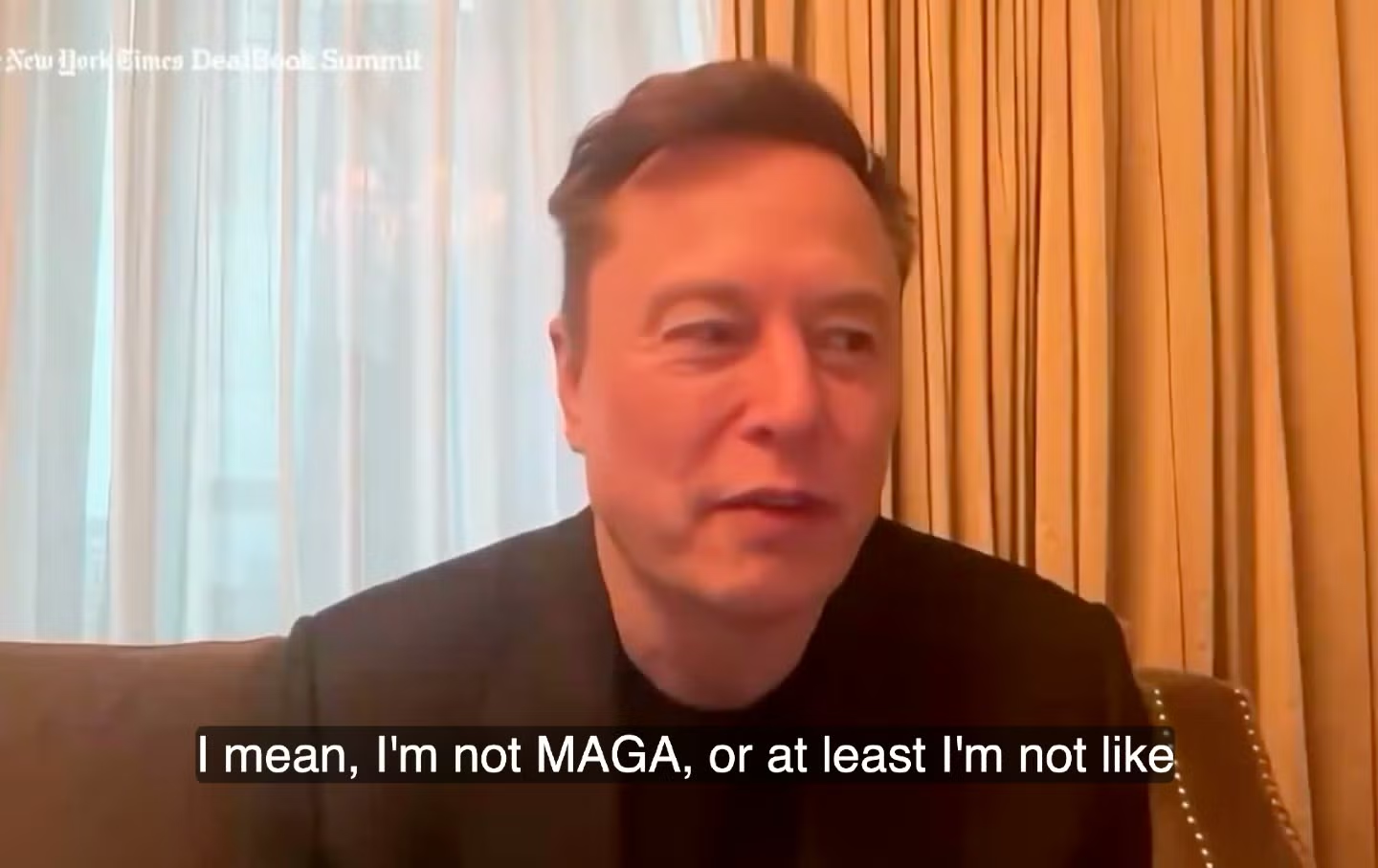
Now, Musk is singing a very different tune, trying to sound like a dulcet-voiced centrist rather than a booming fascist. Speaking at the New York Times DealBook Summit on Wednesday, Musk sheepishly said, “I’m not MAGA. If that means sort of blind adherence to a set of policies by the Republican Party, then I certainly don’t have that.” He then declared himself a “moderate” and said he could work well with Gina Hinojosa, the incoming Democratic governor of Musk’s adopted home state of Texas.
These conciliatory words ring very hollow, considering Musk spent at least $212 million in a futile bid to elect Hinojosa’s rival Greg Abbott and other Texas Republicans. Musk did acknowledge, “I feel pretty foolish about having spent so much money and not seeing much for it. Probably if I could rewind the clock, I would have spent less money.”
Musk is not the only plutocrat suffering from buyer’s remorse. Alex Karp, the founder of surveillance giant Palantir, has also supported the hard right in recent years but is now posing as a born-again Democrat. In a post-midterms interview with Politico, Karp claimed, “I’ve been a Democrat my whole life. I grew up in a far-left environment. I know more about being a progressive than almost anybody on the planet, and I absolutely believe Palantir—all of our products are essentially progressive.”
The political danger is the centrist Democrats, always eager for donations from billionaires, will welcome back figures such as Musk and Karp as prodigal sons who may have sinned but deserve a second chance.
The dangers of right-wing billionaires using the mask of moderation to take over the Democratic Party are not theoretical. It is well demonstrated by one of Musk’s business partners, James Murdoch, who sits on the board of Tesla. James Murdoch is, of course, son of Rupert Murdoch, the far-right press baron who owns Fox News. He is also, along with his wife Kathryn, one of the biggest donors to the Democratic Party, assiduously propping up centrist Democrats in a bid to thwart the party’s move to the left.
In the soap opera lore of the Murdoch family, amplified not just in press coverage but in shows such as Succession, James and Kathryn represent the good, liberal wing of the family, unlike older brother Lachan, who has won control of the media empire in part because he is as stridently right-wing as his father.
This view of good Murdochs versus bad Murdochs is an oversimplification. A lengthy Politico profile of James and Kathryn paints a more complex portrait. James had been groomed to run the media empire, but was tarnished by the fact that he oversaw the British tabloid The News of the World when it was forced to shutter in 2011 in the wake of the notorious phone-hacking scandal. His emerging pseudo-liberalism then coincided neatly with his growing ostracization from the News Corp fold.
Popular
“swipe left below to view more authors”Swipe →Ironically, in cultivating Democrats, James Murdoch is following in the footsteps of his estranged father. Although Rupert Murdoch is right-wing, he’s always been willing to cozy up to centrist politicians in order to have government support when they held office. As Politico notes, Rupert “had held fundraising breakfasts for Hillary Clinton and his Sun tabloid backed Tony Blair’s Labour Party even as his own politics were to the right of theirs.”
Clearly, James was taking notes. Since 2020, he and his wife have given $30 million to the Democratic Party. It’s valuable for the Murdochs to have tight connections with both Democrats and Republicans.
Like Rupert Murdoch, though, James and Kathryn know that influence comes not just from political donations but also from shaping nonprofits and the media. They have heavily invested in groups such as Majority Democrats (a clearinghouse for centrist Democrats that recently held a big conference in Denver) as well as media outlets such as New York magazine, Vox and The Bulwark.
Their political orientation can roughly be described as Never Trump Republican, with an added (and commendable) concern for climate change. In other words, they think the Democrats should try to win over the center-right voters who once supported George W. Bush, Mitt Romney, and Liz Cheney.
As Jeff Hauser of the Revolving Door Project told Politico, “They forget that Kamala Harris tried to co-opt reasonable Republicans into her campaign, and turn away from populist anger, and it didn’t work.” Ravi Mangla of the Working Families Party had a similar critique: “People are really angry at the cozy relationship between the political establishment and who they view as a donor class that has way too much power and access in our politics. It raises questions of whether those groups are best positioned to deliver on what voters are asking of people or are asking of the party.”
In pursuit of their politics, James and Kathryn have given lavishly to figures such as former Transportation Secretary Pete Buttigieg and Pennsylvania Governor Josh Shapiro, who says he is “grateful that they invested early on in my race.”
The question worth asking is what returns the Murdochs can expect from their investment. Or to put it another way, the Murdoch family already owns the Republicans, so it seems a bit greedy for them to want to buy another political party.
More from The Nation


Why the Midterms Were So Painful for Trans People Why the Midterms Were So Painful for Trans People
We watched politician after politician sell us out. Then we were demonized for getting mad about it.

Voters Just Rejected Data Centers and Big Tech. Congress Is Moving Fast to Undermine Them. Voters Just Rejected Data Centers and Big Tech. Congress Is Moving Fast to Undermine Them.
A look at the forces driving the rush for “permitting reform” before a new Congress starts its term.
Trump’s Man on the Inside Trump’s Man on the Inside
Before the balance of power shifts in Congress, the president hopes to ram through the appointment of a MAGA crony to federal office.
Jamaal Bowman’s Memoir Is Revealing About the Cost of Conviction Jamaal Bowman’s Memoir Is Revealing About the Cost of Conviction
Why we still need to rebuild the infrastructure of care.