
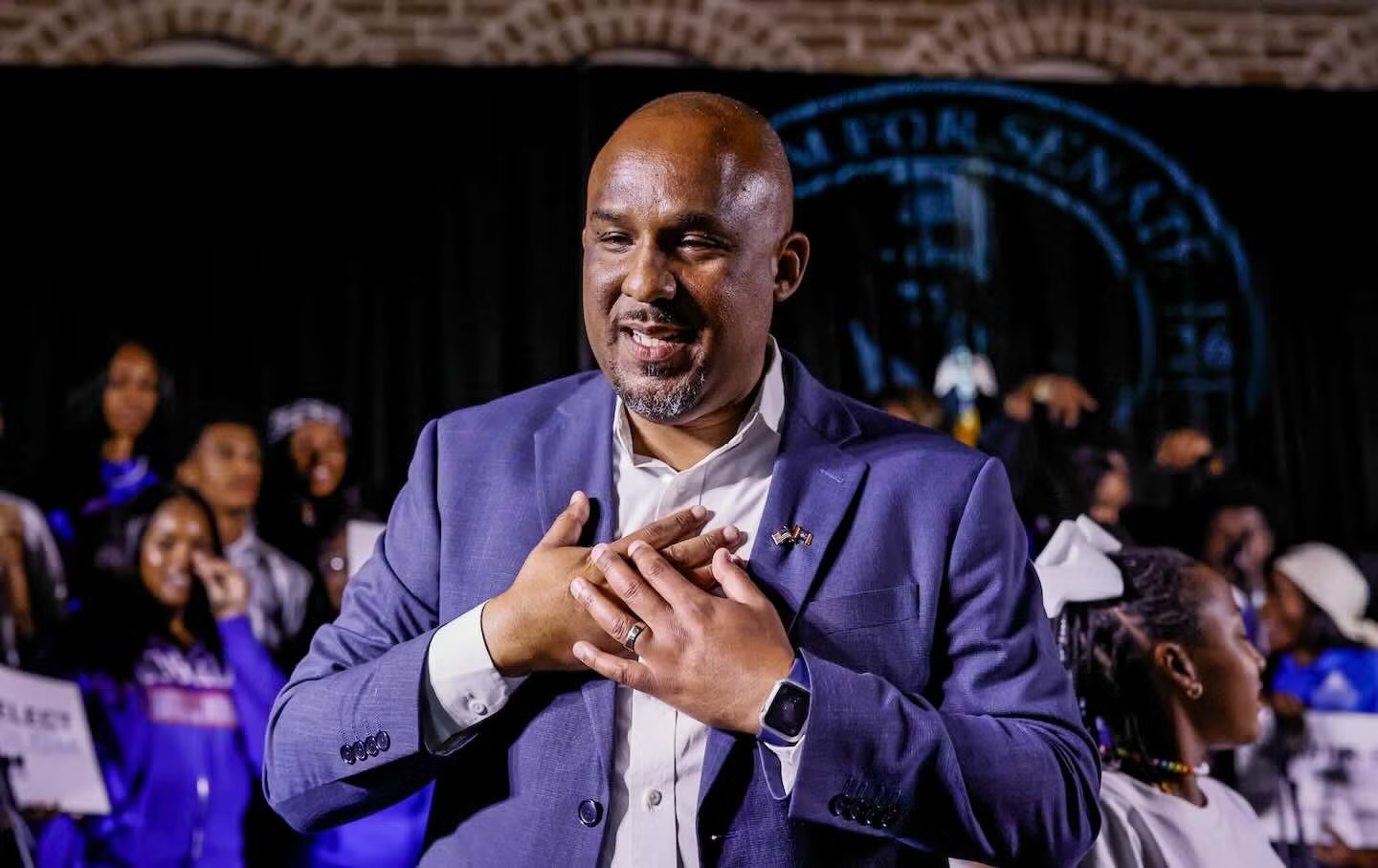
Mississippi Sen.-elect Scott Colom (D-MS) gestures to the crowd after his victory speech at Tougaloo College on November 11, 2026 in Tougaloo, Mississippi.
(Aron Smith / Jackson State University via Getty Images)
On Thursday, Scott Colom was declared the victor in the hotly contested United States Senate race in Mississippi. Colom, a lawyer and district attorney, will become the first Black person from Mississippi to hold a US Senate seat in more than 140 years. Colom’s victory against the incumbent Cindy Hyde-Smith was declared after close ballot-counting. Upon learning of this, I sat in my office and wept, reflecting on childhood summer visits to Mississippi, where my maternal great-grandfather lacked running water and electricity. He died while I was in law school—never having had running water.
Pundits will point to Colom’s important win as particularly noteworthy for several reasons. For example, in 2023, Hyde-Smith blocked his candidacy to become a federal judge by withholding the “’blue slip’ required under Senate Judiciary Committee practice to advance Colom’s judicial nomination, despite support from fellow Mississippi Republican Sen. Roger Wicker,” reported The Advocate. And in 2024, Donald Trump swept the state, defeating Kamala Harris by almost 23 points—a jump in voter support from his 2020 and 2016 victories in the state. Commentators will also likely frame Colom’s victory as a response to the very real economic hardship Americans are facing given Trump’s disastrous policies. All are true.
However, Colom’s victory means something much more profound and ground shaking—perhaps even greater than the presidential victory of Barack Obama, who failed to receive more than 43 percent of the vote in the state in both of his elections—especially for many Black Americans with a legacy tied to Mississippi. For those of us who share this lineage, Colom’s victory is not only a repudiation of Donald Trump but also the horrific political and social machines that drove American slavery and Jim Crow. For centuries—not decades—Mississippi was a proud “slave state.” It embraced and profited from the enslavement of Black people and fought hard to keep its status quo.
In its 1861 declaration of secession—A Declaration of the Immediate Causes which Induce and Justify the Secession of the State of Mississippi from the Federal Union—state lawmakers affirmed, “Our position is thoroughly identified with the institution of slavery—the greatest material interest of the world. Its labor supplies the product which constitutes by far the largest and most important portions of commerce of the earth.” Mississippi referred to enslaved Black people as “products” that were “peculiar to the climate verging on the tropical regions, and by an imperious law of nature, none but the black race can bear exposure to the tropical sun.”
Mississippi saw enslaved Black people as essential to its economy and ways of being. Its declaration of secession points to a degradation in being denied owning people rather than the immorality of human bondage, rape, forced pregnancy and childbearing, and the cruelties of family separation and the whip. Even after the Civil War in which Mississippi’s losses were high (all of its enlisted Ole Miss students died fighting for the Confederacy), the state refused to ratify the Thirteenth Amendment, which abolished slavery and involuntary servitude. In fact, it wasn’t until 2013 that the state did so—148 years later.
Even while it could not block Black people’s newly ratified constitutional freedoms, Mississippi erected barriers nonetheless. It was the first state to enact notorious Black Codes, barring Black people from freely engaging in labor contracting. It passed harmful apprenticeship policies, stripping Black children away from their parents on dubious claims of neglect. These practices condemned Black children to slavery under the guise of apprenticeship to plantation owners. Mississippi lawmakers also imposed fines on Black people who traveled and stood together on public streets, calling this vagrancy.
Despite all of these barriers to equal participation in society, the newly freed Black Americans in Mississippi came into office, helping to enact policies that resulted in public education for all and even married women’s property rights. That window closed abruptly due to the United States Supreme Court dismantling Reconstruction by upholding segregationists laws and granting its imprimatur to “separate but equal” strategies.
Mississippi welcomed the end of Reconstruction and profited from it with coercive sharecropping practices and convict leasing. Aspects of those legacies linger. For example, it must be noted that Black Americans today represent more than half of Mississippi’s prison population, while representing only 38% of the state’s entire population.
The horrors of Mississippi’s Jim Crow-era are hard to turn away from. Featured in award-winning documentaries like Eyes on the Prize, detailing amongst other things Mississippi’s brazen and violent citizen’s councils organizing against Black voting rights. In films like Mississippi Burning, which narrates the tragic killings of three young civil rights workers—Andrew Goodman, Michael Schwerner, and James Chaney. In song, Nina Simone’s Mississippi Goddam comes to mind, as well as Billie Holiday’s Strange Fruit, capturing the chilling terror of lynchings. In the testimony of Fannie Lou Hamer at the 1964 Democratic National Convention, when she spoke of being arrested and beaten by law enforcement after attempting to vote. Or the terrifying image of Emmett Till on the cover of Jet magazine after his bloated, beaten, and tortured 14-year-old body was lifted from the Tallahatchie River. His murderers, Roy Bryant and J.W. Milam, were acquitted in barely an hour by an all-white jury. They later confessed in Look magazine.
Colom’s victory must be understood against a complex backdrop, where Black people fled Mississippi during the Great Black Migration to never return given a legacy of cruelty and hate. And one where so many remained like Colom and his forbears, committed to fighting for democracy in a state that they toiled to build and where quite literally, the blood of their ancestors was spilt.
For me, Colom’s victory is a balm or salve on scars carried across generations—on the backs of grandparents and great grandparents. Of my grandmother’s siblings who fled Mississippi, she was the only one who would cross the Mason Dixon, to drive south to visit family. Sadly, this took courage. Several of her siblings simply could not. My summers in the South, especially the visits to Mississippi, left an indelible mark.
Whether they are residing now in the state or the offspring of the hundreds of thousands that fled north in the greatest migration, Colom’s win is more than a joyous occasion for the Black Americans who remain connected to Mississippi. It is the closest to redemption that the state and perhaps the US has come to in modern times.