
The Voters Who Saved Democracy Are Being Written Out of the Story
The media downplayed the importance of Black voters for Democratic victories.
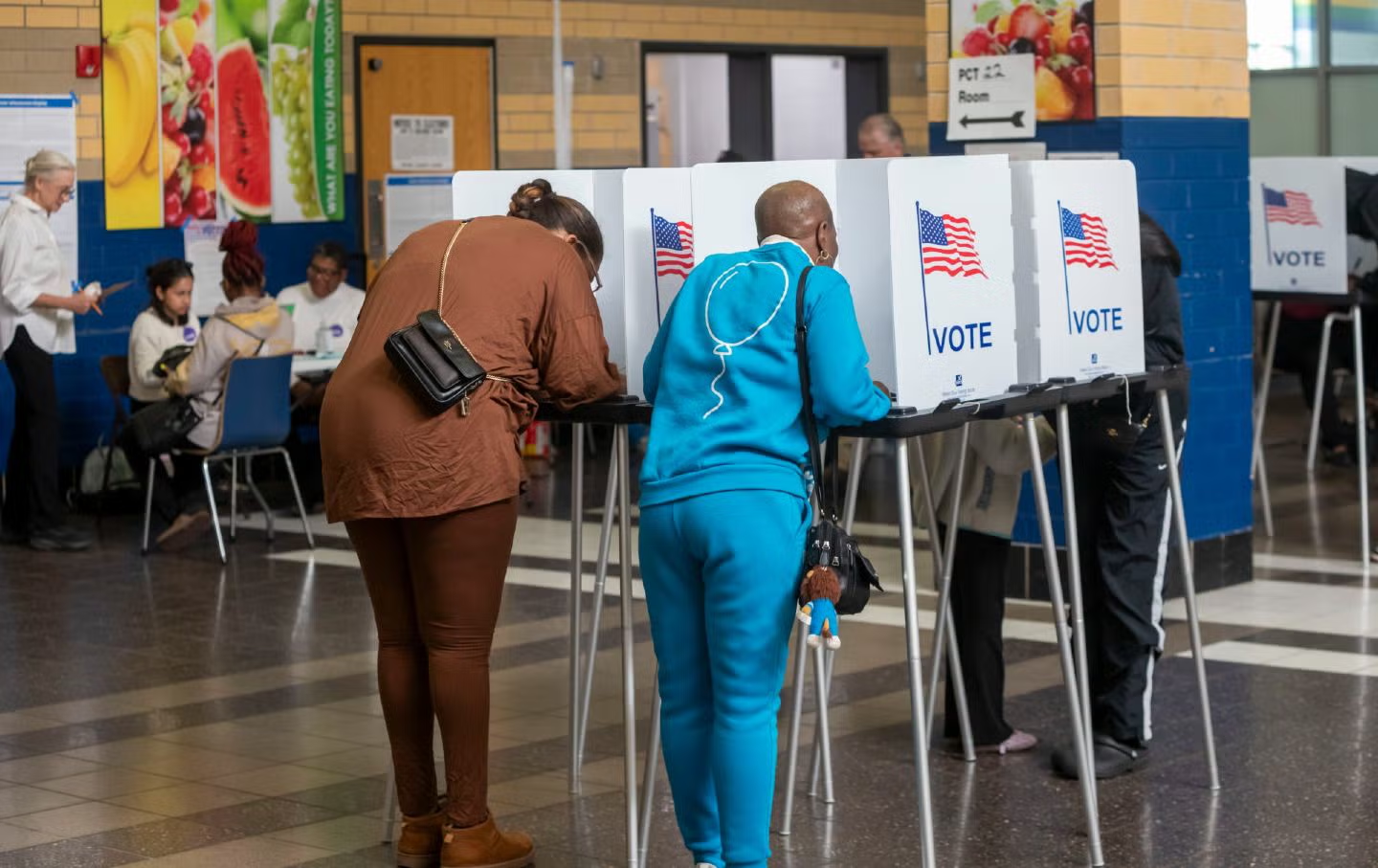
Here are some media headlines and hot takes after last week’s Democratic midterm victories. See if you can catch what’s missing from their framing.
First, CNN ran an exit-poll explainer under the headline “Women, young voters and independents: See where Democrats made inroads.” Time said the “distinct gains came from young, rural, and Hispanic voters.” The Washington Post told readers, “Democrats have a surprising group of voters to thank”: namely, rural voters in Republican strongholds. And Reuters reported, “Latinos drive Democratic gains.”
While those shifts were real, and the shift among Latinos was critical to Democratic fortunes in Texas, what each outlet neglected to mention is the centrality of Black voters to the party’s wins. And yet, these voters were the most crucial part of the story.
In Georgia, South Carolina, North Carolina, Ohio, Michigan, and Mississippi—where Scott Colom appears set to become the first Black senator since Reconstruction—only the Black vote secured Democratic victories and flipped the Senate. In each of those states, exit polls show that white voters supported Republicans and would have gladly kept the chamber in GOP hands.
Even in Texas, although Latinos are the largest group of voters of color, at 25 percent of the total, with only 72 percent voting for James Talarico, and only 39 percent of white voters doing so, he needed the 12 percent of the electorate that was Black to turn out big, and they did, with 91 percent of their vote.
The extent to which the media downplayed the importance of Black voters to Democratic victories was stunning. For instance, Newsweek highlighted rural voters breaking for Democrats in South Carolina, while only noting farther down in the story that those rural voters were Black, while white rural folks mostly stayed home.
And The Washington Post, rather than crediting Black voters for Annie Andrews’s win there, ran a graphic highlighting the “significant improvements” Democrats made with less-educated whites, as if to suggest that had powered her victory. But this “improvement” moved these only voters from a 42-point Republican margin to a 21-point margin—hardly the key to Andrews’s victory, since this group still overwhelmingly rejected her.
The New York Times followed the same pattern, running a story proclaiming “White, Working-Class Voters Shifted Left,” noting, almost as an afterthought, that they still rejected Democrats by nearly 20 points.
And it wasn’t only in Senate races where the Black vote made the difference. In House races, white voters mostly supported Republicans, nationally, meaning that here too, African American voters led the way, however much the media appears to have missed it.
This is no minor mistake, but rather anti-Blackness that refuses to give credit where it’s due. To the political press, those who drift away and come back are a story. Those who never left are like humidity in New Orleans, always there and not worth a headline. That tendency punishes Black Americans for being right first, seeing what Trumpism was in 2016, and voting against it consistently for a decade.
And when we see Black movement in the numbers, as with increased turnout, they still struggle to get credit. During an interview in which he was crediting every other possible constituency for the Democrats’ victories, a Vox interviewer asked Democratic political consultant David Shor about Black turnout. Only then did Shor acknowledge that the Black share of the electorate had risen four points in Georgia compared with the 2022 midterms. But even then, he immediately changed the subject back to the Latino vote in Texas, which wasn’t what the interviewer had asked about, and which also ignored the importance of Black turnout in that state.
This kind of erasure also harms those who did swing, because it hides who their allies are. Working-class whites who voted for Democrats spent years hearing that their problems were caused by “Black crime,” “DEI,” or government handouts to Black communities. In the end, they got nothing from those who offered them scapegoats without solutions. When they finally woke up, they joined a coalition that Black voters had been holding down the whole time.
Popular
“swipe left below to view more authors”Swipe →But if the coverage never says so, these new arrivals may fail to realize that the people they were taught to fear are the ones who kept the door open for them. Black voters are the base of any coalition that can beat authoritarianism. Leaving that out of the story is how the right keeps working people divided.
Perhaps the most dangerous effect of erasing the importance of the Black vote is on Democratic priorities. Parties respond to stories about why they won. If the official story is that white rural voters or independents delivered the majority, the party will cater to them and, once again, treat the concerns of its most loyal voters as something that can wait.
But Black voters cannot afford to wait. In April, the Supreme Court gutted Section 2 of the Voting Rights Act. Meanwhile, the Trump administration has dismantled much of the federal civil rights apparatus, and the Justice Department’s Voting Rights Section has been hollowed out.
Restoring the Voting Rights Act is the Democratic Party’s best strategy for concretizing its gains. It won Senate seats in three (and likely four) Southern states, flipped House seats throughout the region, and held on to others, despite Republican attempts to gerrymander them away. A South where Black citizens can vote freely, in fairly drawn districts, is a South where those gains can last. And a South that is competitive for Democrats, where the promises of Reconstruction can finally be realized, is the recipe for lasting multiracial democracy.
Yes, President Trump will veto a new Voting Rights Act. But Democrats should pass it anyway, and they should make the veto a central issue in 2028.
But that won’t happen if the party believes the media framing about their victories. In state after state, Black voters didn’t just save the Democratic Party; they saved democracy. The least we owe them is the courage to tell the truth about that, and perhaps a thank you.
More from The Nation
The Political Power of Seniors The Political Power of Seniors
In places like Wisconsin, campaigns can’t win without seniors. They are the second-largest, fastest-growing, and most reliable group of voters.
Notes From the Blue Star State Notes From the Blue Star State
Texas is predominantly and pragmatically populist. If the national Democratic Party wishes to conquer the Electoral College for a generation, it will follow the lead of the voters...

Stephen Miller Is the Real President Now Stephen Miller Is the Real President Now
Trump just promoted his worst, most dangerous adviser. Get ready for a constitutional crisis.
Chuck Schumer and Hakeem Jeffries Are Not Meeting the Moment Chuck Schumer and Hakeem Jeffries Are Not Meeting the Moment
The Democrats' congressional leaders have been handed an enormous mandate they have no interest in carrying out.
Trump, Toast or Toasted… Trump, Toast or Toasted…
America has been burned by his corruption.

Russia’s Last Independent Newspaper Is Going Dark Russia’s Last Independent Newspaper Is Going Dark
The closing of “Novaya Gazeta” marks the end of what little press freedom remained in Putin’s Russia.

