

A screenshot of Donald Trump talking about Jon Husted’s butt.
(LiveNOW from Fox)One of the mysteries of the 2026 midterms will always be why Donald Trump thought he could charm voters by repeatedly and lasciviously celebrating the human buttocks.
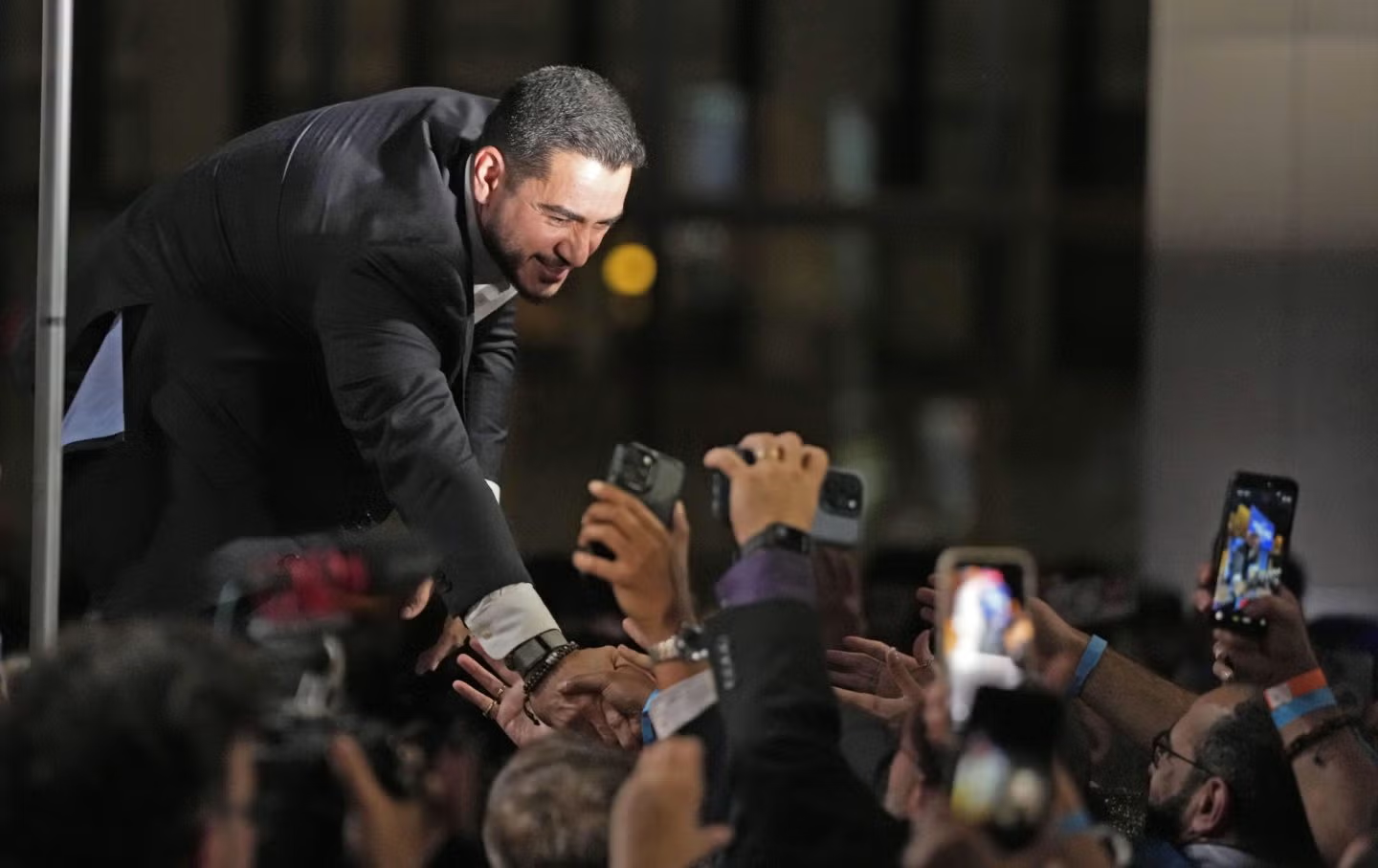
On October 12, Trump astonished a rally in Ohio with his lurid leering at Senator Jon Husted. “I started examining his body because I didn’t know he was a great athlete,” Trump said, alluding to Husted’s history as a college football player. “And I looked—I watched up, and down, I looked at his ass, and I looked at the whole…” Tributes to Husted’s rear would remain a staple until the end of the campaign.
But Trump wasn’t content to ogle just Husted. Speaking in Michigan on October 25, Trump made similar comments about both the singer Nicki Minaj (credited with “one hell of a beautiful ass”) and senatorial candidate Mike Rogers. Trump added, “I’d say that about your ass too, Mike, if it gets you a guaranteed victory.”
The degree to which Trump talks about other people’s bums really is bizarre and arguably without precedent in American political history. Abraham Lincoln did enjoy making scatological jokes about bodily functions, but that was in keeping with his persona as a son of the soil born in a log cabin—and he was not known to constantly praise, say, Charles Sumner’s behind on the campaign trail. In 2020, then–vice presidential candidate Sarah Palin appeared on The Masked Singer to perform “Baby Got Back,” Sir Mix-a-Lot’s classic rap tribute to the posterior. This was unusual but a one-off event—and by that point, Palin had long transitioned from a serious political figure to, well, the kind of D-list celebrity who sings about butts on television.
By contrast, Trump’s butt commentary is relentless, and coming from the incumbent president of the United States. And because of the cult-like hold that Trump has over the Republican Party, ass-talk started to proliferate. On October 29, during an appearance on Fox News, vice president JD Vance was asked a serious question from a voter about how the affordability crisis was harming young people. Inexplicably, Vance responded, “I want to point out that I’ve only gotten one question about Jon Husted’s ass.” A few days later, Florida senatorial candidate Ashley Moody told a rally, “Maybe I should be upset [Trump] didn’t talk about my asset.”
All of this loopy bum talk didn’t help the Republicans, despite Trump’s absurd claim that his praise of Husted’s rear caused the senator’s poll numbers to vault 14 points. Husted and Rogers went down to defeat, while Moody won an unexpectedly narrow race, helped by the fact the Democratic Party didn’t sufficiently fund her rival Angie Nixon.
After the Republicans were soundly trounced in the worst midterm defeat in half a century, Republican operative Todd Gillman told Politico, “Honestly, we need to move as far away from Trump as we can. I think Republicans might be screwed all the way until ’30. Talking about Nicki Minaj’s fat ass. All that stuff is just wearing people out.”
Even if it is politically ineffective, Trump’s ass-talk is a political fact, one that demands an explanation. On November 1, The New York Times published a lengthy analysis of Trump’s increasing verbal incoherence, including “his baffling fixation with admiring men’s posteriors.” “He is cruder than he used to be,” the paper reports, “using nearly 15 swear words per 10,000 words compared with 14 two years ago and six a decade ago, a change consistent with age-related disinhibition.”
It makes sense that, at the age of 80, Trump is less willing or perhaps less able to censor himself. But while this cognitive explanation offers a necessary context for Trump’s rough language, it doesn’t explain the specific content of the speech. Why does he have an anal focus, rather than, say, a genital or oral one?
Further, the fact that Trump’s ass talk was echoed by respectable Republicans such as Vance and Moody means it has a social meaning that goes beyond the peculiarities of Trump’s admittedly twisted personality. Trump is a freak but not an isolated case. He’s a weirdo with an immense mass following, so his quirks have a wider social resonance.
Saturday Night Live, less restricted by the rules of propriety than The New York Times, offered an unvarnished sexual explanation in a recent skit that shows the president suffering from “gay dementia.”
This joke is, as often with SNL, both too glib and borderline offensive. The truth is that Trump’s ass-talk is only occasionally sexual but more frequently involves excretion; it targets women as well as men, and is as much about asserting domination and humiliation as about expressing desire. In other words, Trump’s fixation is scatological and anal, rather than narrowly erotic.
Consider Trump’s description of Norway as a “shithouse country” (a term of abuse Trump has used against other nations in the past). Similarly, Trump has obsessed in speeches about the dangers of low-flow toilets, lamenting in 2019 the need to flush “10 times.”
Writing in Rolling Stone, Jack Crosbie argued that Trump’s ass talk is “ripe for armchair psychoanalysis: Trump is self-conscious about his own aging body, Trump values the superficial and material above all other things, Trump sees validation from the strong and tall and beautiful as evidence that what he is doing is good and just.”
This is all very suggestive, but it’s useful to move beyond such amateur speculation and consult the work of a true expert. In thinking about Trump’s anal fixation, few works are more illuminating than Normal O. Brown’s towering study Life Against Death: The Psychoanalytical Meaning of History. Brown was a distinguished classicist, and the virtue of his book lies in its provocative application of Sigmund Freud’s psychoanalytical theories to social and political analysis. As such, it rivals other mid-20th-century works of daring, psychologically informed social theory by figures such as Herbert Marcuse and Wilhelm Reich.
Surprisingly, Brown’s book has a Trump connection. It was originally published to obscurity by an academic press but found fame when it was championed by Norman Podhoretz, a New York literary critic and editor at Commentary. Podhoretz would later become one of the founding fathers of neoconservatism and, late in life, one of the most prominent pro-Trump intellectuals. In a 1999 essay in Harper’s, Christopher Hitchens noted that Podhoretz and other neoconservatives have an “obsessive” and prurient focus on anal sex.
In a brilliant and celebrated chapter on “the excremental vision” of Jonathan Swift, Brown notes,
according to Freudian theory the human infant passes through a stage—the anal stage—as a result of which the libido, the life energy of the body, gets concentrated in the anal zone. The infantile stage of anal eroticism takes the essential form of attaching symbolic meaning to the anal product. As a result of these symbolic equations, the anal product acquires for the child significance of being his own child or creation, which he may use either to obtain narcissistic pleasure in play, or to obtain love from another (feces as gift), or to assert independence from another (feces as property), or to commit aggression against another (feces as weapon).
Popular
“swipe left below to view more authors”Swipe →The anal stage is universal, but as the infant matures, these impulses are sublimated into more socially acceptable behavior. If Trump is in fact suffering cognitive decline, it could be that sublimation is no longer possible. It’s broadly true that for Trump, subtext and text are often one: He doesn’t sublimate desire but gives it free vent, often in erratic and socially aggressive ways.
In the writings of Swift, one sees anal aggression brilliantly sublimated into a harsh and compelling satirical vision of humanity. Brown demonstrates that this is both Swift’s practice as a writer and his thematic concern. Trump, lacking Swift’s genius, turns anal aggression into mere verbal abusiveness: In the vernacular, Trump is a man who loves to shit talk.
Elsewhere in his study, Brown links the anal stage to hoarding, particularly of gold. Very slightly sublimated, hoarding gold turns into a love of the gold standard. This cluster of compulsions (narcissism, abusive language, hoarding, the fetishization of gold) can easily serve as a quite acute account of Trump’s psychology. Even if one doesn’t accept the scientific validity of Freudian categories, there is no denying that it offers a fresh and original way to think about commonly linked character traits.
While Brown was fully aware of the sadism of the anal stage, he also entertained the utopian hope that humans might be able to deprogram themselves of their social conditioning and achieve a return to the childhood ecstasy in the polymorphous perverse. The case of Trump suggests that this program might be dangerous if applied unilaterally. If one individual reverts to the anal stage while the rest of society remains committed to sublimation, you have a recipe for tyranny: the alpha male baboon who smears his shit over everyone in order to assert dominance. In other words, Trump’s impulse to constantly talk ass is symptomatic of the fact that he is an asshole.
More from The Nation

Protest and Vigil at an ICE Detention Center Protest and Vigil at an ICE Detention Center
Calling out a Brooklyn prison where ICE rampages.

Democrats Crushed Trump. Here’s What They Should Do Next. Democrats Crushed Trump. Here’s What They Should Do Next.
Seeking facile compromises with Trump is a fool’s mission—and voters who are hungry for change will not accept half-measures.

We Stomped All Over the Patriarchy on Tuesday Night We Stomped All Over the Patriarchy on Tuesday Night
Almost everywhere, abortion rights initiatives won, and pro-choice candidates prevailed. Even in Idaho, where they didn’t, women are taking heart.
Democrats Would Be Insane Not to Break With Israel Now Democrats Would Be Insane Not to Break With Israel Now
The party has an unequivocal mandate to fundamentally change the US-Israel relationship.

Actually, Democrats Don’t Have to Sacrifice Trans People or Immigrants to Win Actually, Democrats Don’t Have to Sacrifice Trans People or Immigrants to Win
For two years, leading Democratic factions have insisted that the party must abandon key populations to win. Tuesday proved them wrong.

David Sacks’s Sack of Lies David Sacks’s Sack of Lies
Trump’s adviser pushes AI without guardrails.

