This November, Vote Like Alito Is on the Ballot
In this week’s Elie v. U.S., our justice correspondent gives Democrats another reason to vote in November. Plus: How Sarah Huckabee Sanders’s Medicaid unmasked the racists.
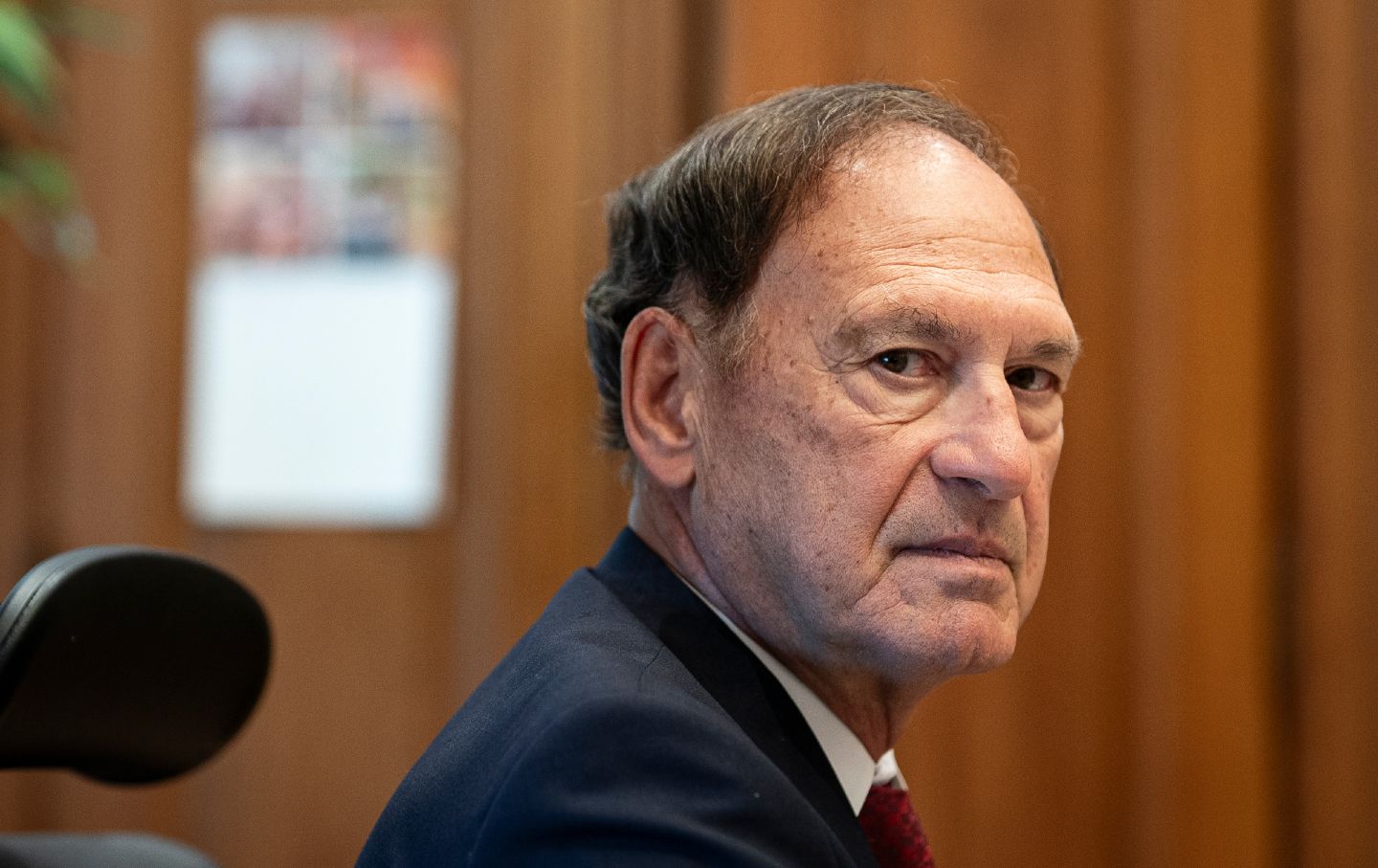
Samuel Alito Jr., associate justice of the US Supreme Court.
(Al Drago / Bloomberg via Getty Images)
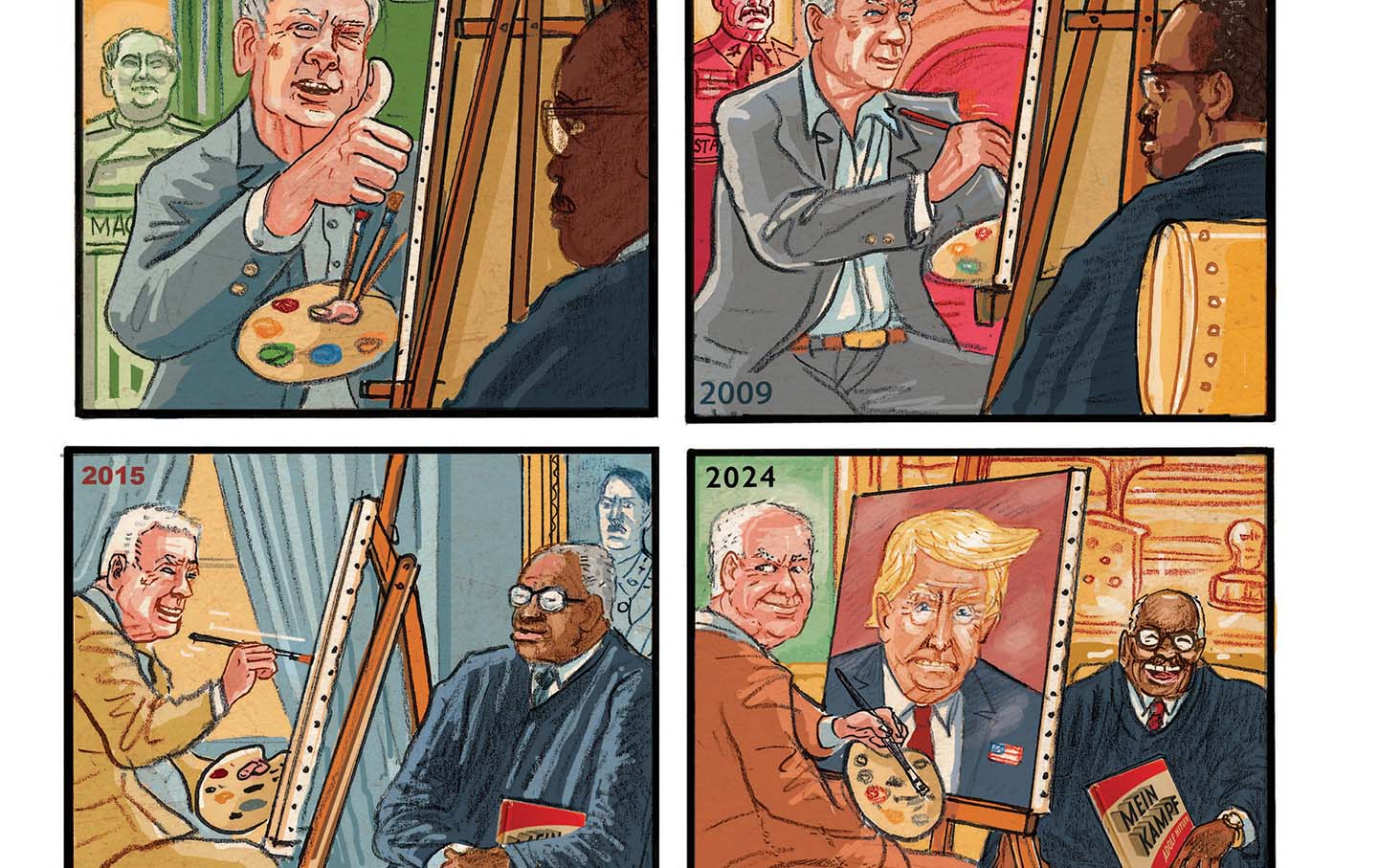
The Supreme Court headed back to work this week, hearing four cases over its first five days. At the same time, Justice Samuel Alito has been making the media rounds, promoting his new book on originalism and complaining about how his disgusting, politicized opinions are portrayed in the press.
Regular readers of this newsletter will remember that I predicted Alito, who turned 76 in April, would have retired by now. I thought that he timed his book launch so that he’d be able to promote it without juggling cases, and that he’d want to give Republicans a chance to replace him before the midterms. Turns out I was wrong, though I’m quite happy to have been wrong. Alito’s decision to remain on the court means there’s a chance that Democrats can win the Senate and block his replacement for the next two years. And now there’s also a chance that Democrats can win the White House and the Senate in 2028, which spins the actuary table through 2032. By refusing to retire, Alito’s given the Democrats a potential win, because dealing with Alito for another few years is preferable to dealing with Alito’s Republican replacement for another 30.
But I’m not the only one who’s connecting the dots; so is Alito. During his media blitz, he’s said that he’ll consider retiring next year. That is a message to Republican voters: Alito is “on the ballot” this November. He’s telling voters that his seat could be up for grabs, should voters return Republicans to power in the Senate.
Alito’s statement should light a fire under Democratic voters in all 50 states. If Democrats retake the Senate, they can effectively block an Alito replacement to the Supreme Court, forcing him either to stay on the court or risk the Democrats’ holding the seat open through the 2028 presidential election cycle. That plan would, of course, require Democrats to have both a spine and a self-preservation instinct, which I’m not sure they do, but I’m trying to manifest by speaking it into the world. Making sure the guy who killed abortion rights doesn’t get a chance to handpick his successor is more than enough reason to vote for any Democrat, even if you’re a progressive who’s unimpressed by a squishy moderate—or a centrist scared by a true progressive.
The thing is, that’s not how liberal voters have traditionally behaved. In fact, the opposite’s been true. Alito’s out there making statements about his future precisely because he thinks dangling his potential retirement will light a fire under Republican voters.
Historically speaking, Alito’s right. Republican voters have long shown an ability to hold their noses and vote for Republican senators who will confirm reactionary justices. Democratic voters have consistently failed to appreciate how Supreme Court appointments and confirmations can scuttle the entire liberal agenda.
Think about it this way: Who is going to make more use of the Alito situation in the Texas Senate race? Is it more likely that a Republican who finds Ken Paxton odious and corrupt will hold their nose and vote for him, despite everything, to help secure Alito’s replacement, or is it more likely that a Democrat who finds James Talarico unreliable on issues of race or LGBTQ rights will hold their nose and vote for him to block an Alito replacement? History suggests that Alito’s statements will do more to help Paxton than anything Paxton’s estranged wife can say.
But I hope I’m wrong. I’ve been wrong before.
The Bad and the Ugly
- Cornell students held a massive sit-in over the university’s atrocious response to allegations that a student was raped by multiple members of a school fraternity. That is great. But…
- In France, high school students are nearly shutting down the country with protests over understaffing and overcrowding at French schools. They have partnered with labor union activists, and the protests have been going on for two weeks.
- An FBI whistleblower claims that the Trump administration pushed for unconstitutional investigations into people who protested ICE in Los Angeles. This is why we should be more like France: If everybody is protesting, they can’t stop all of us.
- Despite multiple court orders telling Trump he can’t tie FEMA funding to cooperation with ICE, he’s still doing it, states say.
- In a potentially major decision, the Third Circuit Court of Appeals ruled that training AI on copyrighted material is not “fair use.” That’s huge. LLMs work by scraping vast amounts of copyrighted content. The lawyers for the AI company will now appeal to the Supreme Court.
Inspired Takes
- Elizabeth Spiers wrote in The Nation about the Cornell 7, the culture of rape and violence against women that permeates college campuses, and the importance of teaching boys what consent means from the earliest ages. The piece is arresting, and I’ve talked about it with nearly everyone I know.
- Cate Latimer and Alice Scott sat down with Milan van Dam for The Nation. At 17, van Dam is the youngest member of the Democratic National Committee. They talked with him about what Gen Z wants from the Democratic Party.
- I sat for an interview with the podcast A People’s Climate about, well, climate change and what it’s going to take to get a legal system that does something about it. The episode goes live on Saturday.
- If you will allow some shameless self-promotion, sign-ups have started for The Nation’s annual Caribbean cruise. If you have the interest, time, and ability, come along. It’s a good time; we’ll get to hang out, and you can hear what I think about things when I’m five drinks to the wind and my editor is locked on dry land.
Worst Argument of the Week
It’s probably obvious to you that I have protests on my mind this week. That might be because The New York Times did a deep dive on Trump’s plans to fence off Lafayette Square, the park across from the White House that has been the site of many great American protests. Trump wants to put a permanent barricade around the green, with a gate that can be opened or closed at officials’ discretion.
Popular
“swipe left below to view more authors”Swipe →The story really pissed me off, but perhaps not for the obvious reasons. Experts and activists decried Trump’s plan as an attack on free speech, and as yet another authoritarian step by the president. And it is. Locking down the site will obviously discourage protests. Even when the gate is “open,” the fence might deter people from gathering. There’s also the obvious safety concerns because, if people have to go into a pen to protest, they can more easily be rounded up or, worse, trampled.
That’s all very bad. But what really destroys me is that the fence will likely work because people won’t break it down. People will accept the fence as a new reality. They will work with the fence, around the fence, literally inside the box the fence creates, instead of ramming through the fence with a bulldozer painted red, white, and blue.
Protests are supposed to be acts of civil disobedience, not boisterous obedience. They are supposed to break laws. They are supposed to spring up in places authorities do not want them to happen. To protest is to risk one’s life. That’s part of what makes them effective. It’s not a party. It’s not a festival. It’s a dangerous, subversive activity, and that’s why the people who do it should be lauded.
To cite the example of France once again: Can you imagine a French protest being stopped by a lock, or a gate, or a fence? “Ah, zut, we were going to storm le parc but c’est fermé à clé. Merde.”
If Trump builds his fence, it will take an act of Congress to bring it down, instead of 10 enraged students with an industrial-strength diamond-tipped steel cutter they stole from Home Depot. And that makes me sad.
What I Wrote
The Supreme Court is back in session, so I wrote about its first case: a landmark environmental lawsuit that, if successful, could change the way the fossil fuel industry operates. The lawsuit is so important that the Supreme Court will not allow it to be successful, even if the Republican justices have to abandon their ideological priors to stop it.
Also: For people who don’t get the print magazine, my annual Supreme Court preview went live on the Web this week. I gave a rundown of the most important cases (according to me) the court is set to decide this term and tried to remind people that we are not powerless in the face of these people that nobody elected.
In News Unrelated to the Current Chaos
Sarah Huckabee Sanders, who somehow remains the governor of Arkansas, released a new ad touting kicking people off Medicaid. The ad sparked controversy among the MAGA-nati, but not because the underlying message was that poor people don’t deserve healthcare. No, Huckabee Sanders got in trouble because the main character in her ad about a poor person who doesn’t deserve healthcare is a young white guy.
Republicans, you see, believe that all “underserving” Medicaid recipients are Black. And so, featuring a white guy in the role of spooning off the public dole really pissed them off. Racist commentator Matt Walsh said of the ad: “Republicans don’t have the balls to do this ad with ‘Shaniqua’ as the villain, even though that would actually be an accurate portrayal of the problem at hand.”
Walsh is, as per usual, wrong. In Arkansas, 60 percent of people who rely on Medicaid are white. Only 18 percent are Black. Huckabee Sanders made the mistake of telling white people the truth about whom government funding cuts hurt.
All that happened here is that the racists told on themselves (in Apartheid X comment after comment). Their problem is not with poor white folks receiving healthcare; their problem is with Black people receiving healthcare. Their problem isn’t with government spending; their problem is with government spending on Black people.
White Democrats, be they progressive or moderate, need to understand and internalize this episode. This is why the “it’s the economy, stupid” messaging no longer works. This is why policies designed to help “working-class” white folks are rejected by those very same people. The kinds of white people objecting to the ad are not interested in government services or programs if the benefits have to be shared with Black people, even when Black people are the overwhelming minority of beneficiaries.
It’s the racism, stupid. It’s always been the racism. The racism is why the white working class is never going to come back to the Democratic Party, no matter what you give them.
***
If you enjoyed this installment of Elie v. U.S., click here to receive the newsletter in your inbox each Friday.