
A New Theory of John Roberts’s Jurisprudence
In this week’s Elie v. U.S., our justice correspondent explains why he thinks Roberts rules the way he does. Plus: Elie mourns the end of summer—and the world.
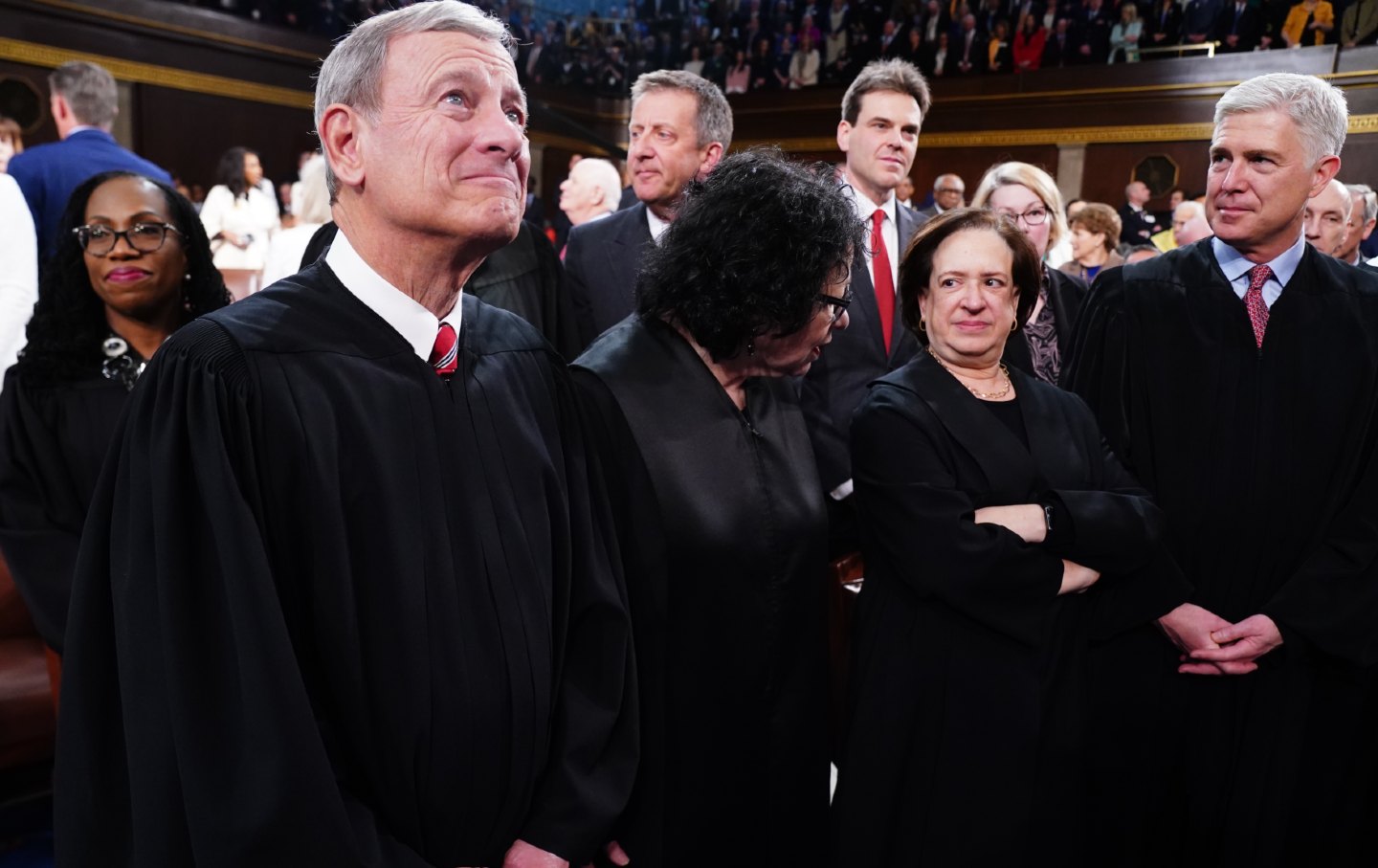
Supreme Court Chief Justice John Roberts flanked by associate justices.
(Shawn Thew-Pool / Getty Images)
I think Republicans are starting to worry that Democrats might pull off court expansion. That’s because this week, the Republicans forced a vote on a constitutional amendment that would cap the number of Supreme Court justices at nine.
Amending the Constitution is notoriously difficult. An amendment must pass with a two-thirds majority in both the House and the Senate, and then it must be ratified by three-quarters of the states.
The Republicans’ court-capping proposal failed the first hurdle. All but one Democrat (Representative Don Davis of North Carolina) voted against the amendment.
Speaker of the House Mike Johnson is generally able to count. He knew, surely, that this amendment was DOA. Prior to the vote, Johnson said he wanted to put Democrats on the record about court expansion.
Mission accomplished? A vote against a constitutional amendment capping the number of Supreme Court justices is far from a vote in favor of expanding the court. But what Johnson and his Republican colleagues may be learning is that court expansion is no longer an inherently radical or radioactive proposal. Josh Orton, president of Demand Justice (disclosure: I’m a board member) told NBC News: “What was once a fairly dramatic and fringe idea has now become mainstream because of how fed up the country has become with the [Supreme Court’s] Roberts majority.”
Let me put it like this: Representative Jim Clyburn, a man not known for getting out ahead of his skis, proposed on Sunday to add four justices to the Supreme Court, bringing their number to 13.
If Democrats win the House, Senate, and White House in 2028, court expansion is going to be on the table. And Republicans know it. And now they know they can’t amend the Constitution to stop it.
The Bad and the Ugly
- While Mike Johnson failed to cap the number of justices, he did succeed at his House resolution to “condemn socialism,” whatever the hell that means. Eight Democrats joined the Republicans in this futile effort at fascist thought policing. One of those Democrats, Vicente Gonzalez of Texas, took the opportunity to sound just as intellectually vapid as the character Rob Ritchie from The West Wing, saying, “Socialism. I don’t know. I’m from the ’80s. Socialism is not a good word for us, right?” You know what else is not a good word for us? Cowardice. Why don’t you vote for a House resolution to condemn cowardice and then resign?
- Instead of voting for stupid Republican resolutions, maybe Democrats like Don Davis and Vicente Gonzalez should just kneel before Elon Musk and offer to shine his shoes with their tongues. His Super PAC is starting up again, targeting Democrats; if these Dems can convince him that they’re really no threat to his global world order, perhaps Musk will leave them alone.
- You know what Mike Johnson didn’t do this week? Take any measures whatsoever to safeguard the upcoming midterm elections despite a whistleblower report that the US Postal Service is rushing through Trump changes without proper procedures or testing.
- Immigrant-rights groups sued the Department of Homeland Security over its unverified voter-registration list. This is the list that Trump wants all states to adopt, even though nobody knows how DHS came up with it or whether it’s accurate.
- The Seventh Circuit Court of Appeals has ruled that possession of AI-generated child pornography is protected by the First Amendment. Umm… no. My legal analysis is “no.” I have conducted a thorough review of all relevant case law dating back to the 1215 Magna Carta and determined this is “wrong.” Somebody make this stop. Please.
Inspired Takes
- Gloria Steinem has died. As The Nation’s Joan Walsh wrote, “There is no way to do justice to the 92 astonishing years of the incomparable feminist.” All I want to add is that Steinem made my life better. Yes, my life as a cis hetero male. I couldn’t have my career and my life without the professional women I’ve learned from, worked with, and worked for.
- Like every progressive, I enjoyed watching Old Man Markey beat the hell out of Seth “Weaksauce” Moulton in the Massachusetts senatorial primary. John Nichols explains that this wasn’t just a feel-good progressive ass-whupping, though. Markey’s victory is a shot across the bow of the AI-tech-bro mafia.
- This New York magazine piece from Cristian Farias is the best legal and cultural breakdown of the ongoing Nolan Wells situation.
Worst Argument of the Week
This week the Supreme Court issued a 5–4 shadow-docket ruling that gives Donald Trump permission to move forward with the construction of his gilded ballroom. As I anticipated in an earlier newsletter, the court ruled that the National Trust for Historic Preservation lacks the standing to sue Trump to stop the construction. More distressing still, the Republican majority failed to say who, if anybody, can or will ever have standing to sue to stop the vandalism of the people’s house in the future.
By focusing on the standing, which is the right to sue, the court side-stepped the orange elephant in the room: the fact that Trump’s ballroom construction is patently illegal. Trump did not receive authorization from Congress before knocking down public property (the East Wing) or building something new on the spot. But that doesn’t seem to matter to the court. The only question it’s interested in is whether anybody has the authority to stop him—and according to a majority of the justices, it would seem that nobody does.
Popular
“swipe left below to view more authors”Swipe →The arguments the court offered in its ruling are legally incoherent. The National Trust for Historic Preservation argued it had standing to sue under a line of past Supreme Court precedents that hold that people can sue for “aesthetic” injury: These precedents allow a conservation group to claim harm when an environmental feature (be it a building, animal, or habitat) is harmed. The Republican majority says that these past precedents still stand, but the National Trust didn’t meet the standard, because they were “merely offended” as opposed to aesthetically harmed. Does the court explain this new distinction between offense and harm? No, it does not.
By creating a distinction without a difference, and then failing so much as to explain what that distinction might be, the court is essentially trying to give Trump what he wants (an adult rumpus room) without applying the actual law. It’s like taking your kid out for ice cream “because it’s Tuesday” without setting the precedent “on Tuesdays we go out for ice cream.” That might be an acceptable way to parent, but it’s a terrible way to run a judicial system that is supposed to treat 342 million people equally.
Admittedly, people paying attention have come to expect this kind of slavish devotion to the Trump agenda from this Supreme Court, even if it comes at the cost of the dutiful application of laws. What’s surprising about the ballroom situation is that the court’s capitulation arrived via a vote of 5–4, not 6–3. That’s because Chief Justice John Roberts noticed the hypocrisy this time and dissented.
Roberts, uncharacteristically, excoriated his Republican colleagues for their failure to apply a long-standing precedent or to establish a new rule in its place that could be applied equally and fairly in future situations. He even laced his dissent with some snark, writing: “[I]t now is the case that ‘I want to look at a crocodile’ can adequately answer the ever critical ‘what’s it to you?’ question of Article III standing, while ‘I want to look at the White House’ cannot—no matter how distinctive the particular viewer’s interest in looking at it may be.”
Roberts went on to quote Winston Churchill and… it seems pretty clear to me that Roberts himself is offended by Trump’s garish White House extensions. But don’t give him too much credit. Roberts’s objections in this case stand in stark contrast to all the other times he has made special rules for Trump that ignore prior Supreme Court precedents and replace them with unworkable rules. This is the same Roberts who granted Trump immunity for criminal acts committed while in office. But here he is having a nutty over the White House ballroom. Where was this Churchillian Roberts when it came time to stop the fascists from assaulting democracy?
For me, this is more evidence of something I believe about Roberts but cannot prove: He thinks Trump is a temporary inconvenience whose worst qualities won’t be repeated by the next Republican president. His posture is to give Trump whatever he wants while he’s alive—to keep Trump from completely destroying the court’s thin veneer of legitimacy—and hope that, once Trump is dead and gone, everything will return to “normal.” Something like the ballroom offends Roberts because the damage will outlive Trump (I bet Roberts thinks Democrats are too weak and feckless to destroy the ballroom and restore the East Wing when they get a chance, and I’m not sure he’s wrong about that). In contrast, he thinks something like absolute immunity will die with Trump, because future presidents won’t actually commit crimes while they’re in office (I am sure he’s wrong about that).
That’s just my guess about Roberts, offered from my armchair with no training in psychoanalysis.
But maybe Roberts just really is one of those guys who likes to strap on a fanny pack and visit all the monuments in DC while boring the hell out of his kids with his stories about Howard Taft.
What I Wrote
I’m deep in Supreme Court term preview-land. I tried to tell my editors that my preview could be one word: “Pain.” But apparently the predictive wisdom of Clubber Lang is frowned upon in this establishment.
In News Unrelated to the Current Chaos
I’ve been too wrapped up in what is to come to have any enjoyment anymore. Like Frodo Baggins, “I can’t recall the taste of food.”
My trepidation about the future doesn’t just come from the Supreme Court, the midterm elections, or the encroachment of fascism. It comes from darkening fall—the one that denotes the passage of time that sometimes seems to happen while you weren’t looking. I hate autumn, and not just because white people insist on putting pumpkins in places they don’t belong. It’s a time of death and decay, and as I age I always wonder more pressingly if I will make it through to see another spring.
My youngest child is about to start middle school. The kid makes his own breakfast now and beats me at video games. When my oldest child hit middle school it was thrilling and exciting, but now that my youngest is at that stage I’m gripped with a little bit of “wait… why are things moving so fast?”
The younger one is my “outdoorsy” kid, and this summer he’s really forced me to think a lot about the destruction of the natural world and the uninhabitable planet we’re leaving to him. I’m used to thinking of climate change as a political problem, and a legal problem, but I think watching my kid experience things we both know won’t be there for his children really brings home the apocalyptic nature of our failure to do fuck-all to stop the climate crisis. I used to think about the great historical tragedies of lost knowledge, like the burning of the library at Alexandria, with a sense of “how could those people let that happen?” Now, I know how.
Another parent, my editor, happened to overhear her own son talking to a friend recently about all the crazy stories his grandparents had from their childhoods that he could never imagine. He’s an outdoorsy kid too, loves the natural world. When she asked him about the stories he thought he’d have to tell to his children, he smooth-called, “I’ll tell them about all the animals we got to see that no longer exist.”
The line gutted me. Not just because it’s true, but because her kid (and my kid) knows it’s true. They know we’re living in a time of great loss. They know their parents’ generation has failed them.
***
If you enjoyed this installment of Elie v. U.S., click here to receive the newsletter in your inbox each Friday.
More from The Nation

Will the GOP’s Big Money Save Jon Husted in Ohio? Will the GOP’s Big Money Save Jon Husted in Ohio?
Former senator Sherrod Brown is leading in most polls, but a tidal wave of spending may prop up the struggling incumbent.
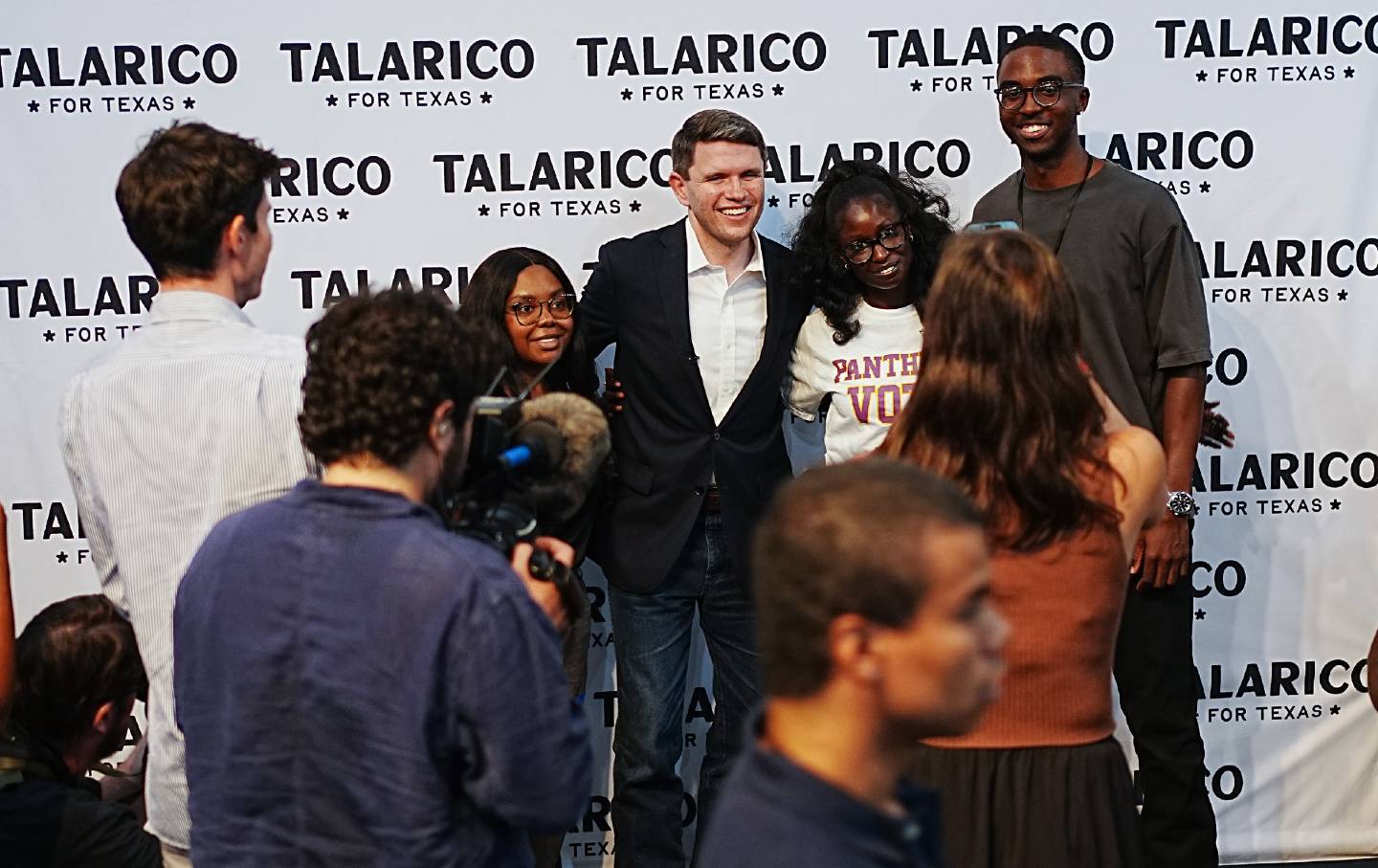
James Talarico Is Preaching a Gospel of Pluralism James Talarico Is Preaching a Gospel of Pluralism
He’s not the only progressive doing it.
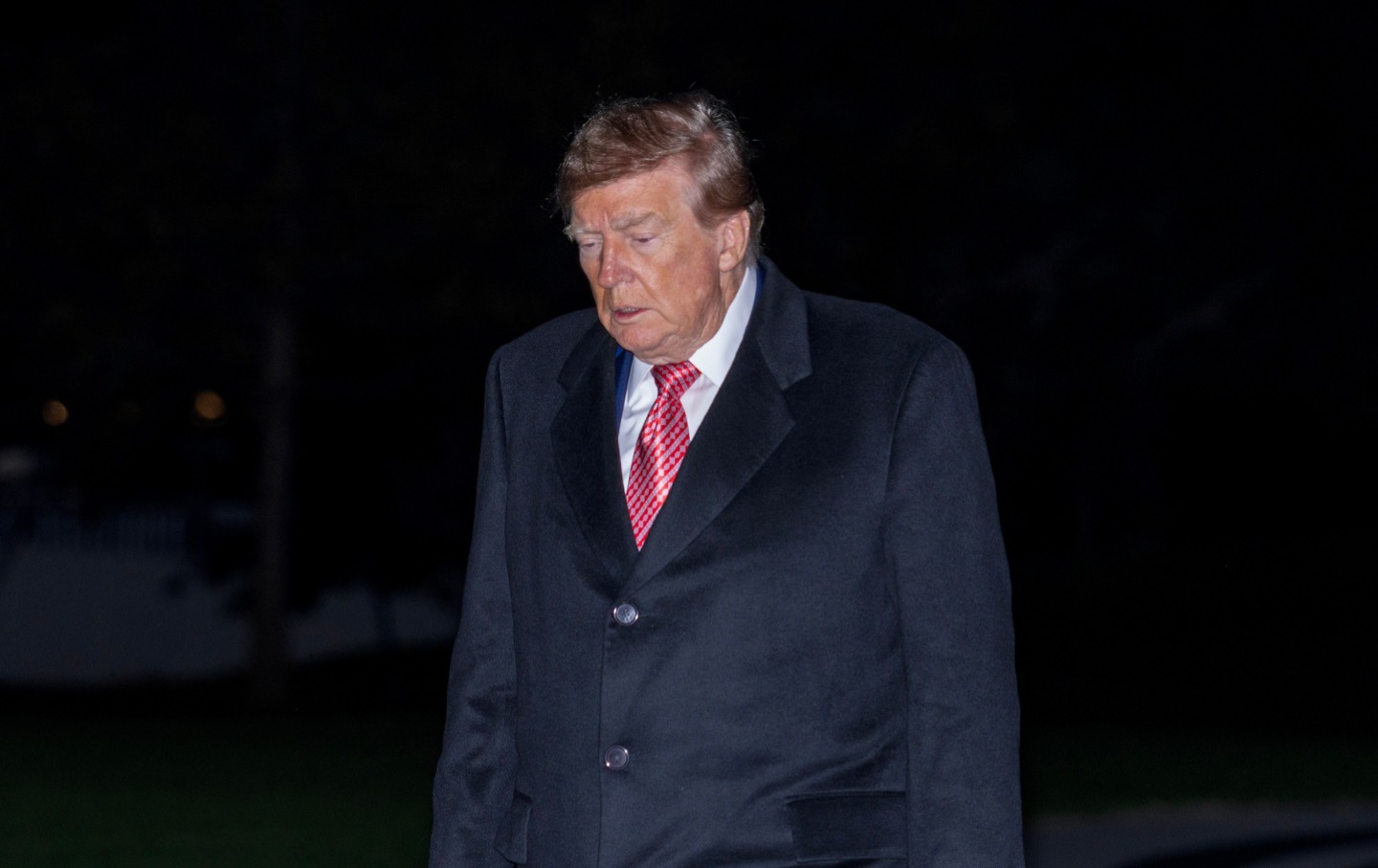
Even Republicans Are Waking Up to Trump’s Corruption Even Republicans Are Waking Up to Trump’s Corruption
And, somewhat shockingly, so are Democratic elites.


Mamdani Can No Longer Avoid the Issue of the NYPD Mamdani Can No Longer Avoid the Issue of the NYPD
The mayor has been able to put difficult questions about policing on the back burner—until now.

Why Democratic Leaders Keep Waging War on the Young Why Democratic Leaders Keep Waging War on the Young
The party's silver-haired establishment is caught up in an existential culture war.

