
Texas’s DNA Doesn’t Run As Red as the Right Wants You to Think
David Griscom’s new book The Myth of Red Texas undoes the idea of Texas as a place with conservatism inherent to its political bloodline.
Texas’s DNA Doesn’t Run As Red as the Right Wants You to Think
David Griscom’s new book “The Myth of Red Texas” undoes the idea of Texas as a place with conservatism inherent to its political bloodline.
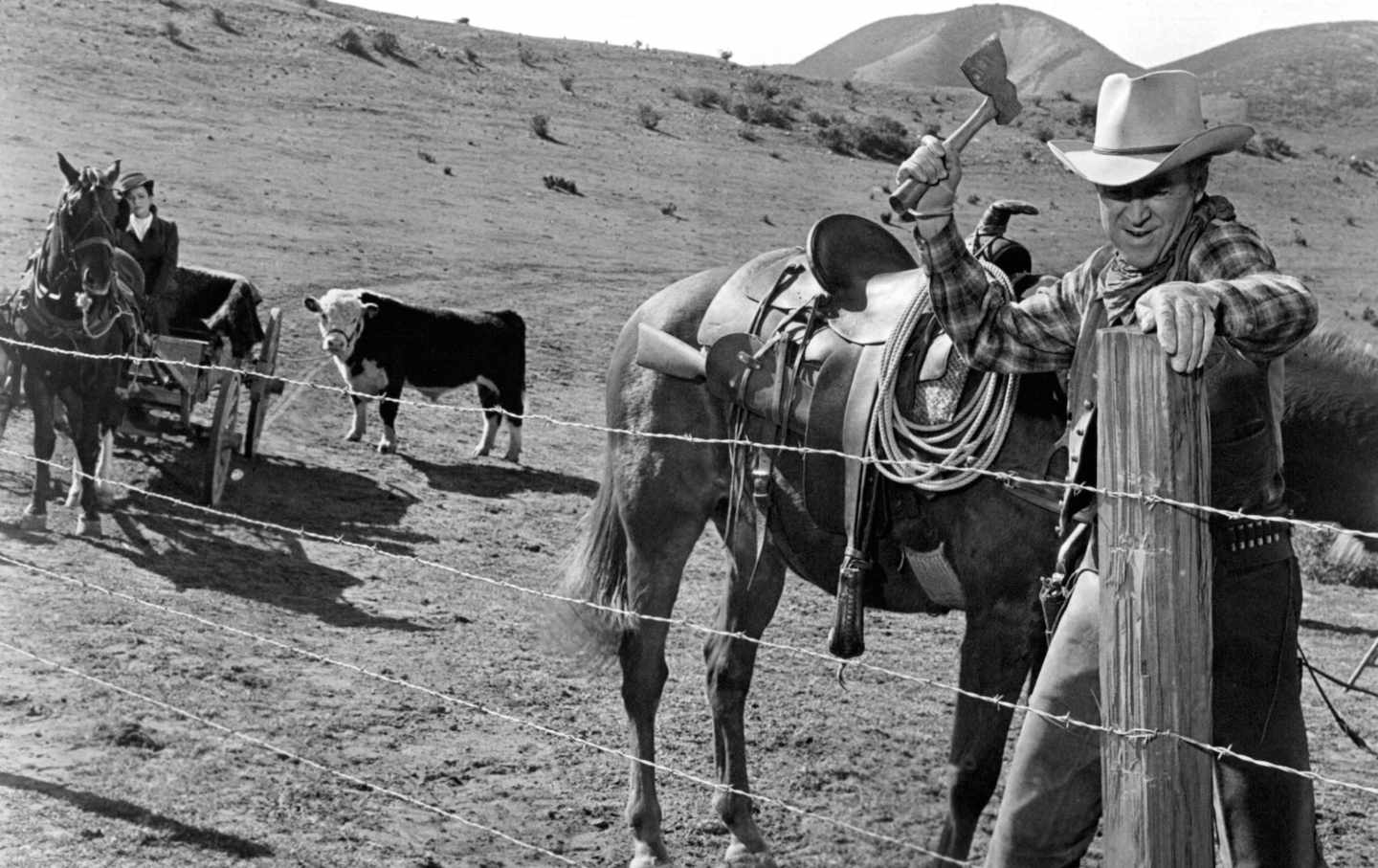
A scene from the film The Rare Breed showing James Stewart cutting a barbed-wire fence in 1880s Texas.
(Universal Pictures / Getty Images)
David Griscom is a sixth-generation Texan, political commentator, and host of The Jacobin Show, a weekly political analysis broadcast. In his new book, The Myth of Red Texas: Cowboys, Populism, and Class War in the Radical South, he undoes the idea of Texas as a place with conservatism inherent to its political bloodline.
I have lived in Texas for almost my entire life, and the El Pasoans and Houstonians I have known do not easily surrender to the conservative oil-and-cattle caricature of Texas.
Griscom breaks past exactly that caricature. The book recovers a Texas whose radical past speaks directly to what still feels possible here: one filled with striking cowboys, tenant farmers, fence cutters, socialists, and Populists fighting landowners, debt, and corporate power. I sat down with him to talk about that political inheritance and what it means to remember it now, as Texas heads into a statewide Senate race in which James Talarico is trying to prove that politics for working people can actually win here.
—Lajward Zahra
Lajward Zahra: One of the first histories you return to is the Fence Cutting Wars of the 1880s, when landless cattlemen cut through the barbed-wire fences that large ranchers erected to control open-range pastures. What made you want to begin with these disputes? Were you imagining the book mainly for Texans, as a way of offering them a different political legacy, or also for the rest of the country?
David Griscom: The book really started when I began researching the story of the fence cutters a few years ago for Jacobin. The way that story is often presented in Texas history is as a story of how law and order came to Texas. But if you are a sixth-generation Texan, you are much more likely to be related to a fence cutter than to the Texas Rangers who put down that revolt.
That is really where the idea started. Both with this book and with my other work on Left Reckoning, I have wanted to encourage people to look into the radical history of the United States. A lot of the other work I have done has been around places like Louisiana and Arkansas, and they also have these very rich traditions that I think are either purposefully hidden or just understudied.
I think it is a two-way street. The right has a very active political movement trying to deny and discredit these moments. I think that on the left, while we are very good at debunking the myths of the right, we sometimes forget that it is also important to root ourselves in a tradition of resistance to dominant power.
LZ: In 1883, cowboys in the Texas Panhandle went on strike against large ranches, demanding higher wages at a moment when corporate owners were tightening control over cattle work. The usual version of the story is that the cowboys lost, but you write that the strike still set a new wage standard and showed that solidarity was there from the beginning of Texas’s cattle economy. What changes when we remember cowboys not as symbols of rugged individualism or as figures placed next to the Rangers, but as workers with shared material interests who organized against cattle barons?
DG: The history of the cowboy strike is really fascinating. Every year around May Day, some newspaper writer will write a quick essay about the cowboy strike, and the story usually goes, “Oh, this is interesting, but the cowboys all got drunk in the saloon and lost the strike.”
I am indebted to Mark Lause for [debunking this narrative] in his book on the cowboy strike for Verso. It is fascinating to go back and see the cliché in action—how the victor writes history. Almost all the records of the strike are taken either directly from spokespeople for the major ranches or from the memoirs of the daughters or grandsons of ranchers. A certain version of the story was presented, and that was the version a lot of Texas historians in the first half of the 20th century were looking at. It became one of those things that gets repeated enough that most people do not go back and look at the original government documents or the sourcing.
As I write in the book, the strike not only happened, but was incredibly successful because of the strategic and deeply wise decision by the cowboys to strike strategically when they were needed for the spring roundup.
I think this myth is especially important for them to uphold. I respond in the book to a writer who basically denies the history of the cowboy strike through a very cultural lens, as if cowboys are individualistic and the West is where solidarity goes to die. But if you look at the actual work of cowboying, it was very communal. These workers understood that they were part of a class, and that they were on the opposite side of the big landowners.
It is important to reclaim that history because the right is trying to define Texans and Texan-ness in a very particular way. We need our own version, but not only as a debunking of the right. We also need to be able to say that we have cowboys and workers throughout our history who we can look toward as models.
LZ: Populism is in the title of, and woven throughout, the book. Today, the term “populist” is often used as a pejorative, denoting the crude, reactionary, or anti-intellectual. What do we overlook when we talk about rural populism with condescension, rather than as a tradition of class consciousness and self-respect? And how does that complicate the way rural populism is discussed today, when the word is often treated as almost synonymous with Donald Trump and right-wing grievance?
DG: At the end of the day, I think it is a fight for dignity. “Populism” is probably one of the most abused terms in American politics today. It usually means a rhetorical style of us-versus-them. And do not get me wrong, the Populists certainly used that kind of style. But when they invoked “the people,” everybody knew exactly who the people were.
One thing that has been lost in the historical record is that when people hear “populism,” they think of people using fiery, inspirational language with a clear enemy. But they also had very specific plans for how they were going to improve people’s lives.
This idea that populism is just about rallying around a demagogue is something that actually existing Texas populism disproves. After Thomas Lewis Nugent, the great leader of the Texas Populist movement, died, the movement achieved some of its most meaningful results under a completely different leader. Usually, movements like that struggle with any transfer of power or leadership. But Texas populism did something different.
That is because this was not a top-down movement. It was very much grassroots. It came out of the Southern Farmers Alliance, labor, and all these economic organizations of everyday people. That was the source of American populism, and of Texas populism in particular.
I think there is a lot to learn from it. It discredits the idea of populism as a top-down movement, and it also helps us think about how to build something like that again today.
Rural America is suffering. If we can look at the major crises people are experiencing in rural America, organize people around those economic conditions, and then bring that into politics, that is very different from making a political argument after the fact about how supporting this or that politician will improve their lives.
What made populism stick was that everyone in the community was participating in it. They were investigating the problems themselves, so when they made political demands, they understood that those demands were in their own best interest. That is very different from the top-down approaches, like you see with Donald Trump, that people mislabel as populist today.
LZ: If Texas populism was rooted in farmers’ alliances, labor organizations, radical newspapers, traveling lecturers, and communities studying their own conditions, what happened to it? How did a movement with such a robust social base get buried so deeply that Texans are surprised to hear this history at all?
DG: I think a few things happened. The Democratic Party made itself hostile to the Populist movement, but the Populists’ power came from the fact that they had an organized working-class movement of farmers and laborers behind them. When they threatened to create a schism and leave for another political movement, they actually had a social base as leverage. We do not have that in the same way today.
Race was also central. There were real efforts to bring Black Texans into the Populist movement, and Black labor leaders helped accelerate its success. That threatened the ruling class in Texas. In Grimes County, a white Populist sheriff appointed Black deputies, provoking white supremacists in the community to organize a “white man’s union” to take power back. More broadly, the implementation of Jim Crow and the restriction of the vote in Texas, which also targeted poor whites, was a direct response to the success of the Populists.
That is important to remember because these movements were not put down because they were unpopular or because people thought they were not Texan. They were met with white supremacist backlash, voter suppression, violence, and electoral fraud. Later, the right in Texas built a whole project around presenting a very specific view of who Texans are.
LZ: I want to go back to what you call the “California hypothesis,” the idea that Texas’s problems can be blamed on liberal newcomers from California, who supposedly bring Democratic politics with them and threaten the state’s conservative identity. You connect that story to the long Democratic electoral drought in Texas. But one of the paradoxes you point to is that many Republican voters in Texas are themselves recent arrivals, while native-born Texans are often less uniformly conservative than the myth suggests.
What does that reveal about Texas politics now, and about the way ideas of who counts as “really Texan” get used politically?
DG: I come from Austin, and you will see bumper stickers that say things like “Don’t LA My Austin” or “Don’t California My Texas.” I have seen them in Lockhart, too, where they say, “Don’t Austin My Lockhart.”
Popular
“swipe left below to view more authors”Swipe →There is a lot of anxiety in Texas about what is happening to the culture of the state. That mixes with the fact that Texas is becoming more unaffordable. People are having a harder and harder time staying in their communities. Beloved businesses, restaurants, and activities are closing. I think that is a direct result of Republican mismanagement of the state, which has been a boon for the wealthiest Texans and very difficult for everyday Texans. Texas continues to lead the country in some of the most humiliating and devastating poverty statistics, particularly for young people and women.
The California hypothesis is a perfect way for Republicans to do what they are good at, which is culture war. They are able to speak to that anxiety: “Texas is changing, and I feel like I cannot afford it.” But instead of pointing the finger at Republican economic policies, they turn it into a cultural argument. They say Californians have come in and pushed all of this.
But the idea that Californians are moving to Texas and becoming Democratic voters is not accurate to the data we have. The original Republican takeover of Texas was built, in part, on recruiting Republicans who were moving here because of corporate relocation. Today, Texas is seeing a massive influx of people from outside the state who often move to cities like Austin, Dallas, or Houston, which are run by Democrats, but many of them are Republican voters.
In 2018, if the vote had been restricted to native-born Texans, Beto O’Rourke would have won the Senate seat. These new voters are very important to the Republican Party.
That is another part of the California hypothesis that is interesting to me. For people coming here who do not have deep roots in the state, the best way to become a “true Texan” is to vote for the Republican Party. If Texas means conservative politics, then you can become Texan by supporting conservative politics. It works on many levels for them, and I would argue that it is fairly effective.
You can see this in the way people are surprised by this book and this history. That surprise is the product of a long right-wing project to present a very specific view of Texas. One quick example is Dan Patrick, who is from Maryland and is now the lieutenant governor of one of the largest economies in the world. He regularly attacks the Alamo Museum for its programming, to the point of getting leaders at the Alamo fired over museum programming. It is amazing to watch someone in that position get so worked up over whether the Alamo mentions Native Americans.
Become a Sustaining Donor This September
Between the reemergence of right-wing red-baiting and Donald Trump’s use of the chilling National Security Presidential Memorandum–7 to criminalize left political organizing, we’re seeing McCarthyism reborn before our eyes.
This assault on democracy cannot be ignored or wished away. Resisting it requires bravery in the face of threats and repression, a steadfast commitment to the truth, and the unwavering belief that we can—and will—overcome this darkness.
We must have an independent media that sets the record straight, unearths corruption and abuses of power, and advances a politics of justice and dignity for all if we’re to win this fight.
That’s why I’m writing to you today. This September, The Nation needs to add 100 monthly donors to sustain our progressive journalism. Your contribution makes the next investigative report, the next truth-speaking column, and the next pathbreaking essay all possible.
I hope you’ll support our work with a recurring donation today. If you donate $10 or more a month, we’ll send you a brand new “Hands Off the Free Press!” sticker to recognise your commitment to our cause. Please, donate today.
Onward,
Katrina vanden Heuvel
Editor and Publisher, The Nation
More from The Nation
Clear Sign: Stop Gun Violence Clear Sign: Stop Gun Violence
Claiming over 130 American lives daily, a lethal epidemic is scarring our communities.
Mike Johnson Is the Most Dangerous House Speaker in American History Mike Johnson Is the Most Dangerous House Speaker in American History
His decision to shut the House down at a moment of crisis around AI is the act of a reckless charlatan.

The Ed Sheeran Controversy The Ed Sheeran Controversy
In a society that claims to promote free speech, what crosses the line from controversial to unacceptable? Who gets to define where the line begins and ends?
We Need to Protect College Sports from Ted Cruz We Need to Protect College Sports from Ted Cruz
In this week’s Elie v. U.S., our justice correspondent looks at the Supreme Court’s rejection of Trump’s latest move to restrict mail-in voting. Plus, why Ted Cruz’s college-...
Why Aren’t We Talking About the Warmongering Lies of Mike Rogers? Why Aren’t We Talking About the Warmongering Lies of Mike Rogers?
The media’s relentless focus on Hasan Piker allows the dishonest GOP hawk (and actual Michigan Senate candidate) to evade scrutiny.

