Nolan’s Odyssey Misses the Point
Nolan’s “Odyssey” Misses the Point
The big-budget movie keeps much of the violence and spectacle but none of the nuance and wit of the classical epic.
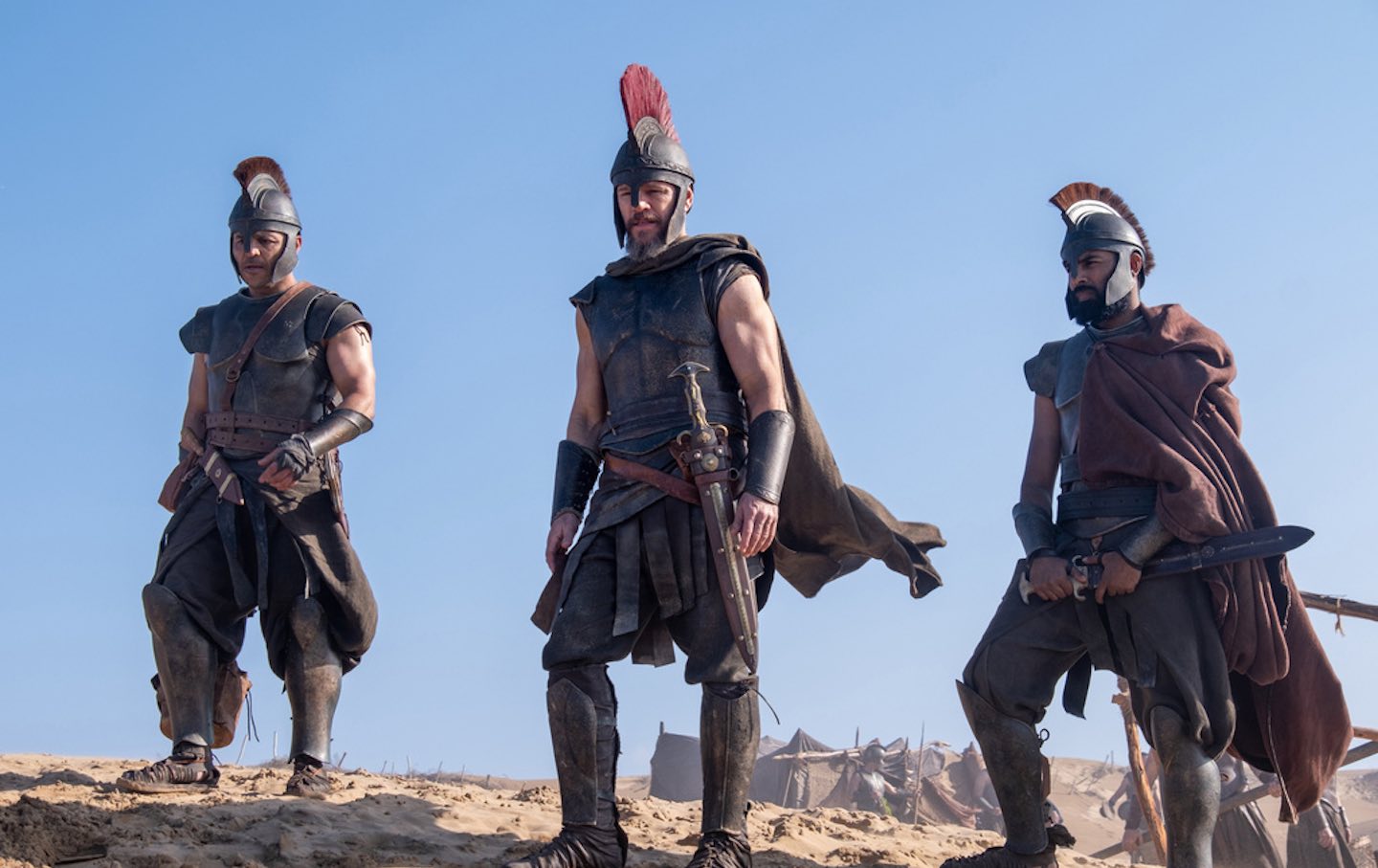
Jimmy Gonzales as Cepheus, Matt Damon as Odysseus and Himesh Patel as Eurylochus in The Odyssey.
(Universal Studios / AP Photo)Odysseus was my hero when I was a child. I loved that he was a wanderer, an adventurer, a teller of tales, but most of all I loved that he was really really smart—polutropos, “the man of many wiles.” He got himself into and out of tight spots by being clever, by talking, paying attention, looking ahead, making a plan. The other Greek heroes, Heracles, for example, were just big oafs waving swords. I barely noticed that Odysseus did plenty of his own sword-waving. He wasn’t just brain; he was brawn too. I just took what I needed as a small female person who loved writing poetry and hated gym.
You could say Christopher Nolan did the same, just taking what he needed, in his three-hour all-star, all-IMAX film of Homer’s epic. Guilt and trauma have long been themes of his work (Oppenheimer, Memento), so why not make Odysseus a traumatized veteran of the Trojan War, obsessed with guilt for his crimes against humanity? After all, he did come up with the stratagem of the Trojan Horse, which, after 10 long years of stalemate, allowed the Greek army to enter the walled city and slaughter its desperate, screaming inhabitants—a horrific scene presented by Nolan several times in flashbacks. But I’m not sure the ancient Greeks were as tender-hearted as we are (or pretend to be). Certainly, there is no suggestion in Homer that Odysseus was troubled by his part in the war. His very first deed on the way home was to lead his men on a raid of the Troy-allied island of Ismaros, where they stole everything not nailed down, killed the men, and enslaved the women. (It ends badly, but only because his men lack Odysseus’ prudence and hang about feasting while the inhabitants regroup and attack.) Think of Odysseus as a kind of Viking—he plunders both for treasure and for glory.
Nolan skims over that, along with much else. He doesn’t tell us that after the killing of 108 suitors, Odysseus forces the slave women who’ve consorted with them to clean up the carnage and then directs his son Telemachus to kill them. Telemachus, blandly played in the movie by Tom Holland, goes his father one better: Those sluts don’t deserve an honorable death by the sword, so he hangs them (“they gasped, feet twitching for a little while, but not for long,” in Emily Wilson’s translation). Telemachus also cuts off the nose, ears, genitals, hands, and feet of the disloyal goatherd Melanthius. If Odysseus is a Viking, Telemachus has the makings of a first-class serial killer.
The omission of these savageries isn’t what troubles me about Nolan’s version—a modern audience would be revolted by them, and it’s not like the film lacks blood and gore and cruelty. It’s that he cuts out so much that is funny, beautiful, witty, and poetic. We have the Cyclops episode, but not shrewd Odysseus directing his men to grasp on to the wooly underbellies of the Cyclops’s sheep so the now blind giant won’t feel them as they escape the cave. We don’t have possibly the world’s oldest dad joke when the Cyclops asks for the name of the man who blinded him and Odysseus shouts “No One” causing the giant to bellow out “No one hurt me!” to the great bewilderment of the other giants. We don’t meet the charming, peaceful Phaiacians and their adorable teenage princess Nausicaa. We don’t hear the Sirens’ song. We do have Odysseus’ seven-year dalliance with the beautiful goddess Calypso (Charlize Theron)—but Nolan has her secretly drugging Odysseus with lotus flowers so that he forgets about his past life, including his beloved wife, Penelope. Calypso is like a New Age sex healer, prone to pronouncements like “Give yourself to the storm.… give up control and live.” And indeed the two of them look very Californian, taking long walks on the beach wearing billowy, sand-colored robes. In Homer’s poem, Odysseus knows perfectly well that he’s married, and weeps on the beach every day from homesickness.
A more effective modernization is the Circe episode. In Homer, Circe, who enjoys turning men into animals, for some reason, is a beautiful goddess in a lovely palace, with whom (after forcing her to free his men from their transformation into pigs) Odysseus has a year-long mutually delightful affair. Nolan makes her a weary, middle-aged Wiccan in a tumbledown stone cottage, who turns his men into pigs because “this is who they are.” Preach, sister! Samantha Morton is absolutely brilliant in the part—just about the only actor in the film who comes across as the character she is playing and not a movie star playing a part. Anne Hathaway is a passionate and angry Penelope, but mostly she is Anne Hathaway dressed in shimmering blue gowns and elaborate gold jewelry. You never forget that Odysseus is Matt Damon.
Much has been written and tweeted attacking Nolan’s decision to have a gorgeous Black actress, Lupita Nyong’o as Helen of Troy. It’s true that she is “white-armed Helen” in the poem, but come on, people! You should be used to nontraditional casting by now. You could even say that making Helen Black is a way of showing how different she is from everyone around her, being half divine and born from a swan’s egg and all. What bothered me was the scene where Telemachus, looking for news about his father, visits her and her husband, Menelaus, in their palace at Sparta. In the film, Menelaus is a brute and a wife-beater, who has horribly scarred Helen’s face. In Homer, Helen and Menelaus are generous and sophisticated hosts, seemingly untouched by all they have been through. Like Tom and Daisy Buchanan in The Great Gatsby, they’ve caused immense damage that has no effect on them, rather like the Homeric gods themselves.
Taking out this material leaves us with a simpler, more sentimental story of a man who just wants to go home, who loves his old dog, his son, and his wife, and somehow ends up killing an enormous number of people. He doesn’t seem particularly clever or wily and he’s anything but complicated (Emily Wilson’s translation of polutropos). He’s basically yet another action hero—big-biceped, strong, sweaty, taciturn. Nolan leaves out the plot points most alien to contemporary sensibilities—the extreme violence and sadism, the gods constantly interfering in human affairs. (Only Athena, played by Zendaya, appears now and then, mostly to criticize him, less a majestic deity than a girlfriend who is really tired of picking up his socks.) But he also leaves out much that makes Homer’s Odyssey an indelible work of imagination, Odysseus an endlessly fascinating character, and his story so rich in multiple meanings—so polutropos—that people have been turning it over in their minds for three thousand years.