The Politics of Cruelty Starts With the Vulnerable
Trump’s attacks on Somali kindergarteners, immigrants, and the rule of law form a coherent authoritarian project. But voters and the courts are pushing back.
President Donald Trump recently reposted a racist attack against Somali kindergartners. Not adults or teens, but 4- and 5-year-old kids. Girls at a kindergarten graduation ceremony in Minneapolis were singing while wearing hijabs. And in an online video, someone with the moniker End Wokeness argued that this sartorial choice at an event bringing community together and showcasing American diversity signified the collapse of the education system and, by implication, an ongoing fundamentalist religious invasion.
Authoritarianism is defined in part by a gleeful willingness by state actors to scapegoat and direct violence at vulnerable minorities, and the United States is clearly hurtling toward this point.
Trump didn’t author the sniveling commentary on the kindergarten video, but in circulating it on Truth Social to his millions of followers, he gave it a visibility and a weight that it previously lacked. And in using his platform to dehumanize children, he stoked the racial hatreds, the pogromista-attitude, that his movement thrives on and that his goon squad is using to destroy the sense of safety of millions of immigrants.
The latest Trumpian diatribe against Somalis didn’t come in a vacuum. In recent weeks, ICE has been ramping up its odious activities, culminating with its agents killing two people within the span of three days. The first was a middle-aged man, Lorenzo Salgado Araujo, in Texas—killed in cold blood by ICE agents who, it turns out, were looking for another individual. The second was Joan Sebastian Guerrero, a Colombian immigrant in small-town Maine. Both were shot in their cars while driving to work; both, ICE has claimed without evidence—threatened officers’ lives.
Let’s be clear: ICE is, as it did in Minneapolis earlier this year, killing with impunity; it is operating more like a paramilitary organization than an accountable federal agency, and it is doing so during a period in which its agents are under relentless pressure from the White House to increase their arrest rates.
To meet their quotas, ICE agents are performing positively Stakhanovite acts of labor heroics. Over the past month, daily arrest rates of immigrants have more than doubled, now hitting more than 2,000 per day. Small wonder that, to meet these targets and make that omelet, some eggs end up getting broken.
Of course, if you’re looking for evidence of authoritarian intent, you don’t have to zero in exclusively on Trump’s escalating war on immigrants. In fact, there’s a smorgasbord of choice these days.
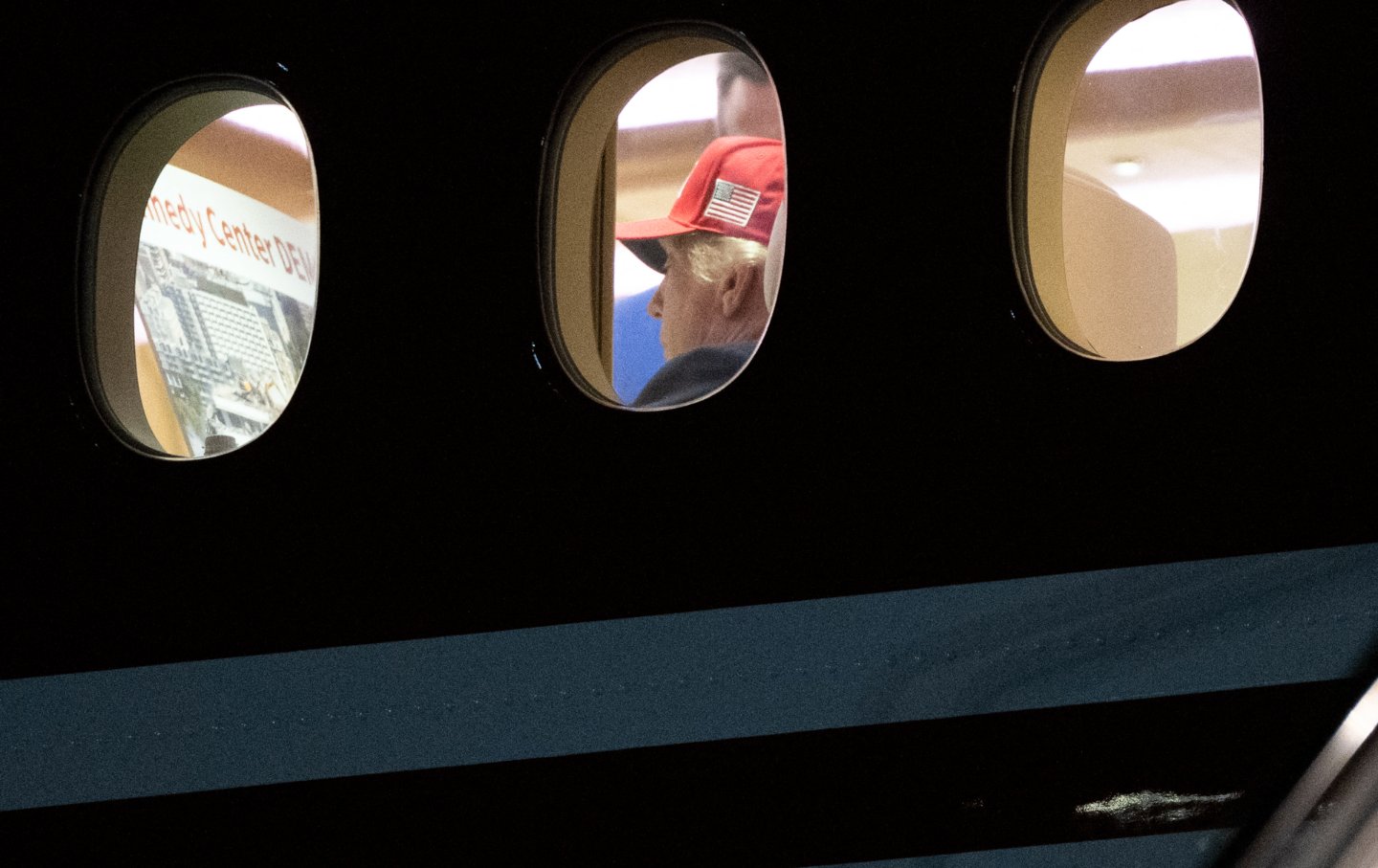
Take the subpoenas issued against New York Times journalists after they reported on the security risks of Trump using the Qatari-donated Air Force One as he left an acrimonious NATO summit. It turns out that accepting a deluxe superjet as a bribe—excuse me, a considerate “gift”—comes with a set of obvious risks.
The Times’ sin wasn’t getting the details wrong; it was showing how poor Trump’s decision to accept the plane as a “gift” was in the first place. And for that, vengeance must be visited upon the newspaper. FBI Director Kash Patel spent eight hours in the White House plotting the administration’s response; and the result was the rash of subpoenas and searches carried out by an organization that is increasingly coming to resemble the secret police of the old Soviet Union and its satellite states—witness the FBI interviewing hundreds of voter registration activists in Ohio over the past month, searching for “fraud” and hoping to intimidate voter mobilization groups nationwide as the midterm elections approach.
Meanwhile, in an act of piracy, Trump announced that the United States would seize control of the Strait of Hormuz and demand that, in exchange for the “security” provided by US military might, the owners of each ship passing through pay a toll to the United States to the tune of 20 percent of the cargo’s value.
Now, I’m not terribly good at foreign languages, but I think this gobbledygook translates roughly to: “We resumed hostilities with Iran because Iran was claiming the right to charge security fees for passage through the Strait, and, as we have repeatedly stated, we believe in the free passage of goods and ships on the high seas; so to enforce that bedrock principle of freedom of navigation, we’re going to charge even more than Iran would have charged.” One doesn’t need a Rosetta Stone to appreciate the linguistic similarities between Trump and, say, Al Capone. This is simply a classic protection racket in violation of both international norms and laws. And, while he rolled this particular piece of lunacy back within 24 hours, in the face of near-universal opprobrium, he quickly moved on, once more threatening the demolition of the country’s civilian infrastructure—an act that would be a clear war crime—if Iran didn’t yield to his demands.
No wonder that the ever more dishonorable Secretary of State Marco Rubio chose this week to announce a campaign by the administration to kill off the International Criminal Court, using diplomatic pressure, sanctions, visa revocations, and other tools to force countries around the world to reject a crucial part of the rules-based international order. There are, here, clearly ghosts of Hitler’s decision to blow up the League of Nations in the early 1930s, and to replace the tools of international diplomacy with the law of the jungle. Turns out, surprise surprise, that fascism in the 2020s really isn’t a whole lot different from, or more sophisticated than, fascism in the 1930s.
Amid the accelerating authoritarianism, however, things aren’t all doom and gloom.
In court after court, Trump is losing his battle to take over the election systems of the 50 states. Now, don’t get me wrong, he may eventually try to do so anyway, judges’ orders notwithstanding, through a nebulous assertion of emergency powers—indeed, his scheduled prime-time speech this Thursday evening may take the country down just this dangerous road. But if he does, he will confront a wall of court decisions from across the country—and it’s hard to see how he could maintain his grip over a system that is united in opposition to his actions and as his already dismal polling numbers drop even further. (In poll after poll, Trump is now roughly 20 points underwater).
Popular
“swipe left below to view more authors”Swipe →Increasingly, on issue after issue, judges also aren’t holding back their disdain for this regime’s efforts to subvert the law. Just look at this week’s scathing ruling on the self-dealing qualities of the $1.8 billion “anti-weaponization fund” that Trump and Acting Attorney General Todd Blanche cooked up this past spring—and Judge Kathleen Williams’s recommendation that the lawyers involved, including Blanche, be disciplined for their actions. For those Senate Republicans already uncomfortable with Blanche’s nomination to remove “acting” from his title, Williams’s recommendation just might give them the cover they need to come down against this preposterous choice.
Then there’s the United Kingdom, where the hard-right populist Nigel Farage’s bubble is bursting in the face of credible allegations that he accepted millions of pounds in “gifts” from several high-profile crypto businessmen and then failed to declare them to Parliament as required. In a stunt, Farage resigned his parliamentary seat, thus triggering a by-election that he hoped he would convincingly win, a result that, he believed, would allow him to emerge from the scandal strengthened as a populist leader who fights the deep-state players conspiring to sabotage his movement. Instead, the other major parties declared that they wouldn’t run against him and left the opposition field to a perennial eccentric candidate named Count Binface.
Binface, who campaigns in one by-election after the next with a giant trash can covering his head, is, in national polls, significantly ahead of Farage, whose support has cratered in the wake of the financial scandal. There haven’t been local polls in Farage’s constituency, but at the last election, Farage only got 46.2 percent of the vote there, and it’s likely his local support has eroded in the wake of the scandal allegations. It is possible that the Reform leader’s ill-conceived decision to trigger a snap by-election in August will result in his loss to a comedian who campaigns on a platform of nationalizing Adele and abolishing video reviews of referees’ calls in soccer games. And even if Farage wins, he’s likely to do so only barely, eking out a win against the most fringe of fringe candidates. Either outcome would be catastrophic to his credibility as a potential future prime minister.
Ten years ago, the United Kingdom and the United States embarked on a disastrous hard-right populist course. In the United Kingdom, Farage spearheaded the Brexit campaign; in the United States, Trump captured the Republican Party. Now, a decade later, Farage’s ability to defy gravity may finally be coming to an end; one can only hope that US voters, too, have also soured on this foul political movement and its avatars.