I Quit College Basketball to Transition. This Is What the Debate About Trans Athletes Misses.
In order to make progress on gender equity in sports, we must expand our understanding of trans people.
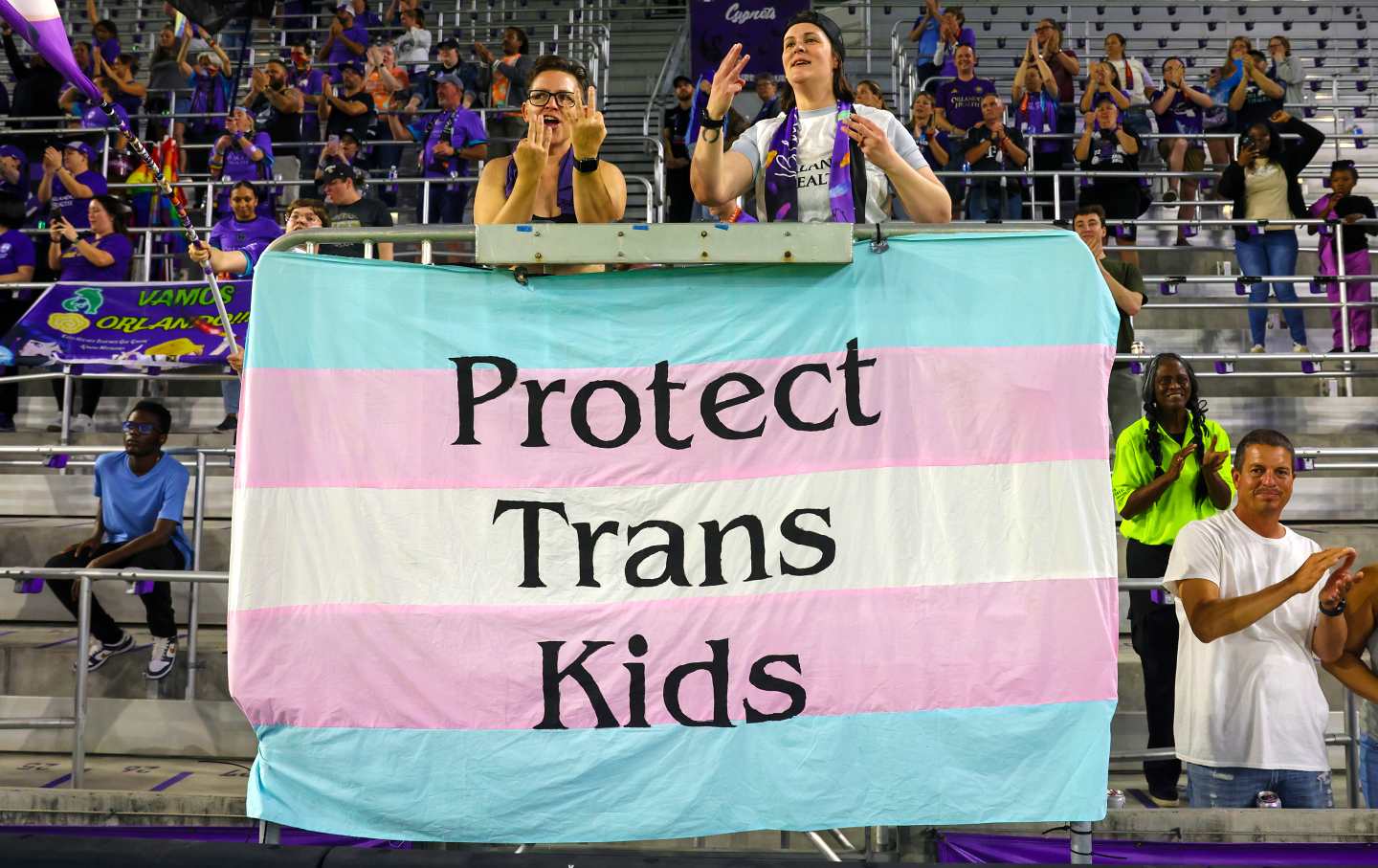
Orlando Pride supporters stand in front of a banner about protecting trans kids during a game on March 14, 2025, in Orlando, Florida.
(Alex Menendez / NWSL via Getty Images)I was 17 when I received a news alert on my phone: Donald Trump had announced that he was running for president. That was in 2015, and I was graduating high school. I remember thinking to myself, “Surely, Trump will never be a viable candidate.”
When Trump was inaugurated in 2017, I was a sophomore playing on the basketball team at my women’s college while navigating the realization that I was a transgender man. At first, I was grateful to play at the Division III level, and I put off medically transitioning to keep playing. Burned out and mentally unwell after my junior season, I weighed the options of completing a four-year career or putting myself on testosterone and eliminating my eligibility.
My school was small and low-profile enough that no one outside of my teammates and coaches knew I was trans, so I wasn’t making headlines like Lia Thomas. With the latest Supreme Court ruling upholding states’ rights to ban trans athletes from women and girls’ sports, I can’t help but wonder what that would have meant for me if I were still wearing number 15.
How would the ruling apply to me if I weren’t a trans woman or assigned male at birth? Did it matter less as I didn’t play an individual-focused sport like track or swimming? The Supreme Court ruling bans trans athletes from girls and women’s sports, and I was transgender, but not the kind they care more about limiting participation.
I don’t write these words to make a statement about trans women competing in sports, but to illustrate the under-recognized nuance and complexity of this issue. There are and have been many other trans athletes like me who played with the sex they were assigned at birth. There are and have been nonbinary participants in the WNBA and the PWHL, athletes who often choose to forgo medical transition and reject the gender binary. But they rarely make headlines.
I’m purposefully dragging attention away from trans women here, even though the Supreme Court and fascistic right-wing conservatives want to spend their energy on it—moreso than on our collapsing economy, crumbling healthcare system, the climate crisis, or gun violence. If this country wants to make progress on gender equity in sports, we must expand our understanding of how trans people show up in sports. This Supreme Court ruling just adds to the misconceptions of trans people in general, when we could be working toward gender equity in all aspects of life by pushing aside the fear and including everyone in one of our most valued pillars of society.
It’s ironic how the right focuses on people with little power and argues that they need to come under the most control, that these marginalized groups ought to be feared. It’s understandable to be wary about a group of people largely unknown and invisible—especially given the fearmongering in even mainstream publications—but it’s not OK to leave that fear unquestioned. I implore all Americans to find the courage and try to overcome these fears.
While the right pursues what it claims is fairness in sports, it continues to not care about fairness or equity in any aspect of life in this country. Why not try to make the housing market, wages, or health insurance fair? As Mayor Zohran Mamdani makes positive changes for New York City, the right paints socialism—a system based on the idea that no one should be disadvantaged—as something to be feared and avoided at all costs. Those on the right seem fine with unfairness in most of their lives but insist upon “fairness” on the playing field.
Why don’t other factors of competitive advantage get talked about? Why do we assume that sports are fair in the first place? More importantly, why can’t we focus first on the real disadvantages persisting in this country?
The best lesson I got from playing sports was that life isn’t fair, which continues to be true in my career working in college athletics as well as in all other parts of my life. Sports are fundamentally unfair—and are a great vessel for teaching everyone how to power through adversity born from unfair conditions. Trans women competing may have unfair advantages in certain cases, but we should treat it the same as any other unfair advantage that exists—especially in youth sports.
It wasn’t fair that I walked away from basketball after my junior season knowing I could probably finish a four-year career, but I knew that there were other parts of myself that I needed to nurture. I don’t regret my choice at all, but it often feels like the greatest example of unfairness that sports has ever delivered to me.
Let’s not forget that trans people simply existing, saying exactly who they are and expressing that in its entirety, is what terrifies an authoritarian government the most. And when it’s women doing it, it scares them even more.